About fourteen months ago, the owner of a small online plant nursery I have followed for years posted something on her business Instagram account that stopped me mid-scroll. It was not a photograph of an unusual specimen or a care tip for a difficult variety. It was a candid, slightly exhausted admission that she had spent the previous Sunday responding to 94 customer support messages, and that the vast majority of them had asked one of the same seven questions she had answered thousands of times over the five years she had been running the business.
Questions about shipping times. Questions about whether specific plants were safe for pets. Questions about what to do when a delivered plant arrived with yellowing leaves. Questions about whether she shipped to specific postal codes. Questions about care requirements for recently purchased specimens. Questions about her return policy. Questions about order tracking.
Ninety-four messages. One Sunday. The same seven questions, distributed across different customers, different phrasings, different tones of urgency, but fundamentally the same informational need, answered by the same person, manually, one at a time, at the cost of the entire day she had been planning to spend on the propagation work that was the actual creative heart of her business.
She was not running a customer support operation that happened to sell plants. She was running a plant business that was being gradually consumed by customer support.
I sent her a message suggesting she look into AI agents for customer support automation. She replied three days later, which told its own story about her message volume, saying she had assumed AI chatbots were either too expensive for a small business, too complicated to set up without technical expertise, or too limited to handle the nuanced questions her customers asked.
Six weeks after that conversation, she messaged me again. She had implemented an AI agent using a platform that had taken her one weekend to configure. It was handling approximately 78 percent of her incoming customer messages automatically, without her involvement, at a quality level that her customers were responding to positively. Her Sunday was her own again. Her propagation work had resumed. Her response time for the complex questions that genuinely required her expertise had improved, because those questions were no longer buried under the avalanche of routine ones.
Her experience is becoming increasingly common among small business owners in 2026, and it reflects a genuine and significant shift in what AI customer support tools can do, how accessible they are to non-technical business owners, and how meaningfully they can transform the operational reality of running a customer-facing small business without a dedicated support team.
In this guide, you will learn exactly what AI agents are, how they differ from the earlier generation of customer support chatbots that gave automation a frustrating reputation, how to choose the right platform for your specific business, how to implement and configure an AI agent that genuinely serves your customers well, and the specific practices that separate AI customer support implementations that work from those that create more problems than they solve.
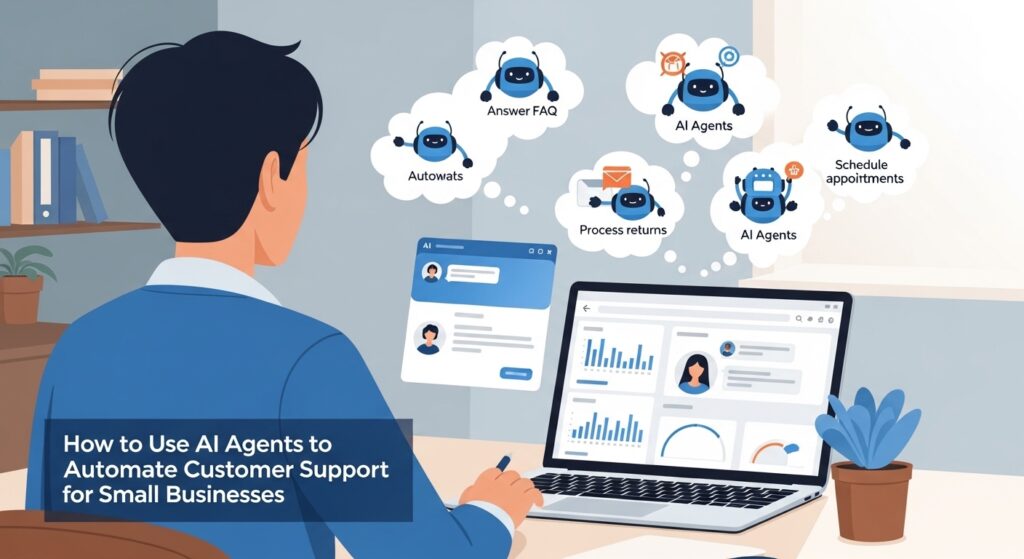
What AI Agents Are and Why They Are Different From Traditional Chatbots
The term AI agent is used broadly and sometimes imprecisely, so establishing a clear understanding of what it means in the customer support context, and specifically how AI agents differ from the earlier chatbot technology that many small business owners have understandably learned to distrust, is essential before getting into implementation.
The Chatbot Problem That AI Agents Solve
The customer support chatbots that proliferated across business websites through the mid-2010s and early 2020s were, for the most part, genuinely frustrating tools that created negative customer experiences rather than positive ones. They operated on rigid decision tree logic, following pre-programmed conversation flows that could only respond usefully to inputs that closely matched the specific phrasings and categories their designers had anticipated.
A customer who asked “do you ship to Canada” in a slightly different formulation than the chatbot had been programmed to recognize would receive either an irrelevant response or a dead-end prompt to contact human support, defeating the automation purpose entirely. A customer with a question that fell even slightly outside the chatbot’s predetermined categories would encounter the digital equivalent of a wall, a series of menu options that did not address their need and a growing sense of frustration that transferred onto the brand they were trying to engage with.
The widespread experience of these limitations made the word “chatbot” something of a liability in customer experience discussions, associated in many customers’ minds with the deliberate obstruction of genuine support rather than its provision.
What Makes AI Agents Genuinely Different
AI agents in the 2026 context are fundamentally different from these decision-tree chatbots in ways that are not incremental but categorical. They are powered by the same large language model technology that underlies tools like Claude, ChatGPT, and Gemini, which means they understand natural language with genuine comprehension rather than pattern matching, can respond to questions in their unlimited natural phrasings rather than only to anticipated formulations, and can handle novel or nuanced questions by reasoning about the information available to them rather than failing when inputs do not match a programmed category.
The specific capabilities that distinguish AI agents from earlier chatbots include natural language understanding that handles the full variability of how real customers actually ask questions, the ability to synthesize information from multiple knowledge sources to answer questions that were not specifically anticipated during setup, context retention across a conversation that allows coherent multi-turn exchanges rather than stateless single-response interactions, tone adaptation that matches the customer’s communication style and emotional state, and the judgment to recognize when a question genuinely requires human involvement and to route it accordingly rather than attempting to answer everything regardless of its complexity.
Read: The Ultimate Guide to Remote Work Setup: Choosing the Right Ergonomic Tools
The result, when implemented well, is a customer support experience that feels genuinely helpful rather than obstructive, that resolves the majority of routine customer needs without human involvement, and that handles the transition to human support for complex cases in a way that feels like a service rather than an admission of failure.
Step 1, Understand What AI Agents Can and Cannot Handle
Before choosing a platform or beginning implementation, developing an honest, specific understanding of which customer support functions AI agents can handle effectively and which genuinely require human judgment is the most important preparation you can do.
What AI Agents Handle Exceptionally Well
Frequently asked questions of every type are the strongest use case for AI agent automation, and the breadth of what counts as a frequently asked question in most small businesses is typically larger than owners initially appreciate until they audit their support history systematically. Shipping policies, return processes, product specifications, care instructions, compatibility questions, availability, pricing, order status, and the dozens of other routine informational needs that consume the majority of customer support volume in most businesses are all ideal AI agent territory.
Order status and tracking inquiries can be handled by AI agents that are integrated with your e-commerce platform, allowing the agent to look up a customer’s order details and provide accurate, specific tracking information without human involvement. For businesses whose e-commerce operates through platforms like Shopify, WooCommerce, or BigCommerce, these integrations are increasingly straightforward and represent one of the highest-volume automation opportunities available.
After-hours support is one of the highest-value AI agent applications for small businesses whose owners cannot realistically provide 24 hour human support coverage. An AI agent that responds to customer messages at 11pm with the same quality as during business hours prevents the customer experience damage of extended response delays and captures the purchase-decision moments that occur outside business hours.
Initial triage and information gathering for complex cases is a valuable AI agent function even when the case ultimately requires human resolution. An agent that greets a customer with a complex complaint, gathers the relevant order information, understands the nature of the issue, and prepares a structured summary for the human agent who will follow up, makes the human support interaction faster, more informed, and more efficient.
Proactive support communication, sending automated but personalized messages triggered by specific customer behaviors or order events, including shipping confirmation, delivery notification, post-purchase care guidance, and follow-up satisfaction checks, is a high-value AI agent function that improves the customer experience while requiring no ongoing human effort after initial setup.
What AI Agents Cannot Handle Well
Complex, emotionally charged complaints from customers who are genuinely upset about a significant problem require human empathy, judgment, and relationship management capability that AI agents in 2026 can approximate but cannot fully replicate. Customers who have experienced a significant failure of product quality, a serious logistics problem, or a situation that has caused them genuine inconvenience or distress, need to feel heard and genuinely cared about by a human being, and routing these cases to human support is both ethically appropriate and strategically sound for brand relationship preservation.
Novel situations without precedent in your knowledge base require human judgment to navigate, because AI agents can only reason from the information they have been given and cannot make the kind of contextual business judgment calls that unprecedented situations require. A customer with an unusual return request that falls outside your stated policy, a situation involving potential legal implications, or a case that requires creative problem-solving beyond your documented procedures, belongs with a human decision-maker.
High-value relationship management with your most significant customers, the clients or customers whose relationships represent a disproportionate share of your revenue or whose advocacy creates measurable business value, deserves personalized human attention that signals the specific importance you place on those relationships. AI automation for these interactions risks communicating generic treatment of people who should feel specifically valued.
Step 2, Choose the Right AI Agent Platform for Your Business
The AI customer support platform landscape in 2026 has expanded significantly, offering small business owners a range of options that vary in capability, cost, technical complexity, and integration compatibility. Choosing the right platform for your specific business requires understanding your specific needs clearly before evaluating options.
The Key Criteria for Platform Selection
Ease of setup and configuration is the first and most practically important criterion for small business owners without dedicated technical staff. The best AI customer support platforms for small businesses are designed to be configured through intuitive, no-code interfaces that allow business owners to provide the knowledge and policies the agent will need through natural language input rather than through technical configuration processes that require developer involvement.
Integration with your existing tools determines how much of the automation potential is actually accessible without significant technical work. A platform that integrates natively with your e-commerce platform, your CRM, your helpdesk software, and your communication channels, including website chat, email, WhatsApp, Instagram, and Facebook Messenger, provides automation capability across the full surface of your customer communication without requiring custom development to connect disparate systems.
Quality of AI reasoning determines how well the agent handles the full variability of real customer questions and how gracefully it navigates situations that fall outside straightforward FAQ territory. Testing each platform you consider with your actual customer questions, including the edge cases and unusual phrasings that represent the harder end of your support volume, is the most reliable way to assess reasoning quality for your specific use case.
Handoff capability determines how well the platform manages the transition from AI to human support for cases that require it. A platform with weak handoff capability either fails to identify cases that need human involvement or creates disruptive, poorly contextualized handoffs that force customers to repeat information the AI has already gathered. A platform with strong handoff capability makes the transition invisible and well-prepared, routing cases to human agents with full conversation context and a clear summary of the customer’s need.
Pricing structure for small business budgets should be evaluated as a total cost of ownership relative to the support labor it replaces, not as an absolute cost in isolation. A platform that costs 150 dollars per month but saves fifteen hours of owner or staff time per week at any realistic hourly value calculation represents an extraordinarily positive return. A platform that costs 30 dollars per month but requires ten hours of ongoing maintenance to keep functioning is a worse value despite its lower headline price.
Recommended Platforms for Small Business AI Customer Support in 2026
Tidio is one of the most widely used and most highly regarded AI customer support platforms specifically designed for small business accessibility, offering a visual, no-code configuration interface, strong e-commerce platform integrations including Shopify, WooCommerce, and Wix, multi-channel deployment across website chat, email, and messaging platforms, and a free tier that allows small businesses to test the platform’s capability before committing to a paid plan. Its AI agent, called Lyro, is specifically trained for customer support contexts and handles the majority of routine small business support scenarios without requiring extensive custom configuration.
Intercom offers more sophisticated AI agent capability at a higher price point that is appropriate for small businesses with higher support volume or more complex support requirements. Its AI agent, called Fin, is built on large language model technology and demonstrates strong performance on nuanced, multi-part customer questions. Intercom’s integration ecosystem is extensive, and its reporting and analytics capabilities provide the performance visibility that allows systematic improvement of AI agent effectiveness over time.
Zendesk AI integrates AI agent capability within the most widely used helpdesk platform in professional customer support, making it the appropriate choice for small businesses that already use Zendesk for their support operations and want to add AI automation within their existing workflow rather than adopting a new platform.
Freshdesk with its AI capabilities offers a mid-market option that balances capability and affordability, with strong omnichannel support across email, chat, phone, and social media, and AI agent features that handle the majority of routine small business support needs.
ManyChat specializes specifically in AI-powered messaging automation for Instagram, Facebook Messenger, and WhatsApp, making it the most appropriate choice for businesses whose primary customer communication channel is social media messaging rather than website chat or email.
Step 3, Build Your Knowledge Base Before Configuring Your Agent
The quality of your AI agent’s responses is directly determined by the quality and completeness of the knowledge base you provide it with. An AI agent is not a general knowledge system. It is a reasoning system that applies its language understanding capability to the specific information you have given it about your specific business. The time you invest in building a comprehensive, accurate, and well-organized knowledge base before configuring your agent determines the ceiling of what your agent can accomplish.
Auditing Your Existing Customer Support History
Begin your knowledge base development by systematically reviewing your existing customer support history, specifically the questions your customers have actually asked over the past six to twelve months. This audit serves two critical functions. It reveals the actual distribution of question types that your agent will need to handle, which should determine your knowledge base development priorities, and it surfaces the specific phrasings, edge cases, and nuances of real customer questions that your knowledge base needs to address to serve real customers rather than idealized ones.
Most small businesses that conduct this audit for the first time are surprised by both the concentration of volume around a small number of question categories, typically five to ten categories account for 70 to 80 percent of total volume, and the diversity of phrasings and circumstances within those categories that a knowledge base must address to serve real customer variability.
The plant nursery owner found that her support history, when systematically analyzed, revealed 94 percent of her messages fell into eight categories, with shipping and plant health questions together accounting for more than half of total volume. This analysis transformed her knowledge base development from an overwhelming open-ended task into a focused, prioritized effort with clear coverage targets.
Writing Knowledge Base Content for AI Consumption
The knowledge base content you write for an AI agent does not need to be formatted as a traditional FAQ document, though FAQ documents are a useful starting point. Modern AI customer support platforms can consume knowledge in multiple formats, including policy documents, product descriptions, process guides, and conversational explanations, and apply their language understanding capability to synthesize relevant information from these sources in response to specific customer questions.
The qualities that make knowledge base content effective for AI agent use are accuracy, completeness, specificity, and organization. Accuracy is non-negotiable because an AI agent will confidently provide incorrect information if its knowledge base contains incorrect information. Completeness matters because an agent can only answer questions that its knowledge base addresses, and gaps in coverage produce either incorrect guessing or honest admissions of ignorance that create escalation work. Specificity matters because vague policy statements produce vague agent responses that do not fully resolve customer questions. Organization matters because well-organized knowledge allows the AI to navigate to relevant information efficiently, reducing the risk of incomplete or conflated responses.
Write your knowledge base content as though you were writing it for a highly capable but completely new team member who knows nothing about your business but can reason carefully about anything you explain clearly. Assume nothing. Explain the logic behind policies, not just the policies themselves. Provide the context that allows the agent to handle variations and edge cases, not just the straightforward standard scenarios.
Including Escalation Triggers in Your Knowledge Base
A critical component of effective knowledge base development is explicitly defining the circumstances under which your AI agent should recognize that a case requires human involvement and initiate a handoff rather than attempting to resolve the case independently.
These escalation triggers should be specific and comprehensive enough to capture the full range of situations that require human judgment without being so broad that they route to human support cases that the AI could handle effectively. Common escalation triggers for small businesses include customer expressions of significant distress or anger, requests for exceptions to stated policies, questions about orders with unusual circumstances not covered by standard policy, complaints about product defects or significant quality problems, and any situation where the customer has explicitly requested to speak with a human.
Document these triggers explicitly in your knowledge base as instructions to the agent, and test them thoroughly with realistic scenarios before going live to ensure that genuinely escalation-worthy cases are reliably recognized and routed.
Step 4, Configure, Test, and Refine Your AI Agent Before Launch
The configuration, testing, and refinement process between knowledge base development and public launch is the phase that most small business owners are tempted to abbreviate in their eagerness to achieve the operational relief that AI customer support promises. Abbreviating this phase is the most reliable way to produce a launch that creates customer experience problems rather than solving them.
Configuring Your Agent’s Persona and Communication Style
Your AI agent is a customer-facing representative of your brand, and its communication style, tone, and persona should reflect your brand identity as consistently as any other customer-facing communication you produce. Most AI customer support platforms allow you to define your agent’s persona through natural language instructions that guide its tone, formality level, communication style, and personality characteristics.
For a plant nursery with a warm, knowledgeable, enthusiast community feel, an agent persona that communicates with genuine warmth, uses appropriate botanical terminology comfortably, and reflects a genuine passion for plants serves the brand significantly better than a generic, corporate-neutral customer support voice. For a professional services business, a more formal, precise, and authoritative persona may be appropriate. The persona definition should feel like writing a description of an ideal team member for that brand, not like filling in a configuration form.
Beyond persona, configure your agent with explicit instructions about the specific situations it should handle autonomously versus escalate, the specific information it should always collect before attempting to resolve certain categories of questions, the specific offers or resolutions it is authorized to provide to resolve common complaints, and the specific format and length guidelines that produce responses appropriate for your communication channels.
Testing With Real Customer Scenarios
Test your configured agent against your actual customer support history before launch, specifically by replaying the real questions your customers have asked, in their actual phrasings, and evaluating whether the agent’s responses are accurate, complete, appropriately toned, and genuinely helpful.
Test not just the straightforward standard scenarios but the edge cases, the unusual phrasings, the questions that fall between categories, the emotionally charged messages, and the situations that should trigger escalation rather than automated resolution. These harder test cases are where the gap between a well-configured AI agent and a poorly configured one is most visible, and identifying gaps in coverage or judgment before launch allows you to address them through knowledge base refinement rather than experiencing them through negative customer interactions after launch.
Involve at least one person who was not involved in the configuration process in your testing, because familiarity with the knowledge base creates cognitive biases that make it harder to identify gaps that someone approaching the agent as a customer would immediately encounter.
Implementing a Soft Launch Strategy
Rather than switching from fully manual to fully automated customer support simultaneously, implement your AI agent through a soft launch strategy that allows you to monitor its performance closely during its initial period of operation and address any issues before they affect significant customer volume.
Start by enabling the AI agent for a limited portion of your support volume, perhaps after-hours messages only, or a specific communication channel only, while maintaining full human handling for the remainder. Monitor every interaction closely during the initial period, reviewing agent responses for accuracy, appropriateness, and customer satisfaction signals. Identify patterns in the cases where the agent fails or produces suboptimal responses and use those patterns to refine your knowledge base and configuration. Expand the agent’s scope progressively as its performance demonstrates reliability across the cases it is handling.
This gradual approach extends the time to full operational benefit slightly but dramatically reduces the risk of a launch that damages customer relationships through poor AI performance at scale.
Step 5, Monitor Performance and Improve Continuously
AI customer support implementation is not a set-and-forget project. The businesses that achieve the best long-term results from AI agent customer support are those that treat the initial implementation as the beginning of an ongoing optimization process rather than a completed project.
The Metrics That Matter for AI Customer Support Performance
Resolution rate, the percentage of customer interactions that the AI agent resolves without human involvement, is the primary operational efficiency metric for AI customer support. Tracking this metric over time and by question category reveals both the overall level of automation being achieved and the specific knowledge gaps and configuration weaknesses that are limiting resolution in particular areas.
Customer satisfaction with AI interactions, measured through post-interaction surveys or conversational satisfaction signals, is the most important quality metric for AI customer support and the one that most directly indicates whether automation is enhancing or degrading the customer experience. An AI agent with a high resolution rate but low customer satisfaction is not achieving the business goal of customer support, it is efficiently producing negative customer experiences.
Escalation accuracy, the quality of the agent’s judgment about which cases require human involvement, is a critical metric that has two failure modes of equal importance. Under-escalation, routing cases to automated resolution that genuinely required human involvement, produces poor outcomes for the specific customers affected and potential brand damage. Over-escalation, routing cases to human support that the agent could have resolved, produces unnecessary labor cost and slower response times for cases that automation should be handling.
Response quality on novel questions, cases where customers ask questions that are not directly addressed by the knowledge base, reveals how well the agent reasons from available information to handle situations beyond its explicit knowledge base coverage. Tracking these cases and their outcomes identifies both the agent’s reasoning quality and the knowledge base gaps that most urgently need addressing.
Building a Continuous Improvement Cycle
Establish a regular, scheduled review process for your AI agent performance, at minimum monthly during the first six months of operation and quarterly thereafter. Each review should systematically examine the lowest-performing interaction categories, the cases that generated negative satisfaction signals, the escalations that could have been automated, and the automated resolutions that should have been escalated.
For each identified improvement opportunity, determine whether the issue reflects a knowledge base gap that can be addressed through additional content, a configuration issue that requires parameter adjustment, or a genuine capability limitation that requires a different approach, including potentially a platform change if the limitation is fundamental to the platform’s AI capability rather than addressable through configuration.
The plant nursery owner told me that her most significant performance improvement came not from the initial implementation but from a systematic review she conducted three months after launch, during which she identified that a specific category of plant health questions was producing inconsistent responses because her knowledge base covered general care guidelines but not the specific symptom-to-diagnosis reasoning that her customers’ plant health questions actually required. Adding detailed symptom-specific guidance to her knowledge base in that session improved her resolution rate in that category from 61 percent to 89 percent within two weeks.
Advanced AI Agent Strategies for Growing Small Businesses
Once your AI agent is performing reliably on core customer support functions, several advanced strategies can extend its value beyond reactive support into proactive customer experience enhancement and revenue-generating customer engagement.
Proactive Customer Outreach
Configure your AI agent to initiate outbound communication triggered by specific customer behavior or order events, rather than waiting for customers to initiate contact. A customer who has just received a delivered order can receive a proactive care message that provides product setup guidance and invites any questions, reducing the incoming support volume from customers with predictable post-delivery questions while improving their experience of the brand.
A customer whose shopping cart has been abandoned for more than two hours can receive a proactive message offering assistance with any questions that may be preventing purchase, combining the support function with a sales recovery function that many small businesses find produces meaningful revenue contribution alongside its support value.
AI Agent Integration With Your CRM
Integrating your AI agent with your Customer Relationship Management (CRM) system allows the agent to personalize its interactions based on each customer’s history with your business, recognizing returning customers, referencing their previous purchases in relevant support contexts, and providing the kind of personalized, relationship-aware support that was previously only possible through human agents with access to customer history.
Platforms including HubSpot CRM, which offers a genuinely capable free tier, and Zoho CRM support integrations with major AI customer support platforms that enable this personalization capability without requiring custom development for most common platform combinations.
Using AI Agent Conversation Data for Business Intelligence
The conversations your AI agent has with customers represent a rich and continuously updated stream of business intelligence about what your customers need, what questions your communications are failing to answer proactively, what product issues are generating support volume, and what aspects of your business your customers find most confusing or frustrating.
Establish a regular practice of reviewing AI conversation data not just for support performance optimization but for the broader business insights it contains. A pattern of questions about a specific product’s assembly suggests inadequate assembly documentation. A concentration of questions about a policy that your website addresses suggests the policy explanation is insufficiently clear or insufficiently prominent. A recurring question about a product attribute suggests marketing content that does not adequately communicate that attribute. These insights, visible in AI conversation data at a scale and specificity that manual support never surfaced clearly, represent significant business improvement intelligence that extends well beyond the support function itself.
Common AI Customer Support Mistakes Small Businesses Make
Even well-intentioned and motivated small business owners consistently make these errors when implementing AI customer support:
Deploying an AI agent before the knowledge base is genuinely ready. The most common cause of failed or underperforming AI customer support implementations is launching before the knowledge base has been developed with sufficient completeness, accuracy, and specificity to support the quality of responses the business needs to provide. Every additional week invested in knowledge base development before launch is recovered many times over in the reduced remediation effort and customer experience damage that an underprepared launch produces.
Failing to define escalation triggers clearly and completely. An AI agent without well-defined escalation triggers either attempts to handle everything, including situations genuinely requiring human judgment, or escalates indiscriminately, eliminating the automation benefit. Escalation trigger definition is not a default configuration that platforms provide, it is a business-specific judgment that requires careful thought about which situations in your specific business context the AI genuinely cannot handle well.
Setting it and forgetting it after launch. AI customer support requires ongoing maintenance as your products, policies, and customer questions evolve. A knowledge base that was accurate at launch becomes progressively less accurate as the business changes, and an agent operating from an outdated knowledge base produces increasingly incorrect responses that damage customer trust in proportion to how long the gap between the knowledge base and reality has been allowed to grow.
Using AI to avoid difficult customer conversations rather than to handle routine ones. Some small business owners implement AI customer support with the implicit goal of using automation as a buffer between themselves and customers they find difficult to interact with. This is a strategically poor approach because the customers most in need of skilled human relationship management are precisely the ones most likely to be frustrated by AI redirection, and because the customer relationships most worth preserving are those with customers who are dissatisfied enough to complain rather than silently defecting.
Failing to communicate transparently that customers are interacting with AI. Most customers in 2026 are comfortable with AI customer support interactions, particularly for routine informational needs, but they are significantly less comfortable with AI interactions that are disguised as human ones. Being transparent about the AI nature of your agent, while emphasizing its genuine capability to help with the majority of common questions, builds customer trust rather than undermining it.
Conclusion and Final Thoughts
The plant nursery owner who spent a Sunday answering 94 messages now spends that Sunday doing the propagation work she started her business to do. Her customers receive faster, more consistent responses to their routine questions than they did when she was handling everything manually. Her complex questions receive more thoughtful, less rushed human attention because those questions are no longer buried in routine volume. Her business is growing rather than being consumed by the operational burden of its own success.
Her experience reflects the specific transformation that AI agent customer support offers small businesses in 2026, not the elimination of human customer care, but its liberation from the routine volume that prevents human care from being applied where it genuinely matters most.
The five steps covered in this guide, understanding what AI agents can and cannot handle, choosing the right platform for your business, building a comprehensive knowledge base, configuring and testing before launch, and monitoring performance for continuous improvement, form a complete and immediately applicable framework for implementing AI customer support that genuinely serves your customers well while genuinely reducing the operational burden on you and your team.
AI agents in 2026 are not a solution to a customer support problem. They are a tool that, implemented thoughtfully and managed continuously, transforms customer support from a constraint on your small business’s growth into a scalable infrastructure that grows alongside it.
Your customers deserve excellent support. Your business deserves the capacity to provide it without the cost of your Sundays.
Have you implemented any form of AI customer support automation in your small business, and what has been your biggest challenge or most significant win in the process? Share your specific experience in the comments below. Whether you are just beginning to explore AI agents or refining an implementation you have been running for months, your real-world perspective is exactly what other small business owners need to make their own confident decisions about this genuinely transformative technology.