About three years ago, I sat across from the owner of a small independent bookstore who was genuinely baffled by what was happening to his business. He had been operating for eleven years, had a fiercely loyal customer base, hosted some of the best author events in his city, and had carefully curated a selection of titles that his regular customers trusted completely. And yet, for the third consecutive year, his revenue had declined modestly but consistently, his margins were under pressure from every direction, and he had the unsettling feeling that he was working harder every year to produce smaller results.
He had tried new things. He had added a small café section. He had expanded his children’s section. He had hired a part-time social media manager. Each initiative had produced modest positive results in isolation but had not reversed the broader trajectory. He was making decisions reactively, responding to symptoms without fully diagnosing the underlying condition.
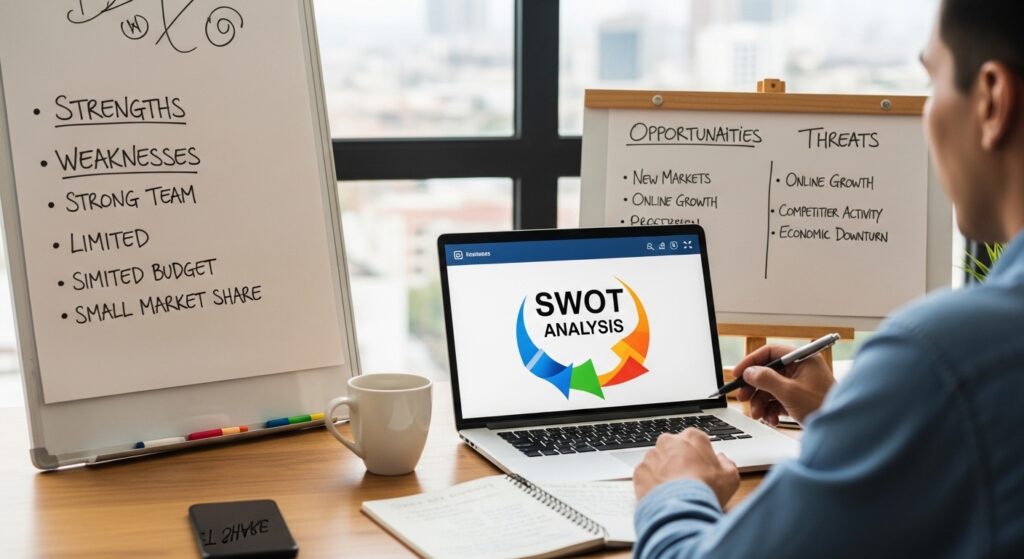
I suggested we spend two hours doing something that would cost him nothing except his honest attention and his willingness to look at his business with fresh, clear eyes. We sat down together with a blank sheet of paper divided into four quadrants and worked through a structured SWOT analysis, examining his bookstore’s genuine Strengths, real Weaknesses, available Opportunities, and credible Threats with the kind of systematic, evidence-based honesty that is genuinely difficult to maintain when you are emotionally invested in the business you are assessing.
What emerged from those two hours was not a collection of new ideas. It was a clear, organized picture of a business that had exceptional assets it was significantly underleveraging, a specific structural weakness that was quietly undermining its margin performance, a competitive opportunity that three recent neighborhood developments had created and that nobody in his local market had yet moved to capture, and a technological threat that, properly understood, was not actually as dangerous to his specific business model as he had feared.
Within six months of acting on those four insights, his revenue had grown, his margins had improved, and he had launched a subscription service that his most loyal customers embraced enthusiastically. The SWOT analysis had not given him anything he did not already know in fragments. What it had given him was a structured way of seeing all those fragments together, clearly and honestly, at the same time.
A SWOT analysis is one of the most widely used, most practically valuable, and most consistently misunderstood strategic planning tools in business. Used correctly, it is a rigorous diagnostic exercise that produces genuine strategic clarity. Used poorly, it produces a list of vague platitudes that consumes an afternoon and generates no actionable insight whatsoever. In this guide, you will learn the difference between the two, and exactly how to conduct a SWOT analysis that belongs firmly in the first category.
What a SWOT Analysis Actually Is and Why It Matters for Small Businesses
SWOT is an acronym standing for Strengths, Weaknesses, Opportunities, and Threats. The framework was developed in the 1960s at the Stanford Research Institute by Albert Humphrey, who was leading a research project examining why corporate planning consistently failed despite significant investment. His insight was that organizations consistently failed at strategic planning not because they lacked information but because they lacked a structured way of organizing that information into a form that made the strategic implications visible and actionable.
The framework divides business assessment into two dimensions that intersect. The first dimension separates internal factors, which are within the business’s control, from external factors, which exist in the environment outside the business regardless of its decisions. The second dimension separates positive factors, which support the business’s success, from negative factors, which challenge or threaten it.
The intersection of these two dimensions creates the four quadrants: Strengths are internal positive factors, the assets and capabilities the business controls that support its success. Weaknesses are internal negative factors, the limitations and gaps the business controls that undermine its performance. Opportunities are external positive factors, the conditions in the environment that the business can potentially exploit. Threats are external negative factors, the conditions in the environment that the business must navigate or defend against.
Why Small Businesses Benefit More From SWOT Analysis Than Large Ones
Large corporations conduct SWOT analyses with teams of analysts, external consultants, and months of data gathering. Small business owners typically conduct them alone or with a small team, in a single focused session, with the data that fits inside their own direct experience and knowledge of their business and market.
This difference is not a disadvantage for small businesses. It is an advantage. The small business owner conducting a SWOT analysis has direct, unmediated knowledge of their operations, their customers, their competitors, and their market that no consultant or analyst can replicate. The challenge is not accessing the knowledge, it is organizing it honestly and systematically enough to extract the strategic insights it contains.
A well-conducted small business SWOT analysis takes two to four hours, costs nothing except the owner’s honest attention, and produces strategic clarity that informs every significant business decision made in the months that follow. For a small business operating without the luxury of a dedicated strategic planning function, it is among the highest-return investments of time available.
Step 1, Preparing for Your SWOT Analysis
The quality of a SWOT analysis is determined largely by the quality of the preparation that precedes it, not by the cleverness of the insights generated during it. Approaching a SWOT analysis without adequate preparation produces a list of generic observations that feels rigorous but lacks the specificity and evidence base that makes strategic insights genuinely actionable.
Gather Your Business Data Before You Begin
Before sitting down to fill in your SWOT quadrants, spend time gathering the factual foundation that will ground your analysis in evidence rather than impression. The specific data most valuable to a small business SWOT analysis includes your financial performance trends over the past two to three years, your customer acquisition and retention data, your pricing and margin structure, your operational cost breakdown, customer feedback from reviews and direct conversations, your team’s skills and capacity, your competitive positioning relative to key competitors, and any recent changes in your market or industry.
You do not need every piece of data to be perfectly precise. But you do need enough factual grounding to distinguish between what you genuinely know about your business and what you merely believe or hope to be true. The most damaging SWOT analyses are those where the Strengths quadrant is filled with aspirational self-perceptions rather than demonstrable competitive advantages, and the Weaknesses quadrant is sanitized to avoid uncomfortable truths. Evidence grounds the analysis in reality and prevents both of these distortions.
Choose Your Participants Carefully
For most small business owners, the SWOT analysis is conducted either individually or with a small group of two to four trusted participants. Both approaches have merit, and the right choice depends on the specific circumstances of your business.
Individual analysis is faster, avoids the social dynamics that can cause group analyses to soften uncomfortable observations about weaknesses, and allows complete honesty about sensitive matters. It also risks missing blind spots that only people with different perspectives within the business can identify.
Group analysis, when conducted with the right participants, surfaces perspectives and insights that the business owner working alone would not reach, creates shared understanding and buy-in for the strategic priorities that emerge, and produces a more comprehensive picture of the business’s true situation. The right participants for a small business group SWOT analysis typically include trusted frontline employees who interact with customers daily, a financial advisor or accountant who sees the business’s numbers with professional objectivity, and potentially a trusted mentor or peer from outside the business who can observe without emotional investment in the outcome.
Set the Right Mindset
The most important preparation is not logistical but psychological. A SWOT analysis is only as valuable as the honesty with which it is conducted, and honesty about your own business’s weaknesses and threats requires a specific mindset that does not come naturally to most business owners who have invested years of effort and significant emotional energy in building something they care about deeply.
Approach your SWOT analysis with the mindset of a curious, objective diagnostician rather than a defensive advocate. Your goal is not to produce a flattering picture of your business. Your goal is to produce an accurate one, because an accurate picture, however uncomfortable in places, is the only foundation on which genuinely effective strategy can be built.
Step 2, Identifying Your Genuine Strengths
The Strengths quadrant should contain the internal assets, capabilities, and characteristics of your business that genuinely differentiate it from competitors and that genuinely support its ability to create value for customers. The operative word in both of those sentences is genuinely.
What Counts as a Real Strength
A genuine business strength is not simply something your business does adequately. It is something your business does better than most or all of your direct competitors, something that your customers recognize and value, and something that would be difficult or time-consuming for a competitor to replicate. Generic observations like “we have good customer service” or “we offer quality products” are not genuine strengths unless they are grounded in specific evidence that distinguishes your customer service or product quality from your competitors’ in ways that customers can identify and that your performance data supports.
Consider strengths across multiple dimensions of your business. Financial strengths might include strong cash flow, low debt, a healthy profit margin, or a diversified revenue base that provides stability. Operational strengths might include proprietary processes, unique supplier relationships, exceptional production efficiency, or a location advantage. Human strengths might include exceptional team expertise, low employee turnover, a founder’s unique industry knowledge, or a customer relationships capability that has produced a loyal repeat customer base over many years. Brand strengths might include strong local reputation, distinctive brand identity, significant customer trust and goodwill, or a specific competitive niche that the business occupies with unusual effectiveness.
For the bookstore, the genuine strengths that emerged from our analysis were specific and evidence-based. His curation capability, which was genuinely exceptional and which his regular customers consistently cited as the primary reason they chose his store over online alternatives, was a strength. His author event relationships, built over eleven years and producing events that regularly attracted audiences his competitors could not assemble, were a strength. His frontline staff’s depth of literary knowledge, which provided a recommendation quality that no algorithm could match, was a strength. His community integration, reflected in his role as a genuine neighborhood institution with relationships that extended far beyond transactions, was a strength.
Generic observations did not appear in his Strengths quadrant. Specific, evidence-based, demonstrably differentiated capabilities did.
Questions That Surface Genuine Strengths
To identify your genuine strengths systematically, work through these specific questions. What do your customers compliment most consistently in reviews, feedback, and direct conversations? What capabilities do you have that you know from experience your direct competitors do not? What resources, relationships, or advantages do you have that were difficult to build and would be difficult for a new competitor to replicate quickly? What has your business consistently done well over time, across different market conditions and business cycles? What specific elements of your product or service have customers chosen your business over competitors to access?
Step 3, Confronting Your Real Weaknesses
The Weaknesses quadrant is where most small business SWOT analyses fail, because it is where the natural human tendency to protect our self-image most directly undermines the intellectual honesty that makes the analysis valuable. A Weaknesses quadrant populated with minor, comfortable observations rather than genuine, significant limitations produces a SWOT analysis that feels like strategic planning but produces no meaningful strategic insight.
What Counts as a Real Weakness
A genuine business weakness is an internal limitation that meaningfully reduces your ability to compete effectively, serve customers well, or achieve your business objectives. Like strengths, weaknesses should be specific, evidence-based, and significant rather than generic, impressionistic, or trivial.
Consider weaknesses across the same dimensions as strengths. Financial weaknesses might include thin margins, high fixed cost structure, cash flow volatility, excessive debt, or dependence on a small number of customers for a disproportionate share of revenue. Operational weaknesses might include outdated technology, inefficient processes, supply chain vulnerabilities, or capacity constraints that limit growth. Human weaknesses might include skills gaps in critical areas, high employee turnover, excessive dependence on the owner personally for capabilities the business cannot function without, or limited management depth. Marketing weaknesses might include poor digital visibility, weak brand recognition outside a narrow existing customer base, or an inability to articulate the business’s unique value proposition clearly and compellingly to potential new customers.
For the bookstore, the weaknesses that emerged were uncomfortable but important. His pricing structure, which had not been systematically reviewed in several years, had allowed margin erosion to occur gradually and invisibly. His digital presence was significantly below what his strong physical community reputation deserved, meaning he was invisible to the large and growing segment of his neighborhood’s residents who discovered new businesses online first. His over-reliance on his own personal relationships for the supplier and author event network meant the business had a significant key-person risk that would become critical if he were ever unable to be actively present.
These were not pleasant observations. They were accurate ones, and accuracy was what made them valuable.
Using External Perspectives to Identify Blind Spots
One of the most reliable ways to identify genuine weaknesses that internal self-assessment misses is to systematically review your customer feedback with fresh eyes, specifically looking for patterns in negative comments and areas of repeated friction. Negative reviews, customer complaints, and the reasons cited by customers who chose not to return are among the most valuable diagnostic data available for identifying genuine business weaknesses, because they represent the honest assessments of people with no motivation to be kind.
If your business uses tools like Google Analytics to track website behavior, the data on pages with high bounce rates, low conversion rates, or significant drop-off points in customer journey flows can reveal specific operational and digital weaknesses that subjective self-assessment would not surface. If your business uses a CRM platform like HubSpot to track customer interactions and sales pipeline stages, analysis of where leads consistently stall or drop out of the conversion process can identify specific weaknesses in your sales and customer acquisition capability.
Step 4, Discovering Your Opportunities
The Opportunities quadrant moves from internal assessment to external analysis, examining the conditions in your business environment that create possibilities for growth, improvement, or competitive advantage that your business is positioned to exploit.
What Counts as a Genuine Opportunity
A genuine business opportunity is not simply something your business could theoretically do. It is a specific, current condition in your external environment that, combined with your specific internal strengths, creates a realistic possibility for meaningful business improvement. The intersection of external conditions with internal capabilities is what makes an opportunity genuine rather than theoretical.
Look for opportunities across several categories of external change. Market trends creating new customer needs or expanding existing ones. Demographic changes in your customer base or geographic market. Competitive gaps left by competitors who have exited the market, reduced their service levels, or failed to adapt to changing customer expectations. Technological developments that your business could adopt to serve customers better or operate more efficiently. Regulatory or policy changes that create new market conditions. Economic trends that affect your customers’ spending priorities and behavior. Partnership possibilities with complementary businesses that could extend your reach or capabilities.
The three neighborhood developments that had created an opportunity for the bookstore were specific and concrete. A large residential development that had added several hundred new households to his immediate neighborhood, a significant increase in remote workers who now spent their weekdays in the neighborhood and represented a new daytime customer segment, and the closure of a competing bookstore in an adjacent neighborhood had all occurred within the same eighteen-month period, collectively creating a larger addressable local market than had existed when he last seriously examined his competitive position.
The subscription service opportunity emerged from a specific observation, that his most loyal customers visited consistently but spent inconsistently, and that a predictable monthly subscription model built around curated book selections tailored to individual reading preferences would convert their irregular spending into reliable recurring revenue while deepening the personalized relationship that was his primary competitive strength.
Research That Surfaces Real Opportunities
Identifying genuine opportunities requires looking beyond the immediate day-to-day experience of running your business. Review local demographic and economic trend data for your market area. Research your industry’s trade publications for emerging trends and market developments. Conduct brief, structured conversations with a sample of current customers specifically focused on unmet needs and unserved preferences. Analyze your competitors’ offerings, reviews, and customer feedback to identify specific gaps and unmet expectations in the competitive landscape.
Tools like Google Trends can reveal whether search interest in your product category is growing or declining and what specific related topics are generating increasing consumer interest. SEMrush or Ubersuggest can show you which search terms related to your business are generating significant search volume, revealing the questions and needs your potential customers are actively looking to address.
Step 5, Assessing Your Threats Honestly
The Threats quadrant examines the external conditions that pose genuine risks to your business’s performance, competitive position, or long-term viability. Like weaknesses, threats are most valuable when they are assessed honestly and specifically rather than minimized or generalized.
What Counts as a Genuine Threat
A genuine business threat is a specific, credible external condition that could meaningfully harm your business if not addressed or adapted to. The most useful threat assessment neither catastrophizes everything nor dismisses real risks to preserve a comfortable sense of security.
Examine threats across several categories. Competitive threats might include new market entrants, price competition from larger competitors with structural cost advantages, or the expansion of an existing competitor into your core market segment. Economic threats might include rising input costs, changing consumer spending patterns, or economic conditions affecting your customers’ purchasing power. Technological threats might include digital alternatives that substitute for your core offering, automation that changes customer expectations for speed and cost, or platform changes that affect your customer acquisition channels. Regulatory threats might include policy changes that increase compliance costs or restrict your business model. Market trend threats might include demographic shifts that reduce your core customer segment or changing consumer preferences that make your current offering less relevant.
For the bookstore owner, the most important result of honest threat assessment was the realization that the technological threat he had been most anxious about, the continued growth of online book retail and e-books, was actually less threatening to his specific business model than he had feared, because his genuine strengths, curation, community, events, and personal recommendation, addressed needs that online retail structurally could not meet. The more significant threat was a medium-term demographic one, the gradual aging of his core customer base without a deliberate strategy for attracting and engaging younger readers who had grown up with different book discovery habits.
Understanding this clearly changed his strategic priorities. Instead of investing energy in trying to compete with aspects of online retail that he could never match, he focused on deepening and extending the capabilities that made his physical store genuinely irreplaceable, while developing specific initiatives to introduce younger readers to the unique experience his store offered.
Distinguishing Genuine Threats From Anxiety
One of the practical challenges of the Threats quadrant is distinguishing between threats that are real and significant and concerns that are more about anxiety than genuine strategic risk. Every business owner, particularly one who cares deeply about their business, carries a collection of fears that may or may not reflect actual strategic risks proportionate to their emotional weight.
A useful discipline for the Threats quadrant is to assess each potential threat against two criteria. First, how probable is this threat to materialize in a timeframe that affects current strategic decisions? Second, how significant would the impact be on the business if it did materialize? Threats that score high on both criteria deserve serious strategic attention and specific mitigation planning. Threats that score low on probability regardless of potential impact, or that would have limited impact regardless of their likelihood, deserve acknowledgment but not disproportionate strategic focus.
Step 6, Converting Your SWOT Into Actionable Strategy
The most important and most frequently skipped step in the SWOT analysis process is converting the completed four-quadrant assessment into specific, actionable strategic priorities. A SWOT analysis that ends with a completed grid but produces no defined actions is an intellectual exercise without practical value.
The Four Strategic Conversations Your SWOT Generates
A completed SWOT analysis naturally generates four strategic conversations, each addressing the relationship between two of the four quadrants.
Strengths and Opportunities, the Growth Conversation. Which of your genuine strengths positions you to exploit which of the specific opportunities you have identified? This is typically the most energizing strategic conversation, because it focuses on growth possibilities that combine existing capabilities with genuine external openings. For each strength-opportunity pairing that produces a compelling strategic possibility, define a specific initiative with a defined owner, timeline, and success metric.
Strengths and Threats, the Defense Conversation. Which of your genuine strengths can be leveraged to reduce the impact of which specific threats? Strong strengths can sometimes convert threats into competitive advantages, if a threat affects all competitors equally but your specific strengths allow you to navigate it more effectively than competitors who do not share them.
Weaknesses and Opportunities, the Improvement Conversation. Which weaknesses, if addressed, would most significantly improve your ability to exploit the identified opportunities? This conversation prioritizes improvement investments by connecting them to specific growth possibilities, making the ROI case for addressing weaknesses more concrete and compelling than general improvement goals typically produce.
Weaknesses and Threats, the Risk Conversation. Which combination of weaknesses and threats represents the most significant vulnerability for your business? This pairing identifies where your business is most exposed, where the combination of internal limitations and external challenges creates a risk that requires mitigation planning or strategic pivoting to address.
Translating Insights Into a 90-Day Action Plan
The most practical output of a small business SWOT analysis is a 90-day action plan that identifies the three to five highest-priority strategic actions, the specific steps required to execute each one, the person responsible for each step, and the specific, measurable outcome that will indicate success.
Ninety days is the right planning horizon for most small business strategic action because it is short enough to maintain focus and momentum but long enough to allow meaningful progress on substantive initiatives. It also creates a natural review point at which the analysis and its outputs can be reassessed in light of what has been learned through implementation.
Use tools like Trello, Asana, or simply a shared spreadsheet to document and track your 90-day action plan, assigning specific tasks to specific people with specific due dates. Strategic clarity without execution accountability produces no business results regardless of how insightful the analysis was.
Common SWOT Analysis Mistakes Small Business Owners Make
Even motivated and thoughtful business owners consistently fall into these patterns that undermine the value of their SWOT analysis:
Being too general in every quadrant. Observations like “good reputation” and “strong competition” are too vague to generate actionable strategic insight. Every item in every quadrant should be specific enough that someone unfamiliar with your business could understand precisely what it means and why it matters.
Filling the Strengths quadrant with aspirations rather than realities. A strength is something your business currently does demonstrably well, supported by evidence. Something you intend to be good at, or believe you should be good at, or are working toward being good at is not a current strength. It may be a future opportunity or an improvement goal, but placing aspirational characteristics in the Strengths quadrant produces a misleading picture of the business’s actual competitive position.
Sanitizing the Weaknesses quadrant to avoid discomfort. The Weaknesses quadrant is only valuable to the extent that it contains honest, significant observations rather than minor, comfortable ones. A SWOT analysis that identifies only trivial weaknesses while avoiding the genuine structural or capability limitations that are actually undermining business performance produces a false sense of strategic security that is more dangerous than no analysis at all.
Treating the SWOT as a one-time exercise rather than a regular practice. Your business’s competitive environment, internal capabilities, and external opportunities and threats change continuously. A SWOT analysis conducted once and never revisited becomes progressively less relevant as the conditions it assessed evolve. Conducting a full SWOT analysis annually and a lighter review of the Opportunities and Threats quadrants quarterly keeps your strategic picture current and your decision-making grounded in present reality rather than an outdated assessment.
Conducting the analysis in isolation without external input. The most significant blind spots in any SWOT analysis are the ones the business owner cannot see precisely because they are too close to the business to recognize them. Building in at least one external perspective, whether from a trusted mentor, an industry peer, a key employee, or a professional advisor, consistently produces a more accurate and more complete picture than purely internal analysis can generate.
Conclusion and Final Thoughts
A SWOT analysis is not a complex tool. It is a simple, structured framework for organizing what you know about your business into a form that makes the strategic implications visible and actionable. Its value comes not from its sophistication but from the quality of the honest, evidence-based thinking that goes into it and the disciplined follow-through that translates its insights into concrete strategic action.
The bookstore owner who came to me confused and reactive left our two-hour session with a clear picture of what his business was genuinely good at, what it genuinely needed to address, what specific external conditions he should move quickly to exploit, and what risks he needed to navigate with deliberate strategy rather than hopeful inertia. That clarity did not come from any insight I contributed. It came from his own deep knowledge of his business, organized and examined systematically for perhaps the first time.
Your business contains the same depth of knowledge. The SWOT framework gives you the structure to see it clearly, and this guide gives you the specific approach to make that clarity actionable.
The six steps covered in this guide, preparing with evidence, identifying genuine strengths, confronting real weaknesses, discovering external opportunities, assessing credible threats, and converting the analysis into a 90-day action plan, form a complete and immediately applicable framework for one of the most valuable strategic exercises any small business owner can undertake.
Set aside two to four hours this week. Gather your data. Divide your page into four honest quadrants. And look at your business with the clear, curious, evidence-based eyes of someone who is genuinely committed to understanding it accurately enough to lead it forward effectively.
Have you conducted a SWOT analysis for your business before, and what was the most surprising or most valuable insight it produced? Share your experience in the comments below. Whether you are conducting your first analysis or refining a practice you have maintained for years, your perspective could be exactly the insight another small business owner needs to finally take this important strategic step.