Eighteen months ago, the owner of a small skincare brand I know was spending every Sunday evening doing something she genuinely dreaded, writing the week’s social media captions, drafting the monthly email newsletter, responding to customer comments from the previous week, brainstorming content ideas for the blog she knew she should be updating but rarely had energy for, and trying to figure out why her Facebook ad campaign was spending money without producing meaningful results.
She was running the marketing for her entire business entirely by herself, on top of manufacturing her products, managing her inventory, fulfilling orders, and handling every other operational responsibility that comes with running a small business without a team. Sunday evenings had become the most exhausting and most dreaded part of her week, and the marketing she was producing under those conditions reflected it. It was inconsistent, uninspired, and clearly the work of someone operating well beyond the limits of their available time and creative energy.
A mutual friend suggested she spend one afternoon experimenting with AI marketing tools. She was skeptical, she had tried a chatbot once and found it generic and unhelpful — but she was exhausted enough to try anything. Three hours later, she called me genuinely excited for the first time in months. She had used an AI writing assistant to draft an entire month’s worth of social media captions in forty minutes. She had used an AI image tool to create product photography alternatives that she had been meaning to hire a photographer for. She had used an AI analytics tool to identify why her Facebook campaign was underperforming and received specific, actionable recommendations for improvement.
She did not replace her marketing judgment with AI. She replaced her marketing exhaustion with AI assistance, and the quality and consistency of her marketing improved dramatically as a result.
In 2026, AI-powered marketing tools are no longer the exclusive domain of large corporations with substantial technology budgets and dedicated marketing teams. They are practical, affordable, and in many cases completely free tools that small business owners can integrate into their existing marketing workflows to save significant time, improve content quality and consistency, make better data-driven decisions, and compete more effectively with larger competitors who have resources they do not.
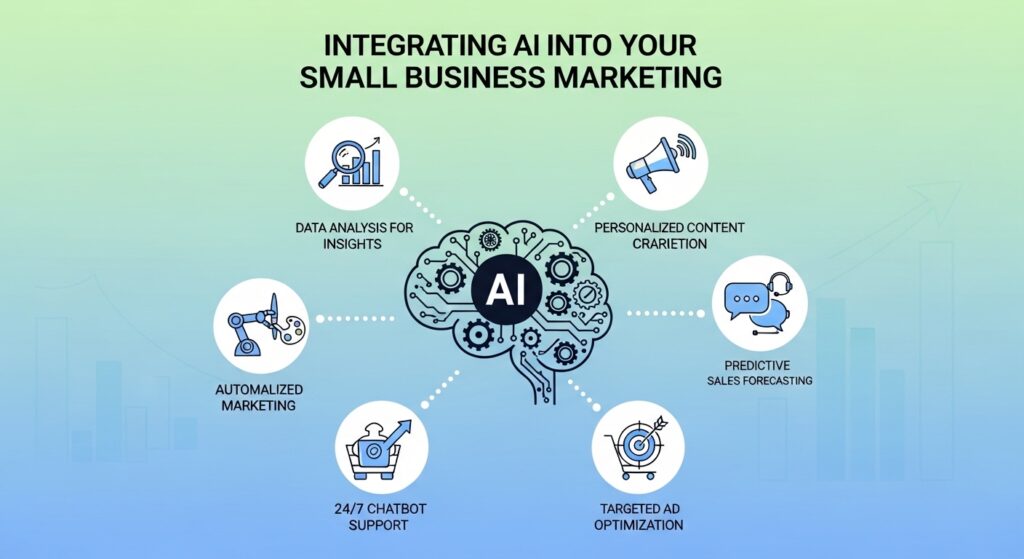
In this guide, you will learn exactly how to integrate AI into every major dimension of your small business marketing — from content creation and social media management to email marketing, customer service, paid advertising, and competitive research. Every recommendation is practical, immediately applicable, and grounded in the specific realities of small business marketing in 2026.
Why AI Marketing Integration Is the Defining Small Business Opportunity of 2026
Before we get into specific applications and tools, it is worth understanding the broader context that makes AI marketing integration such a significant opportunity for small businesses specifically, and why the window for competitive advantage through early adoption remains genuinely open.
Large corporations have been using AI-powered marketing tools for years, using machine learning to optimize advertising bids in real time, using natural language processing to analyze customer sentiment at scale, using predictive analytics to personalize customer experiences across millions of individual interactions. These capabilities were previously accessible only to organizations with substantial technology budgets, dedicated data science teams, and enterprise-level software subscriptions.
The remarkable development of the past two to three years is that the underlying AI capabilities that powered these enterprise advantages have been packaged into affordable, user-friendly tools designed specifically for small business users who have no technical background, limited budgets, and limited time. The AI writing assistant that a Fortune 500 company uses for content generation is now available to a sole trader running a skincare business from her kitchen, often for free or for a modest monthly subscription.
This democratization of AI marketing capability creates an asymmetric opportunity for small businesses willing to adopt these tools early and integrate them thoughtfully into their existing workflows. The small business owner who learns to use AI marketing tools effectively in 2026 can produce the volume, consistency, and sophistication of marketing output that previously required a dedicated marketing team — while maintaining the authentic personal voice and genuine customer relationships that are the small business’s most powerful competitive advantages over larger, more impersonal competitors.
The window for meaningful competitive advantage through early AI adoption will not remain open indefinitely. Early integration, combined with the authentic human judgment and relationship depth that only a genuine small business owner can bring, creates a combination that is currently available and currently underutilized.
Step 1 — Use AI to Transform Your Content Creation Process
Content marketing — the consistent creation and distribution of genuinely helpful, relevant content that attracts and builds trust with your target audience, is one of the highest-return marketing strategies available to small businesses. It is also one of the most time-intensive, which is precisely why so many small business owners start it, struggle to maintain the volume required for effectiveness, and eventually let it lapse.
AI writing tools address this time constraint directly and significantly, not by replacing your marketing voice and judgment, but by handling the mechanical, time-consuming parts of the content creation process that do not require your unique expertise, perspective, or authentic human voice.
Using AI for Blog and Article Content
AI writing assistants like ChatGPT, Claude, and Gemini can dramatically accelerate every stage of the blog content creation process, from initial ideation through research and outline generation to first draft production.
Rather than starting every article with a blank page and the crushing pressure of needing to produce something useful from nothing, you can use an AI assistant to generate a detailed content outline for any topic in seconds, giving you a structured framework to work within that typically cuts your drafting time in half. You can use it to research background information that provides context for your piece, to generate a first draft that you then edit, enrich with your personal expertise and examples, and refine into something that genuinely represents your brand voice.
The critical discipline here is treating AI-generated content as a first draft collaborator rather than a finished product. Every piece of AI-generated content you publish should be reviewed, edited, fact-checked, enriched with your genuine expertise and personal experience, and refined to match your authentic brand voice before it goes live. This human editorial layer is what transforms AI-generated text from generic to genuinely valuable — and it is what ensures your content passes both the authenticity test with your readers and the quality assessment of search engine algorithms that are increasingly sophisticated at identifying and deprioritizing purely AI-generated content without meaningful human input. (For a deeper exploration of how to use AI tools effectively for everyday tasks while maintaining authenticity and quality, check out our comprehensive guide on [Understanding Artificial Intelligence Tools: How to Use AI to Simplify Daily Tasks].)
Using AI for Social Media Content at Scale
Maintaining consistent, high-quality social media presence across one or more platforms requires a volume of content that is genuinely challenging for a single person to sustain alongside all the other responsibilities of running a small business. AI tools make this volume achievable without sacrificing quality or consistency.
A practical workflow that many small business owners find transformative is the content batching session — setting aside two to three hours once a week or once a month to use an AI writing assistant to generate a full batch of social media captions, platform-adapted for each channel in your marketing mix, all in one concentrated session.
Provide the AI with your brand voice guidelines, your target audience description, your key marketing messages, and the specific topics or products you want to feature, and ask it to generate captions in batches of five, ten, or twenty. Review, edit, and personalize each caption to ensure it reflects your authentic voice and specific business context, then schedule the entire batch using a social media scheduling tool like Buffer, Later, or Hootsuite. The result is weeks of consistent social media presence produced in a fraction of the time that writing each caption individually would require.
Using AI for Video Script and Podcast Outline Generation
If video or podcast content is part of your marketing strategy, AI tools can dramatically reduce the preparation time for each episode or video. Provide an AI assistant with your topic, your target audience, your key messages, and your typical content format, and ask it to generate a structured script or outline that you then use as the framework for your recording session.
Many content creators find that working from an AI-generated outline rather than a blank page reduces their recording time significantly, because the structural thinking has already been done, allowing them to focus their mental energy on delivering the content naturally and authentically rather than simultaneously figuring out what to say next.
Step 2 — Automate and Personalize Your Email Marketing With AI
Email marketing remains one of the highest-return marketing channels available to small businesses, and AI is making it simultaneously more effective and less time-intensive through capabilities that range from subject line optimization to audience segmentation and personalized content generation.
AI-Powered Subject Line Optimization
Your email subject line is the single most important factor in determining whether your email is opened or ignored, and the difference between a strong subject line and a weak one can produce a 20, 30, or even 50 percent difference in open rate. AI tools are increasingly powerful at predicting which subject line approaches are most likely to drive opens with a specific audience.
Tools like Mailchimp’s AI-powered subject line assistant and Phrase analyze your historical email performance data and use that learning to suggest subject line variations that are predicted to outperform your current approach with your specific audience. Testing these AI-generated subject line suggestions against your previous hand-written subject lines using A/B testing, sending variation A to half your list and variation B to the other half, provides direct, measurable data on whether the AI suggestions are improving your performance.
Even without dedicated AI subject line tools, using a general AI writing assistant to generate ten to fifteen subject line variations for any given email — then selecting the most compelling option or testing two of the strongest candidates — produces better results than the single subject line most small business owners write in thirty seconds before hitting send.
Using AI for Email Sequence Creation
Email sequences — pre-written series of emails triggered by specific subscriber actions like signing up for your list, making a first purchase, or abandoning a shopping cart — are one of the most powerful automated marketing tools available to small businesses. They allow you to deliver perfectly timed, highly relevant communication to each subscriber based on their specific behavior, without requiring any manual effort after the initial setup.
Writing a complete email sequence — a welcome series, a post-purchase follow-up series, a re-engagement sequence for inactive subscribers — is one of those marketing tasks that most small business owners know they should do and consistently postpone because it feels like a large, time-consuming project.
AI writing assistants make this task dramatically more manageable. Provide the AI with your brand voice, your product or service details, your sequence’s specific goal, and the trigger event for each email — and ask it to draft a complete sequence of five, seven, or ten emails with subject lines, body copy, and calls to action. Review and personalize each email to ensure it accurately represents your brand and your products, then load the sequence into your email platform and let automation deliver it on your behalf indefinitely.
AI-Powered Audience Segmentation
Email list segmentation — dividing your subscriber list into distinct groups based on shared characteristics or behaviors, then sending each group content specifically relevant to them — is one of the most consistently powerful ways to improve email marketing performance. Segmented email campaigns typically achieve significantly higher open rates, click rates, and conversion rates than unsegmented broadcasts.
AI-powered segmentation tools available within platforms like Klaviyo, ActiveCampaign, and Mailchimp can analyze your subscriber behavior data — purchase history, email engagement patterns, website browsing behavior, demographic information — and automatically identify meaningful audience segments that a human analyst might take days to discover manually. These AI-identified segments become the foundation for more relevant, more personalized, and more effective email communication that treats each subscriber as an individual rather than a member of an undifferentiated mass.
Step 3 — Improve Your Social Media Strategy With AI Analytics and Insights
Publishing content consistently is only half of an effective social media strategy. Understanding how your audience responds to different content types, topics, formats, and posting times — and using that understanding to continuously improve your approach — is the other half. AI analytics tools make this understanding accessible to small business owners without requiring data science expertise or hours of manual analysis.
Using AI to Identify Your Best Content
Social media platforms including Instagram, Facebook, LinkedIn, and TikTok all provide native analytics showing how each piece of content has performed. But raw analytics data — engagement rates, reach figures, impression counts — tells you what happened without necessarily telling you why, or what you should do differently as a result.
AI-powered social media analytics tools like Sprout Social, Hootsuite Insights, and Buffer Analyze go beyond raw metrics to identify patterns, generate specific insights, and make actionable recommendations. They can tell you not just that Tuesday’s post outperformed Wednesday’s, but that posts featuring your personal face consistently achieve 40 percent higher engagement than product-only posts, that your audience engages most actively between 7pm and 9pm on weekdays, and that posts featuring specific topic categories significantly outperform others in driving profile visits and website clicks.
These specific, pattern-based insights transform your social media strategy from intuition-guided to evidence-guided, allowing you to deliberately produce more of what works and less of what does not, compounding your results over time.
AI-Powered Hashtag and Keyword Research for Social Media
Finding the right hashtags and keywords for social media, the terms that connect your content with the audiences most likely to engage with and benefit from it, is a research task that AI tools can accelerate significantly.
Tools like Flick, Later’s hashtag suggestion feature, and the AI capabilities within Canva’s social media tools can analyze your content and your audience to suggest relevant, appropriately competitive hashtags that maximize your content’s discoverability without placing it in feeds so broad that it disappears among millions of unrelated posts.
For platforms like LinkedIn and YouTube where keyword optimization significantly impacts content discoverability, using AI keyword research tools to identify the specific terms your target audience uses when searching for content in your niche produces the same compounding discoverability benefits for social content that we explored in depth in our guides on YouTube SEO and digital marketing strategy.
Competitor Analysis With AI
Understanding what your competitors are doing in their marketing, what content is working for them, which platforms they are prioritizing, how they are positioning their products and messages, is one of the most valuable inputs to any small business marketing strategy. Traditionally, this competitive intelligence gathering required significant manual effort, regularly visiting competitor websites and social profiles, manually tracking their campaigns, and synthesizing observations into actionable insights.
AI-powered competitive intelligence tools like Semrush, SimilarWeb, and BuzzSumo automate much of this research, providing data on competitors’ organic search rankings, their most shared content, their social media engagement patterns, their advertising strategies, and the keywords they are targeting. Even the free tiers of these tools provide meaningful competitive data that can meaningfully inform your own marketing decisions without requiring a significant budget.
Step 4 — Use AI to Optimize Your Paid Advertising Performance
Paid digital advertising — particularly on platforms like Google, Facebook, and Instagram — offers small businesses the ability to reach precisely targeted audiences with measurable, trackable campaigns. It is also one of the areas where small business owners most frequently waste money through poorly structured campaigns, ineffective targeting, and unoptimized ad creative.
AI is making paid advertising simultaneously more accessible and more effective for small business advertisers, both through the sophisticated AI optimization built into the advertising platforms themselves and through third-party AI tools that help small businesses create better ads, target more precisely, and interpret their campaign performance more intelligently.
The AI Optimization Built Into Advertising Platforms
Every major digital advertising platform — Google Ads, Meta Ads (Facebook and Instagram), TikTok Ads, and LinkedIn Ads — uses sophisticated machine learning systems to optimize campaign performance automatically. These systems adjust bidding strategies in real time, identify the audience segments most likely to convert, test creative variations against each other, and allocate budget toward the placements and times of day that produce the best results.
For small business advertisers, the most important implication of these built-in AI systems is that properly structured campaigns benefit from optimization that improves continuously as the algorithm accumulates performance data. The critical requirement is giving the algorithm sufficient learning time, at least two to four weeks of consistent campaign running before making significant structural changes, and sufficient budget to generate the click and conversion data the algorithm needs to optimize effectively.
Google’s Performance Max campaigns and Meta’s Advantage+ campaigns are the most fully AI-automated advertising options on their respective platforms, allowing advertisers to provide their creative assets, target audience parameters, and conversion goals, and letting the AI handle the vast majority of optimization decisions automatically. For small business owners without the time or expertise to actively manage granular campaign settings, these AI-automated campaign types often produce competitive results with significantly less ongoing management effort.
Using AI Tools to Create More Effective Ad Creative
The creative assets you use in your advertising — the images, videos, headlines, and body copy that make up your ads, are among the most significant determinants of campaign performance. Better creative produces higher click-through rates, lower cost per click, and higher conversion rates, multiplying the return on every dollar of advertising spend.
AI image generation tools like Adobe Firefly, Canva’s AI image generator, and Microsoft Designer can generate advertising image concepts from text descriptions, allowing you to rapidly produce and test multiple creative variations without the cost of professional photography or design for every test. While AI-generated images require careful review for accuracy and brand alignment, they dramatically reduce the time and cost barrier to testing multiple creative approaches simultaneously.
AI copywriting tools can generate multiple headline and body copy variations for any ad in seconds — giving you a pool of tested options rather than a single hand-written version. Combining AI-generated copy variations with platform-native A/B testing creates a data-driven creative optimization loop that continuously identifies and scales the most effective messaging for your specific audience.
AI-Powered Ad Performance Analysis
Understanding why a paid advertising campaign is or is not performing as expected, and knowing specifically what to change to improve results, requires the ability to identify meaningful patterns in campaign data that can be difficult to see without analytical tools.
AI-powered advertising analytics tools like Revealbot and the AI insights features built into Google Ads and Meta Ads Manager can automatically identify performance anomalies, flag campaigns or ad sets that are significantly underperforming, suggest specific optimizations based on observed patterns, and predict which changes are most likely to improve results. For small business owners managing their own advertising without a dedicated media buyer, these AI-powered insights provide a level of analytical support that was previously accessible only to businesses with professional advertising agency relationships.
Step 5 — Deploy AI for Customer Communication and Service
Customer communication — responding to inquiries, addressing complaints, answering frequently asked questions, engaging with reviews, is one of the most time-consuming aspects of small business marketing and one of the areas where AI can provide some of its most immediate and most impactful assistance.
AI-Powered Customer Service Chatbots
AI chatbots deployed on your website or social media platforms can handle a significant proportion of routine customer inquiries automatically, answering frequently asked questions about your products, services, pricing, shipping policies, and return processes around the clock without requiring your personal attention for each interaction.
Modern AI chatbots have advanced dramatically beyond the frustrating, limited decision-tree chatbots of earlier years. Tools like Tidio, ManyChat, and Intercom’s AI features are capable of understanding natural language questions, providing genuinely helpful and contextually appropriate responses, and escalating to human support when a question falls outside their capability, creating a customer service experience that satisfies the majority of routine inquiries automatically while ensuring complex or sensitive situations receive personal attention.
For small business owners who receive significant volumes of repetitive customer inquiries, which is the reality for most product-based businesses, deploying an AI chatbot can reclaim several hours per week previously consumed by answering the same questions repeatedly, while simultaneously improving customer response times and satisfaction by providing instant answers rather than waiting for business hours.
Using AI to Respond to Customer Reviews
Responding to customer reviews — particularly negative ones, is one of the most important and most frequently neglected customer communication responsibilities for small businesses. Thoughtful, professional responses to negative reviews demonstrate that you take customer feedback seriously and handle problems with integrity, which influences prospective customers reading those reviews as much as it addresses the reviewer’s concern.
AI writing assistants can help you draft review responses that are professional, empathetic, and specific to the content of each review, without requiring you to stare at a hostile review trying to compose a calm and constructive response from scratch. Provide the AI with the review text and ask it to draft a response that acknowledges the customer’s concern, explains your business’s approach or policy, and offers a genuine resolution. Review and personalize the draft to ensure it accurately represents your specific situation and your authentic voice before posting.
AI-Powered Personalization at Scale
One of the most powerful competitive advantages available to small businesses is their ability to provide genuinely personal, relationship-based customer communication that large competitors simply cannot replicate at their scale. AI tools allow small businesses to extend this personalization advantage to a larger volume of customer interactions than would be possible through purely manual effort.
AI-powered CRM tools like HubSpot — which offers a genuinely capable free tier — can track individual customer interaction history, purchase patterns, communication preferences, and lifecycle stage, then use this data to trigger personalized communication at scale. A customer who made their first purchase three months ago and has not returned receives a different reactivation message than a loyal repeat customer who has not purchased in thirty days — all triggered and personalized automatically, without requiring you to manually identify and reach out to each individual customer.
Step 6 — Use AI for Market Research and Competitive Intelligence
Understanding your market — your customers’ evolving needs and preferences, your competitors’ strategies and positioning, the trends shaping your industry, is the foundation of effective marketing strategy. Traditionally, gathering this market intelligence required either expensive research agencies or significant personal time investment in manual research. AI is changing both the speed and the cost of market intelligence gathering for small businesses.
AI-Powered Customer Insight Generation
Your existing customers are your richest source of market intelligence, and most small businesses are sitting on a wealth of customer feedback data in the form of reviews, survey responses, social media comments, and support interactions that they never systematically analyze.
AI text analysis tools can process large volumes of unstructured customer feedback, reviews, comments, support tickets, and identify the recurring themes, sentiments, and specific language patterns that reveal what your customers genuinely love, what consistently frustrates them, what questions they most frequently ask, and what motivates their purchasing decisions. These insights inform every dimension of your marketing, from the specific language you use in your ad copy to the product features you emphasize in your content to the objections you proactively address on your product pages.
Tools like MonkeyLearn and the AI analysis features within Typeform and SurveyMonkey can perform this kind of systematic customer feedback analysis at a fraction of the cost of traditional research, making sophisticated customer insight generation accessible to small businesses with modest research budgets.
Using AI to Monitor Industry Trends
Staying informed about the trends shaping your industry, emerging customer preferences, new competitor offerings, regulatory changes, technological developments, is critical for marketing strategy relevance but time-consuming to maintain through manual reading and research.
AI-powered trend monitoring tools like Google Alerts for basic keyword monitoring, Exploding Topics for identifying emerging trend signals before they become mainstream, and BuzzSumo for tracking the most shared and engaged content in your industry provide automated intelligence gathering that keeps you informed about relevant developments without requiring daily manual research sessions.
Regularly incorporating these trend signals into your content strategy, addressing emerging questions your audience is beginning to ask, positioning your products in relation to trends gaining traction in your market — creates a marketing responsiveness that keeps your content relevant and your positioning current in a rapidly evolving marketplace.
Step 7 — Build Your AI Marketing Stack Without Overwhelm
One of the most common mistakes small business owners make when beginning to integrate AI into their marketing is attempting to adopt every available tool simultaneously. The result is a proliferation of subscriptions, a steep collective learning curve, and a workflow disruption that produces worse short-term results than the manual approaches being replaced, leading to disillusionment and abandonment before the genuine benefits have had time to materialize.
The most effective approach is to build your AI marketing stack incrementally — starting with the single application that addresses your most painful current marketing challenge, mastering that tool fully before adding the next, and building a coherent integrated system gradually rather than assembling it all at once.
A Recommended AI Marketing Integration Sequence for Small Businesses
Month one should focus exclusively on AI writing assistance for content creation — using ChatGPT, Claude, or Gemini to accelerate your blog, social media, and email content production. This single change addresses the most universally painful small business marketing challenge — time — and delivers immediate, visible results that build confidence in AI integration.
Month two should add AI-powered social media scheduling and basic analytics, integrating a tool like Buffer or Later with its AI caption suggestions and posting optimization features to systematize your social media distribution and begin gathering performance data.
Month three should introduce AI-enhanced email marketing, optimizing your subject lines, creating automated sequences, and beginning to explore audience segmentation capabilities within your existing email platform.
Months four and five should explore AI tools for paid advertising optimization and customer service chatbot deployment — building on the foundation of content, social, and email systems already in place.
Month six and beyond should integrate AI-powered market research and competitive intelligence tools — using the insights they generate to continuously refine and improve every other element of your AI-enhanced marketing system.
This incremental approach ensures that each tool is properly learned and integrated before the next is added, that the workflow disruption of adoption is managed rather than overwhelming, and that the cumulative benefits of each addition are clearly visible before the next investment is made.
Common AI Marketing Integration Mistakes Small Businesses Make
Even enthusiastic and well-intentioned small business owners consistently make these errors when beginning to integrate AI into their marketing:
- Publishing AI-generated content without human review and editing: AI writing tools produce first drafts, not finished content. Publishing unedited AI-generated content produces generic, often inaccurate, brand-inconsistent marketing that damages rather than builds your business’s credibility. Every piece of AI-generated content requires meaningful human review, editing, and enrichment before publication.
- Expecting AI to replace your marketing strategy: AI tools execute marketing tactics with greater speed and efficiency than purely manual approaches. They cannot replace the strategic thinking, genuine customer empathy, and authentic brand vision that must come from you. AI is a marketing accelerator, not a marketing strategist.
- Choosing tools based on features rather than fit: The most sophisticated AI marketing tool is not necessarily the most valuable one for your specific business. Choose tools based on how well they address your specific marketing challenges, how easily they integrate with your existing workflow, and how accessible their interface is for your technical comfort level.
- Neglecting the human voice in AI-assisted communication: The authentic, personal, relationship-based communication that is a small business’s most powerful competitive advantage over larger competitors must be preserved even as AI tools accelerate the volume and consistency of your marketing output. Use AI to handle the mechanical work of content production, but ensure that your genuine personality, your authentic expertise, and your real customer relationships remain visible in everything you publish.
- Failing to measure results: The same discipline of data-driven decision making that makes AI tools powerful applies to evaluating the AI tools themselves. Track your marketing performance metrics before and after AI integration to measure the specific impact of each tool on the outcomes that matter most to your business — and be willing to discontinue tools that do not produce measurable improvement.
Conclusion and Final Thoughts
AI marketing integration is not about replacing the authentic human judgment, genuine customer relationships, and real business expertise that make small businesses uniquely valuable to their customers. It is about removing the time constraints, energy limitations, and resource gaps that prevent small business owners from consistently delivering the volume, quality, and sophistication of marketing their businesses deserve.
The seven integration areas covered in this guide — AI-powered content creation, intelligent email marketing automation, AI-driven social media analytics, optimized paid advertising, AI-enhanced customer communication, automated market research, and incremental stack building — form a comprehensive framework for AI marketing integration that is practical, affordable, and immediately applicable to small businesses at every stage of their development.
The skincare brand owner who dreaded her Sunday evenings now spends them doing something she genuinely enjoys. Her marketing is more consistent, more professional, and more effective than it has ever been, not because she has more time or more money than she did eighteen months ago, but because she has AI tools working alongside her human judgment and authentic business relationships to produce results that neither could achieve alone.
That partnership — human creativity, judgment, and relationship depth combined with AI speed, consistency, and analytical capability, is the most powerful marketing combination available to a small business in 2026. And it is available to you, starting with the very next marketing task on your list.
Which area of your small business marketing are you most excited to enhance with AI tools — and have you already started experimenting with any AI marketing applications? Share your experience and your biggest marketing challenge in the comments below. Whether you are just beginning your AI integration journey or already using tools that are transforming your results, your perspective is exactly what this community of small business owners needs to hear.