At thirty-four years old, after eleven years working as a civil engineer, my older sister sat across from me at a dinner table and said something I had never expected to hear from her: “I think I am in the wrong career.” She had not said it dramatically or impulsively. She had said it quietly, with the measured certainty of someone who had been sitting with that realization for a long time and had finally decided to stop pretending otherwise.
She had a mortgage, two young children, a stable salary, and a professional identity built over more than a decade. She also had a growing conviction that the work she was doing every day was not the work she was meant to be doing, and that continuing to ignore that conviction was costing her more than the risk of change ever could.
Three years later, she completed a part-time data science certification while continuing to work full time, leveraged her engineering background as a unique differentiator in technical interviews, and accepted a role at a technology company that paid her more than her engineering position and energized her in ways that her previous career never had. The transition was not easy, not fast, and not without genuine uncertainty and difficult moments. But it was entirely possible, and it changed the entire trajectory of her professional and personal life.
Career transitions are one of the most significant and most common professional challenges of modern working life. Research suggests that the average person will change careers, not just jobs, but entire fields, multiple times over the course of their working life. In 2026, with the accelerating pace of industry transformation driven by artificial intelligence, automation, and shifting economic priorities, the frequency and urgency of career transitions is only increasing.
And yet the process of actually making a successful career transition, of moving from where you are to where you want to be without destroying your financial stability, your professional reputation, or your confidence in the process, is something that most people have never been explicitly taught and approach with a combination of hope, anxiety, and very little strategic clarity.
In this guide, you will learn the complete, practical, step-by-step roadmap for making a successful career transition at any age, from any background, and into virtually any new field. Every step is designed to be actionable, realistic, and grounded in the actual experiences of professionals who have made successful transitions — not theoretical advice that sounds compelling but collapses under the pressure of real-world constraints.
Why Career Transitions Are More Common and More Achievable Than Ever Before
Before we get into the roadmap, it is worth understanding the landscape that makes career transitions both more common and more practically achievable in 2026 than at any previous point in professional history.
The traditional model of a single lifelong career, entering a field in your early twenties, building expertise progressively within it, and retiring from it decades later, was never as universal as cultural mythology suggested, but it is now genuinely obsolete for a significant proportion of the workforce. The accelerating pace of industry transformation means that entire job categories are emerging, evolving, and disappearing within single working lifetimes. The skills that defined professional value in a field a decade ago may be partially or fully automated today. The industries that offered the most security and opportunity when you entered the workforce may be contracting precisely as you approach your peak earning years.
This disruption is genuinely challenging. It is also genuinely liberating. The same technological and economic forces that are rendering some career paths less viable are simultaneously creating entirely new fields and dramatically expanding others, fields that actively need professionals who can bring experience, perspective, and transferable skills from adjacent domains.
Simultaneously, the infrastructure for career transitions has never been more accessible. Online learning platforms like Coursera, edX, LinkedIn Learning, and Udemy have democratized access to professional education across virtually every field, allowing people to build credible, employer-recognized credentials in new disciplines without leaving their current jobs or incurring the cost and time commitment of a full degree program. Professional communities and networks have moved online in ways that make it possible to build relationships and reputation in a new field before you have even made the official transition.
The barriers to career change are genuinely lower than they have ever been. The path is still challenging, but it is more navigable than most people fear when standing at the beginning of it.
Step 1 — Conduct an Honest Self-Assessment Before You Decide Where to Go
The most common and most costly mistake people make at the beginning of a career transition is moving too quickly from dissatisfaction with where they are to a specific decision about where they are going — without doing the honest, thorough self-assessment work that ensures the destination they are racing toward is genuinely right for them.
Changing careers is a significant investment of time, energy, financial resources, and emotional capital. Making that investment in the wrong direction, because you were fleeing your current career rather than moving toward something genuinely better suited to your strengths, values, and goals, can leave you equally dissatisfied in a different field, with the additional burden of having spent years and resources on a transition that did not deliver the change you were actually seeking.
Identify What You Are Actually Running From and What You Are Running Toward
Begin by asking yourself with genuine honesty: is my dissatisfaction with my career specific to my current role, my current employer, my current industry, or is it fundamental to the field itself? These are very different diagnoses that call for very different responses.
Many people who believe they need a complete career change actually need a different role within their current field, a different type of organization, moving from a large corporation to a startup, or from a commercial enterprise to a mission-driven nonprofit — or a different manager and team dynamic. Pursuing a full career transition when a more targeted change would address the actual source of dissatisfaction is an expensive and time-consuming mistake worth avoiding.
If your honest assessment concludes that the dissatisfaction is fundamental, that it is the nature of the work itself, the values of the industry, or the daily reality of the profession that is misaligned with who you are, then a genuine career transition is the appropriate response.
Audit Your Transferable Skills and Natural Strengths
Before identifying where you want to go, take a thorough inventory of what you are bringing with you from where you have been. Every professional has a portfolio of transferable skills — capabilities developed in one context that have genuine value in many others, and most people dramatically underestimate the breadth and relevance of theirs.
Transferable skills include communication and writing abilities, project management and organizational capabilities, analytical and problem-solving skills, leadership and team management experience, client relationship management, financial literacy, technical proficiencies that apply across industries, teaching and training capabilities, and the domain knowledge of your existing field that may be genuinely valuable in adjacent ones.
My sister’s engineering background, her comfort with data, her systematic analytical thinking, her experience working with large datasets in infrastructure modeling, was not a liability in her transition to data science. It was a genuine differentiator that distinguished her from candidates with data science training but no real-world analytical experience in complex, high-stakes environments.
Tools like the CliftonStrengths assessment, the Myers-Briggs Type Indicator, and the Holland Code career assessment can provide structured frameworks for identifying your natural strengths and the work environments in which you are most likely to thrive, useful inputs to a self-assessment process that can otherwise feel unstructurably subjective.
Define What You Need From Your Next Career
Beyond what you are good at, it is essential to clarify what you genuinely need, not just what you want — from your next professional chapter. Consider the specific values that must be present in your work for it to feel meaningful. Consider the working conditions, team dynamics, pace, autonomy level, and intellectual demands that allow you to perform at your best. Consider the compensation requirements that are genuinely non-negotiable given your financial obligations and life goals. Consider the lifestyle integration that matters to you, remote work flexibility, travel requirements, predictable hours, the ability to pursue interests outside of work.
This values and needs clarification provides the filter through which you evaluate potential new directions, ensuring that you are not simply replacing one form of dissatisfaction with another.
Step 2 — Research Your Target Field With Genuine Depth and Specificity
Once your self-assessment has pointed you toward one or more potential new directions, the next step is researching those fields with a level of depth and specificity that goes well beyond what a few Google searches or a Wikipedia overview can provide.
Conduct Informational Interviews With People Already Working in the Field
Informational interviews — brief, focused conversations with professionals currently working in your target field, are the single most valuable research tool available to a career changer, and they are dramatically underutilized by most people planning transitions.
An informational interview is not a job interview. It is a twenty to thirty minute conversation in which you ask someone doing the work you are considering to share their honest perspective on what the field is actually like, the day-to-day realities, the most significant challenges, the skills and qualities that distinguish those who thrive from those who struggle, the career pathways that lead into the field from non-traditional backgrounds, and the aspects of the work that are most and least satisfying.
The insights you gain from five or six well-conducted informational interviews will give you a more accurate and more practically useful picture of your target field than months of passive research could produce. They will also begin building the professional relationships in your new field that will eventually support your job search, and they almost always surface specific information about credential requirements, common entry points, and hiring realities that you would never have found through independent research alone.
Reaching out to professionals for informational interviews is far less daunting than most people fear. A brief, honest, respectful message explaining that you are researching a career transition into their field and would greatly value thirty minutes of their time and perspective is received positively by the majority of professionals who receive it. Most people enjoy sharing their professional experience and genuinely like helping someone navigate a path they themselves have traveled.
Understand the Reality of Entry-Level Compensation and Progression
One of the most important and most frequently underestimated realities of career transitions is that entering a new field almost always requires accepting a temporary step back in seniority, compensation, or both, regardless of how senior or well-compensated you were in your previous career.
This reality does not mean a career transition is not worth making. My sister accepted a somewhat lower title than her engineering seniority level might have suggested at entry, and within eighteen months had progressed to a position that exceeded her previous compensation. The temporary step back was the price of entry into a field where long-term trajectory was significantly more favorable.
Understanding this reality in advance, and planning your finances accordingly, is the difference between a transition that proceeds confidently and one that stalls because the short-term financial reality does not match the expectations set by research that focused only on senior-level compensation data in the target field.
Step 3 — Identify and Fill Your Skills Gaps Strategically
The gap between your current skill set and the skill set required to be a credible candidate in your target field is the primary practical obstacle in any career transition, and bridging it strategically is the core work of the transition period.
Map the Specific Skills Your Target Roles Require
Spend time reviewing job postings for roles in your target field at the entry and mid-level — the levels at which you are most likely to enter given your career changing context. Look for the skills, qualifications, and experiences that appear consistently across multiple postings from different employers. These consistent requirements represent the genuine minimum viable skill set for the field.
Separate the requirements into two categories: the must-have skills that appear in the majority of postings and that employers genuinely use to screen candidates, and the nice-to-have skills that appear in some postings and that would strengthen your candidacy but are not universally required. Focus your skill-building effort first and most intensively on the must-have category, the credentials and capabilities that will determine whether you clear the initial screening threshold.
Choose the Right Learning Path for Your Situation
The right approach to filling your skills gaps depends on your target field, your timeline, your financial situation, and the specific nature of the gaps you need to close.
Online certifications and courses from platforms like Coursera, edX, LinkedIn Learning, and Google Career Certificates offer the fastest, most flexible, and most affordable path to building foundational credentials in many fields, particularly technology, data, digital marketing, project management, UX design, and finance. Many of these programs are designed specifically for career changers and can be completed while maintaining full-time employment.
Bootcamps — intensive, accelerated training programs typically lasting three to six months — offer a faster path to job-ready skills in high-demand fields like software development, data science, cybersecurity, and UX design. Reputable bootcamps include employer partnerships, career coaching, and portfolio development support that can significantly accelerate the job search phase of a transition. They are more expensive than self-paced online courses but less expensive and significantly faster than returning to university.
Part-time or evening degree programs may be appropriate for fields where formal academic credentials are genuinely required for entry, healthcare, law, education, and certain engineering specializations, for example. These programs are the longest and most expensive option, but for fields where they are necessary, there is often no effective substitute.
Self-directed learning combined with portfolio projects is the most appropriate approach for creative and technical fields where employers care primarily about demonstrated capability rather than specific credentials. A UX designer, a graphic designer, a writer, or a software developer who can show a portfolio of strong work will often be hired ahead of a candidate with formal credentials but limited practical portfolio.
Build Real Portfolio Projects During Your Learning Phase
Credentials demonstrate that you have learned something. Portfolio projects demonstrate that you can apply what you have learned to produce real outcomes, which is what employers are actually evaluating when they assess a career-changing candidate without direct experience in the field.
During your learning phase, prioritize building tangible, shareable portfolio projects that demonstrate your emerging capabilities in your target field. Volunteer your new skills for nonprofit organizations that need them. Create passion projects that solve real problems in your target domain. Contribute to open-source projects. Write case studies that document your thinking process and your results. These portfolio pieces become the evidence that bridges the gap between your formal credentials and your practical capability — and for many employers, particularly in technology and creative fields, they are more persuasive than credentials alone.
Step 4 — Build Your Network in the New Field Before You Need It
One of the most strategic and most consistently underestimated aspects of a successful career transition is the importance of building genuine professional relationships in your target field during the preparation phase, long before you begin actively applying for positions.
Why Network-First Is the Right Strategy for Career Changers
Career changers face a fundamental disadvantage in traditional job application processes: without direct experience in the field, their applications are frequently filtered out by automated screening systems and human reviewers before they ever reach a hiring decision-maker who might recognize the value of their transferable background.
The most effective way to bypass this screening barrier is through warm introductions — having someone inside the organization or the hiring manager’s network introduce you and vouch for your potential. And warm introductions come from relationships, which means building those relationships proactively, during the preparation phase, before you are in urgent need of them.
Attend industry events, conferences, and meetups in your target field. Join professional associations and online communities relevant to your new direction. Engage thoughtfully with content from professionals in your target field on LinkedIn. Follow up on informational interviews by staying in genuine contact with the people who gave their time to speak with you. The relationships you build during the preparation phase create the network that will surface opportunities, provide introductions, and offer references when your job search begins in earnest.
Rebuild Your LinkedIn Profile Around Your New Direction
Your LinkedIn profile is the primary way professionals in your target field will form their initial impression of you — and during a career transition, it needs to communicate a clear, compelling narrative about who you are becoming, not just a record of who you have been.
Update your headline to reflect your transition direction, something like “Civil Engineer transitioning to Data Science | Python | SQL | Machine Learning” communicates both your background and your direction clearly and searchably. Update your About section to tell your transition story honestly and compellingly — explaining why you are making the change, what you are bringing from your previous career, and what specifically you are building toward. List your new credentials, courses, and portfolio projects in your Experience and Education sections alongside your previous professional history.
The goal is a profile that makes a hiring manager in your target field say “Interesting background — I would like to talk to this person” rather than one that simply reminds them that you have no direct experience in their field.
Step 5 — Craft a Transition-Specific Resume and Cover Letter Strategy
Your resume and cover letter are the primary written tools through which you will present your career transition narrative to potential employers, and they require a fundamentally different approach from the standard job application documents you have used throughout your previous career.
The Functional Resume Approach for Career Changers
Career changers are among the situations where a functional resume — which leads with skills and achievements rather than chronological work history, can be more effective than the standard reverse-chronological format. A functional format allows you to highlight the transferable skills and relevant achievements that are most compelling for your target role at the top of the document, before listing your work history in a way that contextualizes your experience rather than leading with the fact that it is not directly in the target field.
Structure your resume to lead with a professional summary of two to three sentences that frames your background as an asset for your new direction, emphasizing the specific transferable value your previous experience brings. Follow with a core skills section that lists the specific technical and interpersonal skills most relevant to your target roles. Then present your experience section with bullet points written specifically to highlight transferable achievements and responsibilities rather than presenting a generic record of your previous job duties.
The Cover Letter as Your Transition Story
For career changers, the cover letter is not optional and not a formality. It is your most important application document, the place where you can address the obvious question in every hiring manager’s mind proactively, honestly, and compellingly.
Your cover letter should acknowledge your non-traditional background briefly and directly, not defensively or apologetically, and then spend the majority of its content making a specific, evidence-based case for why your particular combination of previous experience and newly developed skills makes you a stronger candidate for this specific role than someone with a more conventional background.
The most effective career transition cover letters tell a genuine story, explaining the why behind the transition, demonstrating genuine knowledge of and enthusiasm for the target field, and connecting specific past achievements to specific anticipated contributions in the new role. Authenticity and specificity are far more persuasive than generic claims about passion and commitment.
Step 6 — Navigate the Job Search as a Career Changer
The job search phase of a career transition requires both realistic expectations about timeline and a strategic approach that accounts for the specific challenges and opportunities of a non-traditional candidacy.
Target the Right Types of Organizations
Not all employers in your target field are equally open to career changers. Startups and growth-stage companies are typically more willing to evaluate candidates on potential and transferable skills than large established organizations with structured hiring pipelines optimized for conventional backgrounds. Organizations in your previous industry that need the specific skills you are building — a construction company hiring data scientists, a healthcare organization hiring UX designers, a financial services firm hiring cybersecurity professionals, are particularly valuable targets because your domain knowledge from your previous career is a genuine differentiator rather than an irrelevance.
Companies that have publicly committed to skills-based hiring — evaluating candidates on demonstrated capability rather than credential and experience checklists, are another high-value target for career changers, as their hiring processes are specifically designed to identify and evaluate the kind of potential and transferable value that career changers often represent.
Prepare for the Inevitable Interview Questions About Your Transition
Every interview during a career transition will include some version of the question: “Why are you making this change?” Preparing a clear, confident, authentic answer to this question is one of the most important interview preparation tasks for a career changer.
Your answer should be forward-looking rather than backward-looking, focused on what draws you to the new field rather than what you are unhappy about in the old one. It should be specific and informed, demonstrating genuine knowledge of and engagement with the target field rather than vague enthusiasm. And it should be honest, because authenticity resonates with interviewers in a way that polished but hollow narratives never do.
Prepare specific examples that demonstrate how your background from your previous career will contribute direct, concrete value in the new role. The ability to articulate this connection clearly and specifically, to show the interviewer exactly how your civil engineering background makes you a stronger data scientist, or how your teaching experience makes you a stronger UX researcher — transforms your non-traditional background from a liability into a differentiator.
Step 7 — Manage the Emotional and Financial Realities of Transition
A career transition guide that addresses only the strategic and practical dimensions of the process while ignoring its emotional and financial realities is incomplete in ways that matter enormously to the people actually living through one.
The Emotional Reality of Career Change
Career transitions are genuinely difficult emotional experiences — even when they are clearly the right choice and progressing well. The loss of a professional identity built over years, the uncertainty of an unfamiliar landscape, the inevitable moments of self-doubt when progress feels slow, the vulnerability of being a beginner again after years of being an expert, these are real psychological challenges that deserve honest acknowledgment rather than motivational dismissal.
Most people in the middle of a career transition experience what psychologist William Bridges called the neutral zone — a disorienting in-between state where the old identity has been released but the new one has not yet fully formed. This phase is uncomfortable but essential. It is the creative space in which genuine transformation happens, and understanding it as a normal and temporary feature of any meaningful transition, rather than evidence that something is wrong, makes it significantly more navigable.
Building and maintaining a genuine support system during your transition, people who believe in your direction, understand the challenge you are undertaking, and can provide both practical encouragement and honest feedback, is not a luxury but a genuine necessity for the emotional sustainability of the process.
The Financial Reality of Career Change
Transitions take time, typically longer than most people initially estimate. The preparation phase, job search, and entry-level adjustment period of a well-executed career transition commonly spans one to two years from the initial decision to the point of established stability in the new field. Financial planning that accounts realistically for this timeline is essential.
Before beginning your transition in earnest, assess your financial runway honestly, how long you can maintain your current standard of living while investing time and potentially money in the transition process. Building or maintaining your emergency fund before and during the transition provides the financial buffer that prevents a slower-than-expected job search from becoming a financial crisis that forces a premature retreat to your previous field. (For guidance on building the financial safety net that makes a career transition sustainable, check out our guide on [Setting Up an Emergency Fund: Why It’s the Most Important Financial Step You’ll Take].)
Where possible, making the transition while still employed, building skills, credentials, network, and portfolio in evenings and weekends before leaving your current role, is significantly safer financially than resigning first and transitioning second. The security of a current income while you build toward your new direction removes the financial pressure that clouds decision-making and tempts premature moves.
Common Career Transition Mistakes to Avoid
Even motivated and well-prepared career changers consistently fall into these traps:
- Choosing a new field based on compensation data alone: A field that pays well but fundamentally misaligns with your strengths, values, or working style preferences will produce the same dissatisfaction as the career you are leaving — at the cost of significant transition investment. Choose your new direction based on fit first and compensation second.
- Underestimating the time and effort required: Career transitions are marathons, not sprints. Expecting to be fully established in a new field within three to six months frequently leads to discouragement and premature abandonment of a transition that would have succeeded with more realistic timelines and sustained effort.
- Neglecting the network-building phase: Many career changers spend enormous energy on credentials and skills development while investing almost nothing in building relationships in their target field. In most industries, who you know is as important as what you know, and warm introductions consistently outperform cold applications for career-changing candidates.
- Trying to hide or minimize your previous career: Your background is not a liability to be apologized for — it is a unique combination of experience and perspective that genuinely differentiates you from candidates who have only ever worked in one field. Learn to articulate the specific value your previous experience contributes to your new direction rather than treating it as irrelevant history.
- Waiting for perfect readiness before beginning the search: Many career changers postpone their job search indefinitely while pursuing additional credentials, convinced that they are not yet ready. In most fields, the only way to truly know what employers are looking for and whether you are ready is to begin the search and let the feedback from real applications and interviews guide your continued development.
- Going it alone: Career transitions are genuinely difficult, and attempting to navigate them without mentors, peer support, professional coaching, or community significantly reduces both the speed and the likelihood of success. Invest in the relationships and support structures that will sustain you through the challenging phases.
Conclusion and Final Thoughts
A career transition is one of the most significant investments of time, energy, courage, and resources that a professional can undertake. It is also one of the most potentially transformative, capable of redirecting not just your professional trajectory but your entire relationship with work, with your sense of purpose, and with the way you spend the majority of your waking hours.
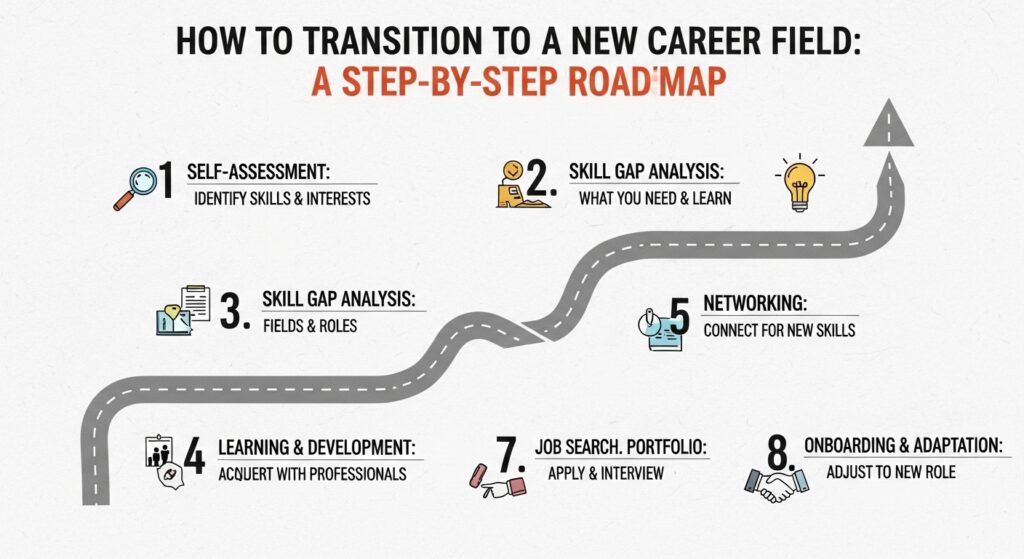
The seven steps covered in this guide — conducting an honest self-assessment, researching your target field with genuine depth, identifying and filling your skills gaps strategically, building your network in the new field proactively, crafting a transition-specific application strategy, navigating the job search with realistic expectations, and managing the emotional and financial realities of the process — provide a complete, practical roadmap that has guided successful transitions across virtually every field and every stage of professional life.
My sister, sitting across that dinner table three years ago, did not know exactly how her transition would unfold. She did not know precisely which steps she would need to take, how long it would take, or exactly what the destination would look like. What she knew was that staying where she was, out of fear of the unknown, was a certainty she could no longer accept.
That clarity, that the cost of staying had finally exceeded the cost of changing, is what most successful career transitions have in common at their beginning. The steps, the skills, and the strategies can be learned. The decision to begin can only come from you.
If you are standing at the beginning of that decision right now, know this: it is possible, it is navigable, and the version of your professional life waiting on the other side of a well-executed transition is almost always worth every difficult step of the journey to get there.
Are you currently planning a career transition, in the middle of one, or reflecting on one you have already made? Share your story in the comments below — which field you are moving from and toward, what has been the most challenging part of the process, and what advice you would give to someone just starting out. Your experience is exactly the kind of real-world guidance that no roadmap can fully replace.