About two years ago, the owner of a small artisan bakery in my neighborhood was facing a problem that many small business owners will immediately recognize. Her Saturday morning rush was extraordinary, the queue regularly extended out the door, she sold out of her signature sourdough before 10am, and her loyal weekend customers were some of the most enthusiastic she had ever encountered in twenty years of baking. But her Tuesday through Thursday trade was so quiet that she was struggling to justify the cost of opening on those days at all.
She had tried social media posts encouraging midweek visits. She had offered a modest discount on weekday purchases. She had even placed a handwritten sign in the window. Nothing moved the needle in any meaningful way. The weekend customers who loved her products simply did not think about her bakery on a Tuesday morning when their daily routine did not bring them past her door.
A fellow small business owner suggested she try email marketing. She was skeptical, she was a baker, not a marketer, and the idea of writing and sending professional emails felt well outside her comfort zone. But she collected email addresses from customers willing to share them, set up a free Mailchimp account, and, following the guidance of a friend familiar with email automation, built three simple automated email sequences over the course of a single weekend.
Within eight weeks, her midweek foot traffic had increased by approximately 23 percent. A Tuesday morning flash sale email to her subscriber list had sold out her entire batch of weekday croissants twice in three weeks. Her monthly revenue had grown meaningfully, not through dramatic change to her products or her prices, but through establishing a direct, reliable communication channel with people who already loved what she made and simply needed a timely, personalized reason to visit.
Her experience illustrates something that marketing data has confirmed consistently across industries and business sizes: email marketing, when executed correctly through well-designed automated sequences, is one of the highest-return marketing channels available to any business — generating measurable improvements in lead generation, customer retention, conversion optimization, and revenue growth at a cost per acquisition that most other channels cannot approach.
In this tutorial, you will learn exactly how email marketing automation works, how to build the specific automated sequences that drive the most significant sales results, which tools make the process accessible without technical expertise, and the specific optimization strategies that continuously improve your email marketing performance over time. Every recommendation is grounded in realistic, professional marketing practice, the kind that builds sustainable revenue growth rather than short-term spikes.
Why Email Marketing Automation Outperforms Every Other Digital Marketing Channel for Revenue Growth
Before we get into the specific sequences and implementation steps, it is worth establishing why email marketing, and automated sequences specifically, consistently outperforms social media, paid advertising, and content marketing for direct revenue generation.
The Ownership Advantage
Every other digital marketing channel you invest in is built on infrastructure you do not own and cannot fully control. Your social media following exists at the discretion of platform algorithms that can reduce your organic reach overnight. Your paid advertising results depend on advertising platforms whose pricing, policies, and audience targeting capabilities change regularly. Your search engine rankings can be affected by algorithm updates beyond your control.
Your email list is different in a fundamental way. It is an asset you own entirely, a direct line of communication to people who have actively opted in to hear from you, that no platform algorithm can stand between you and, and that you can take with you regardless of what any third-party platform decides to do with its policies or pricing.
This ownership advantage compounds over time. An email list that grows consistently becomes progressively more valuable, not just because it reaches more people, but because it accumulates historical engagement data, purchase behavior information, and relationship depth that makes each subsequent campaign more targeted, more personalized, and more effective at driving conversion optimization.
The Revenue Data That Makes the Case
Industry research from the Direct Marketing Association and Litmus consistently identifies email marketing as delivering among the highest returns on investment of any digital marketing channel, with figures commonly cited in the range of thirty to forty dollars of revenue generated for every dollar invested in email marketing execution. These figures vary significantly by industry, list quality, and execution quality, but even conservative estimates place email marketing’s return on investment well above social media advertising and content marketing for direct revenue generation.
The specific reason email marketing achieves these results is the combination of audience intent — subscribers have actively chosen to receive your communication, meaning they are already disposed toward your business, and personalization capability — email allows you to send different content to different subscriber segments based on their behavior, preferences, and purchase history in ways that mass-broadcast channels like social media cannot replicate.
Automated email sequences take these advantages further by removing the requirement for your ongoing personal attention to deliver personalized, timely, behavior-triggered communication at scale — allowing you to build sophisticated lead generation and conversion optimization systems that work continuously on your behalf.
Step 1 — Build and Segment Your Email List Strategically
An automated email sequence is only as valuable as the list it is sent to, which means building a high-quality, properly segmented subscriber list is the prerequisite that determines the effectiveness of everything else in this guide.
The Fundamentals of Ethical List Building
Permission-based list building — collecting email addresses only from people who have explicitly consented to receive your marketing communication, is not just an ethical best practice. It is a legal requirement in most jurisdictions under regulations including GDPR in Europe, CAN-SPAM in the United States, and CASL in Canada, and it is the foundation of a subscriber list that actually produces revenue growth rather than spam complaints.
The most effective email list building approaches for small businesses combine multiple collection touchpoints that collectively capture potential subscribers at every stage of their interaction with your business.
A website opt-in form — embedded prominently on your homepage, your blog posts, and your checkout page, captures visitors who have demonstrated interest in your business through the act of visiting your website. The most effective opt-in forms offer a specific, compelling lead magnet — a free, valuable resource delivered immediately upon subscription, rather than simply asking visitors to subscribe to a generic newsletter. Effective lead magnets for small businesses include free guides relevant to your product category, discount codes on first purchases, exclusive recipes or tutorials, free consultations or assessments, access to exclusive content or early product announcements, and downloadable tools or templates.
Point-of-sale email collection — asking customers at the moment of purchase whether they would like to subscribe to receive exclusive offers and updates, captures customers at the moment of maximum demonstrated purchase intent. This approach built the bakery owner’s initial subscriber list — customers already making a purchase were asked if they wanted to be notified about midweek specials and new product launches.
Social media promotion of your email list, featuring your lead magnet offer and opt-in link in your social media profiles, posts, and paid advertising, extends your list building reach beyond your existing website audience to the broader audience you have built on other platforms.
Segmenting Your List for Maximum Conversion Optimization
List segmentation — dividing your subscribers into groups based on shared characteristics, behaviors, or preferences — is one of the highest-impact practices in email marketing because it allows you to send different messages to different subscribers based on what is most relevant and most likely to drive conversion for each specific group.
Tools like Mailchimp, Klaviyo, and ConvertKit all offer robust segmentation capabilities that allow you to define audience segments based on a wide range of criteria. Common segmentation approaches for small businesses include separating new subscribers from established ones, allowing different messaging for people who are still learning about your business versus those who already know and trust it — separating customers who have made a purchase from subscribers who have not yet converted, allowing different messaging focused on first purchase conversion versus repeat purchase encouragement, and separating subscribers by the specific interest or category that prompted their subscription, allowing product-relevant messaging rather than generic broadcast content.
For the bakery, basic segmentation separated subscribers who had indicated interest in specific product categories, bread enthusiasts versus pastry enthusiasts versus coffee drinkers, allowing her subsequent promotional emails to feature the products most likely to appeal to each recipient rather than broadcasting the same content to everyone.
Step 2 — The Welcome Sequence — Your Highest-Impact Automated Series
The welcome sequence is the first automated email series a new subscriber receives after joining your list, and it is consistently the highest-performing automated sequence in email marketing, generating open rates and click rates significantly above the averages for ongoing marketing campaigns.
The reason is straightforward: the moment of subscription is the moment of maximum engagement and maximum curiosity. A new subscriber has just actively chosen to hear from you, their interest and goodwill toward your brand are at their highest point. The welcome sequence captures this peak engagement moment with a structured series of emails that introduces your brand, delivers your lead magnet promise, and begins building the relationship and trust that eventually converts subscribers into customers.
Welcome Email 1: The Immediate Delivery Email
The first email in your welcome sequence should be sent immediately — within seconds of a new subscriber confirming their opt-in. This email has one primary job: deliver whatever was promised in exchange for the subscription, the discount code, the free guide, the exclusive content, and confirm the subscriber’s decision to join your list was the right one.
Structure this email simply and warmly. Thank the subscriber genuinely for joining. Deliver the promised lead magnet clearly and accessibly, with a prominent download button or a clearly displayed discount code. Introduce yourself and your business briefly in a way that establishes your personality and your core value proposition. Set honest expectations about what kind of emails they will receive and how frequently.
Subject line approach: “Here’s your [lead magnet name] — welcome to [Brand Name]” or “Welcome! Your [discount/guide/resource] is inside.” Delivery and welcome emails consistently achieve the highest open rates in the entire email sequence — often 50 to 70 percent or higher — making this email your most read communication and your most important brand introduction.
Welcome Email 2: The Brand Story Email (Sent Day 2 or 3)
The second email in your welcome sequence shifts from fulfilling the subscription promise to beginning the relationship-building process. This email tells your brand story, the genuine, human narrative of why your business exists, what you stand for, and what makes your products or services meaningfully different from alternatives.
Effective brand story emails are not corporate boilerplate, they are authentic narratives that reveal the specific person or people behind the business, the genuine problem or passion that motivated the business’s founding, and the specific values that guide every decision about products, service, and customer relationships.
The bakery owner’s brand story email told the story of her grandmother’s bread recipe that had been the center of every family gathering throughout her childhood, and how learning to bake that bread had eventually led to twenty years of professional baking and the conviction that genuinely good bread made with quality ingredients deserved to be accessible to her neighborhood every day. It was specific, personal, and immediately memorable in a way that a generic business description never could be.
Welcome Email 3: The Social Proof Email (Sent Day 5)
The third welcome sequence email leverages social proof — customer testimonials, reviews, case studies, or user-generated content — to reinforce the subscriber’s decision to engage with your brand and begin addressing the natural skepticism that stands between a new subscriber and their first purchase.
Feature two or three genuine, specific customer testimonials that speak directly to the outcomes your customers have experienced, not generic praise but specific descriptions of real results, real experiences, and real transformation. Include photographs of real customers or their purchases where appropriate and where consent has been obtained.
For businesses with quantifiable customer outcomes, a fitness studio whose members have achieved measurable results, a marketing consultant whose clients have achieved specific revenue growth milestones, a skincare brand whose customers have documented visible improvements, this email is the appropriate place to present that evidence compellingly and credibly.
Welcome Email 4: The First Purchase Incentive Email (Sent Day 7)
The fourth and typically final email in the standard welcome sequence makes a direct, time-limited offer designed to convert a new subscriber into a first-time customer. Having invested three previous emails in delivering value, telling your brand story, and building social proof credibility, this email earns the right to make a direct sales ask.
The most effective first purchase incentive offers combine a genuine incentive — a discount, free shipping, a bonus item with purchase, or an exclusive bundle, with a clear deadline that creates legitimate urgency. Urgency is a proven conversion optimization mechanism — it transforms the act of purchasing from something a subscriber might do eventually into something they are motivated to do now.
The key word is legitimate. Artificial urgency — countdown timers that reset when they expire, perpetual flash sales that never actually end, destroys subscriber trust when discovered and should never be used. Genuine urgency, a discount that expires at a specific date and time, a limited quantity of a specific product, an offer available exclusively to new subscribers within their first week, provides the same motivational benefit without the ethical and trust damage of manufactured scarcity.
Step 3 — The Abandoned Cart Sequence — Your Highest-Revenue Recovery Tool
For businesses with an e-commerce component — an online store built on Shopify, WooCommerce, Squarespace Commerce, or any other platform, the abandoned cart sequence is typically the highest direct-revenue-generating automated sequence available, recovering a meaningful percentage of the sales that would otherwise be permanently lost when a potential customer adds items to their cart and leaves without completing purchase.
Why Cart Abandonment Is a Massive Revenue Opportunity
Industry research consistently shows that between 60 and 80 percent of online shopping carts are abandoned before purchase, meaning that for every customer who completes a purchase on your online store, between one and three additional potential customers reached the point of adding your product to their cart but did not complete the transaction. These are not cold leads, these are warm, intent-demonstrated potential customers who have gone further toward purchasing than the vast majority of your website visitors ever do.
The reasons for cart abandonment are diverse — unexpected shipping costs revealed at checkout, a desire to compare prices elsewhere before committing, a distraction that pulled the customer away at the critical moment, genuine indecision about the specific product, or a checkout process that introduced friction at the last step. An abandoned cart email sequence addresses these reasons systematically, recovering a meaningful percentage of abandoned purchases and converting them into completed transactions.
Abandoned Cart Email 1: The Gentle Reminder (Sent 1 to 2 Hours After Abandonment)
The first abandoned cart email should be sent within one to two hours of cart abandonment — while the products are still fresh in the potential customer’s mind and before they have had sufficient time to find and purchase an alternative elsewhere.
This email is deliberately low-pressure. It does not assume the customer changed their mind or decided not to purchase, it simply acknowledges that they may have been distracted or interrupted and provides an easy path back to completing their purchase.
Keep this email warm and helpful rather than salesy. Include a clear image and description of the specific items left in the cart, personalizing the email with the exact products they selected rather than generic cart recovery language. Include a prominent Complete Your Purchase button that links directly to their pre-populated cart. Add a brief, genuine statement of your commitment to their satisfaction, your return policy, your customer service availability, or a genuine testimonial relevant to the specific product category they were considering.
Abandoned Cart Email 2: The Value Reinforcement Email (Sent 24 Hours After Abandonment)
The second abandoned cart email, sent approximately 24 hours after abandonment, shifts from gentle reminder to active value reinforcement, addressing the most common rational objections that may have caused the abandonment and reinforcing the specific reasons the products in the cart are worth purchasing.
This email might highlight the specific benefits and differentiating features of the abandoned product, include additional social proof specific to that product or product category, address common concerns about shipping, returns, or product quality proactively, and remind the subscriber of any existing promotions or guarantees that reduce the perceived risk of purchasing.
For the bakery’s online gift box ordering, this email highlighted the freshness guarantee on all shipped products, included a photograph of a recently shipped gift box received by a real customer, and reminded the subscriber that all gift boxes included a handwritten note at no additional charge, a detail that had been mentioned on the product page but may not have registered fully during the cart-building process.
Abandoned Cart Email 3: The Incentive Email (Sent 72 Hours After Abandonment)
The third and typically final abandoned cart email, sent approximately 72 hours after abandonment — introduces a specific, time-limited incentive designed to overcome the price sensitivity or commitment hesitation that may be the remaining barrier to purchase.
A modest discount — 10 to 15 percent, free shipping, or a complimentary addition to the order, is sufficient for most cart recovery scenarios. The incentive does not need to be dramatic to be effective — by the third email, the subscriber is already familiar with the product and predisposed toward it. The incentive simply needs to provide the final nudge that converts consideration into commitment.
Make the incentive deadline clear and genuine — “This offer expires in 48 hours” with a specific expiry date and time, and include a prominent call-to-action button that makes completing the purchase as frictionless as possible.
Klaviyo is widely considered the most powerful email automation platform for e-commerce abandoned cart sequences, offering deep integration with Shopify and WooCommerce, sophisticated behavioral triggering, and powerful personalization capabilities that allow each abandoned cart email to feature the specific products, prices, and images from the individual subscriber’s specific cart.
Step 4 — The Post-Purchase Sequence — Converting Buyers Into Loyal Advocates
The most consistently underutilized automated email sequence in small business email marketing is the post-purchase sequence — the series of emails sent to customers after they have completed a purchase. Most businesses treat the completed purchase as the end of the marketing process. The most successful businesses treat it as the beginning of a long-term customer relationship that generates repeat purchases, referrals, and genuine brand advocacy.
Post-Purchase Email 1: The Order Confirmation and Expectation-Setting Email
The immediate order confirmation email — triggered automatically by the purchase completion, serves both a practical and a strategic purpose. Practically, it confirms the order details, provides a reference number, and sets clear expectations about shipping timeline and delivery. Strategically, it begins the post-purchase relationship on a note of genuine appreciation and excitement that sets the emotional tone for everything that follows.
Beyond the standard transactional content, include a brief, warm expression of genuine appreciation for the customer’s purchase, not a generic thank-you message but a specific acknowledgment of what they ordered and why it is something worth being excited about. For the bakery’s gift box orders, this email included a personal note from the baker about the specific items included in the order and the care that went into their preparation — a human touch that consistently generated positive replies from first-time customers.
Post-Purchase Email 2: The Onboarding or Usage Email (Sent 3 to 5 Days After Purchase)
The second post-purchase email delivers value beyond the product itself, helping the customer get the maximum possible benefit from what they have purchased. This might include usage tips, care instructions, recipe ideas, complementary product suggestions, or any other guidance that enhances the customer’s experience with their purchase.
This email serves a subtle but important purpose: it reduces buyer’s remorse, reinforces the value of the purchase decision, and begins establishing your business as a source of ongoing expertise and guidance rather than simply a transaction provider. Customers who feel well-served and well-informed after their purchase are significantly more likely to make repeat purchases and to recommend your business to others.
Post-Purchase Email 3: The Review Request Email (Sent 7 to 14 Days After Delivery)
Social proof — in the form of genuine customer reviews and testimonials, is one of the most powerful conversion optimization tools available to any business, and the most effective way to accumulate it is through a systematic, automated review request process deployed at the optimal moment after purchase.
The ideal timing for a review request is after the customer has had sufficient time to use and form a genuine opinion about their purchase — typically 7 to 14 days after delivery for physical products, but before the purchase experience has faded from their immediate memory.
Make the review request warm and specific rather than generic and automated-feeling. Reference the specific product they purchased. Explain genuinely why their feedback matters, not just to your business but to the other customers who rely on honest reviews to make informed purchasing decisions. Provide a direct link to your review platform of choice — Google Business Profile reviews, Trustpilot, your Shopify product review section, or whichever platform is most relevant to your business — to minimize the friction between the intent to leave a review and the act of leaving one.
Post-Purchase Email 4: The Loyalty and Repeat Purchase Email (Sent 30 Days After Purchase)
The fourth post-purchase email — sent approximately 30 days after the initial purchase, marks the transition from post-purchase sequence to ongoing customer relationship. This email might introduce a loyalty program if you operate one, present a curated selection of products complementary to the original purchase, offer a repeat customer discount or exclusive access to a new product launch, or simply check in genuinely to see how the customer is enjoying their purchase and whether there is anything you can help with.
The goal of this email is to move the customer from a one-time purchaser to a repeat customer, a transition that has profound implications for revenue growth. Research consistently shows that acquiring a new customer costs significantly more than retaining an existing one, and that repeat customers spend more per transaction, purchase more frequently, and generate more referral business than first-time customers. The post-purchase sequence is the automated infrastructure that makes this repeat customer development happen systematically rather than by chance.
Step 5 — The Re-Engagement Sequence — Recovering Inactive Subscribers
Every email list accumulates inactive subscribers over time — people who joined your list, engaged initially, and then gradually stopped opening or interacting with your emails. These inactive subscribers reduce your list’s overall engagement metrics, which affects your email deliverability, the percentage of your emails that successfully reach subscribers’ inboxes rather than being filtered to spam.
A re-engagement sequence — sometimes called a win-back sequence, is an automated series of emails specifically designed to reactivate inactive subscribers or, when reactivation proves impossible, to cleanly remove them from your list in a way that improves the health and performance of the remaining active subscriber base.
Defining Inactivity for Your Specific List
Before building a re-engagement sequence, define what constitutes inactivity for your specific business and email frequency. For a daily email sender, inactivity might be defined as no opens or clicks in the past 30 days. For a weekly sender, 60 to 90 days might be a more appropriate threshold. For a monthly newsletter, 3 to 6 months of inactivity is typically the appropriate re-engagement trigger.
Mailchimp’s audience management tools and Active Campaign’s engagement tagging features both make it straightforward to automatically identify and tag subscribers who have not engaged within your defined inactivity threshold, creating the audience segment to which your re-engagement sequence is delivered.
Re-Engagement Email 1: The “We Miss You” Email
The first re-engagement email acknowledges the subscriber’s inactivity directly and warmly — without guilt or pressure, and presents a compelling reason to re-engage. This might be a significant new product launch, a major improvement to your service, a substantial discount exclusive to this re-engagement campaign, or simply a genuine expression of appreciation for their original decision to subscribe.
Keep this email short, warm, and focused on the subscriber’s benefit rather than your business’s need for their re-engagement. Subject lines that perform well for re-engagement emails tend to be personal and direct — “We haven’t seen you in a while — here’s something special” or “Is everything okay? We’d love to hear from you.”
Re-Engagement Email 2: The Last Chance Email
The second re-engagement email — sent approximately 5 to 7 days after the first if no engagement occurred — delivers a clear, honest message: this is the subscriber’s last opportunity to indicate they wish to remain on your list before being removed. This transparency is not a threat, it is a genuine service to subscribers who may have forgotten they subscribed or who genuinely no longer want your emails, and a genuine service to your business by protecting the deliverability health of your active list.
Include a prominent Stay Subscribed button that any subscriber who wishes to remain on your list can click to signal their continued interest. Subscribers who click this button should be removed from the inactive segment and returned to your active list. Subscribers who do not engage with either re-engagement email after a defined waiting period should be removed from your active list, a process that improves your average engagement metrics, your deliverability rates, and the overall revenue generation efficiency of your email marketing.
The Tools That Make Email Marketing Automation Accessible
Professional email marketing automation is no longer the exclusive domain of enterprise businesses with dedicated marketing technology teams and substantial software budgets. The following tools make sophisticated automation accessible to small businesses at every budget level.
Mailchimp — The Best Starting Point for Email Marketing Beginners
Mailchimp remains the most widely used email marketing platform for small businesses — and for good reason. Its free tier supports up to 500 subscribers and 1,000 monthly email sends, making it a genuinely capable starting point for businesses building their list from scratch. Its drag-and-drop email builder requires no technical expertise. Its automation builder allows you to create the welcome sequences, abandoned cart sequences, and re-engagement sequences covered in this guide through a visual workflow interface rather than code.
Mailchimp’s paid plans scale affordably as your list grows, and its integration library, connecting with Shopify, WooCommerce, WordPress, Squarespace, and dozens of other platforms, makes it straightforward to connect your email marketing to your existing business infrastructure.
Klaviyo — The E-Commerce Revenue Growth Specialist
Klaviyo is the email and SMS marketing platform most specifically optimized for e-commerce revenue growth, and it is widely considered the most powerful tool available for the abandoned cart, post-purchase, and browse abandonment sequences that drive the highest direct revenue returns for online stores.
Its deep native integration with Shopify allows it to access granular customer behavior data — specific products viewed, cart contents, purchase history, predicted lifetime value, and use this data to trigger and personalize automated sequences with a specificity that generic email platforms cannot match. Klaviyo’s free tier supports up to 250 subscribers and 500 monthly email sends, with paid plans scaling based on list size.
ActiveCampaign — The Best All-Around Marketing Automation Platform
ActiveCampaign combines email marketing, marketing automation, CRM, and sales pipeline management in a single platform, making it the most comprehensive option for small businesses that want to build sophisticated lead generation and conversion optimization systems that span multiple marketing channels.
Its automation builder is among the most powerful available at the small business price point, supporting complex conditional logic, behavior-triggered sequences, lead scoring, and dynamic content personalization that allows a single automation to deliver different content to different subscribers based on their specific behavior and attributes. ActiveCampaign starts at accessible pricing tiers that include the core automation features small businesses need most.
Google Analytics — The Essential Performance Measurement Layer
Google Analytics 4 — free for all users — is the essential complement to any email marketing platform, providing the website behavior and conversion data that allows you to track the full customer journey from email click through website visit to purchase completion. Setting up UTM tracking parameters on all links in your email campaigns — which all the platforms mentioned above support, allows Google Analytics to attribute website conversions specifically to email as a source, giving you precise data on the revenue contribution of your email marketing and the specific sequences and campaigns driving the highest conversion optimization returns.
Common Email Marketing Automation Mistakes to Avoid
Even well-intentioned and reasonably experienced email marketers consistently make these errors that undermine their revenue growth results:
- Sending to an unsegmented list regardless of relevance: Broadcasting the same email to every subscriber regardless of their purchase history, interests, or engagement level produces lower open rates, higher unsubscribe rates, and significantly lower conversion optimization than segmented campaigns targeted to the subscribers most likely to respond to each specific message. Segmentation is not optional for serious email marketing, it is the practice that separates high-performing programs from mediocre ones.
- Prioritizing frequency over quality: Sending emails daily to maximize touchpoints but without sufficient genuinely valuable content to justify the frequency trains subscribers to ignore your emails and accelerates unsubscribe rates. A consistent, well-considered weekly or bi-weekly email that subscribers genuinely look forward to receiving will always outperform a daily email that feels like noise.
- Neglecting email deliverability health: High unsubscribe rates, high spam complaint rates, and low engagement rates all damage your sender reputation — the score that email providers use to determine whether your emails reach subscribers’ inboxes or are filtered to spam. Maintaining deliverability health through regular list cleaning, consistent sender authentication setup, and engagement-focused content is as important as the content of the emails themselves.
- Writing subject lines as afterthoughts: Your subject line determines whether your email is opened — and an unopened email generates zero revenue regardless of how excellent its content is. Invest meaningful creative effort in every subject line. Test subject line variations using A/B testing capabilities available in all the platforms mentioned in this guide. Study which subject line approaches produce the highest open rates with your specific audience and apply those learnings to every subsequent campaign.
- Not tracking revenue attribution: Email marketing without revenue attribution data, knowing specifically how much revenue each sequence, campaign, and email generates — is marketing without accountability. Setting up proper UTM tracking and conversion goals in Google Analytics 4 gives you the data to identify your highest-performing sequences, justify continued investment, and make evidence-based decisions about where to focus optimization effort.
- Building sequences and never revisiting them: Automated sequences set up and forgotten gradually become less relevant as your business evolves, your products change, and your subscriber base’s characteristics shift. Review and update every active automated sequence at least twice per year — refreshing the content, updating the offers, and incorporating learnings from accumulated performance data to maintain their effectiveness.
Conclusion and Final Thoughts
Email marketing automation is not a shortcut to overnight revenue transformation. It is a systematic, professional marketing infrastructure, built once, maintained regularly, and improved continuously through data-driven optimization, that generates compounding revenue growth improvements that accumulate month after month as your list grows, your sequences mature, and your understanding of your specific audience deepens.
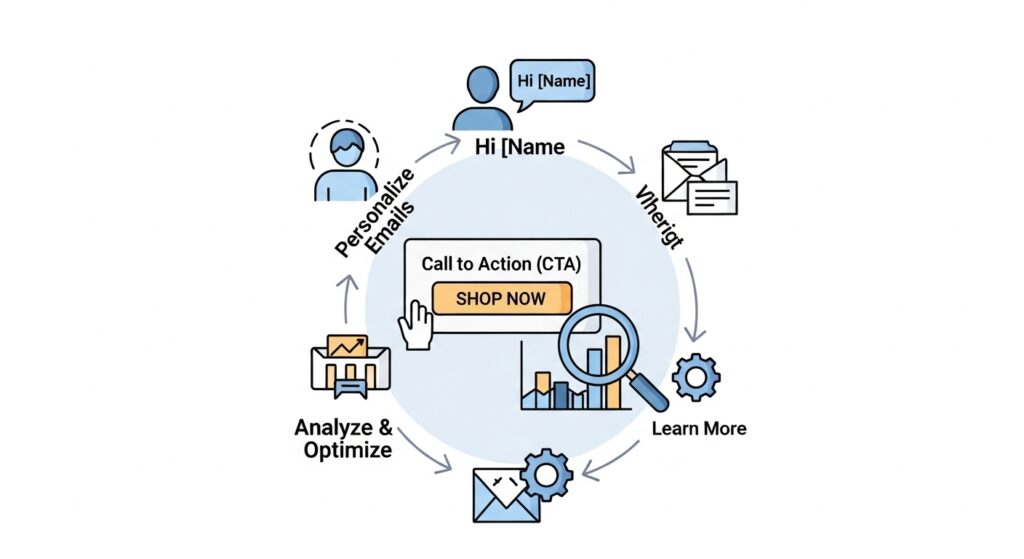
The automated sequences covered in this guide — the welcome sequence that converts new subscribers into engaged prospects, the abandoned cart sequence that recovers lost revenue opportunities, the post-purchase sequence that transforms one-time buyers into loyal repeat customers, and the re-engagement sequence that maintains the health and effectiveness of your growing list, form a complete email marketing automation framework that addresses every stage of the customer lifecycle.
The bakery owner whose midweek foot traffic increased by approximately 23 percent did not achieve that result through marketing genius or substantial budget. She achieved it by establishing a direct, reliable communication channel with people who already loved her products and building automated systems that delivered the right message to the right person at the right moment, consistently, professionally, and without requiring her ongoing personal attention for every send.
That same infrastructure, built with the accessible, affordable tools described in this guide, is available to any business with a genuine product or service and the commitment to communicate about it honestly, consistently, and with genuine value for the people receiving the communication.
The most important first step is simply beginning. Choose a platform, create your first opt-in form, and write your first welcome email. Everything else follows from there.
Which of the four automated sequences covered in this guide are you most excited to build first, and do you currently have any email marketing automation in place that is already driving measurable revenue growth for your business? Share your experience and your questions in the comments below. Whether you are building your first automated sequence or optimizing an existing program, this community of business owners grows faster by learning from each other’s real-world results.