Four years ago, my neighbor called me from a hotel room at 11 o’clock at night, her voice carrying the specific quality of controlled shock that people develop in the hours immediately following a crisis that has not yet fully registered. A kitchen fire that had started while she was putting her children to bed had spread faster than she had believed possible, and by the time the fire department arrived, a significant portion of her home’s ground floor had sustained serious damage. Nobody was hurt. The house was structurally intact. Her family was safe in a hotel, and her homeowner’s insurance policy was active and current.
She should have been in the best possible position that her circumstances allowed. She had done the responsible thing by maintaining her insurance. And yet what followed over the next three months was one of the most exhausting, most frustrating, and most financially damaging experiences of her adult life, not because of the fire itself, but because of what the fire revealed about the gap between having insurance and being prepared to use it effectively.
When her insurance adjuster asked her to document the contents of the damaged rooms, she had almost nothing to work with. She could remember the furniture. She could name the appliances. But the specific model numbers that would determine replacement value rather than depreciated value? The receipts for the kitchen equipment she had accumulated over a decade of cooking as a genuine hobby? The documentation for the jewelry her mother had given her that was stored in a cabinet in the damaged area? The records for the electronics, the children’s musical instruments, the collection of cookbooks she had spent years assembling? Gone, damaged, or simply never recorded in the first place.
The settlement she eventually received was legitimate, carefully calculated by a professional adjuster doing their job correctly, and significantly lower than the actual replacement cost of what she had lost, because without documentation, the burden of proof falls on the policyholder, and without proof, claims default to conservative estimates that protect the insurer rather than generous ones that protect the insured.
She told me afterward that the difference between what she received and what she estimated she had actually lost was enough to have paid for a proper home inventory several times over. The documentation process she had never gotten around to would have taken her a single afternoon. The financial consequence of not having done it cost her thousands of dollars and three months of stressful, adversarial negotiation with a company she had been a loyal customer of for eleven years.
In this guide, you will learn exactly how to create a comprehensive home asset documentation system that ensures you are prepared to file a fast, complete, and maximally supported insurance claim if you ever need to, the specific methods and tools that make the process efficient and the documentation compelling, and the ongoing maintenance habits that keep your documentation current as your household assets change over time. This is the guide my neighbor wishes someone had given her before the fire, not after it.
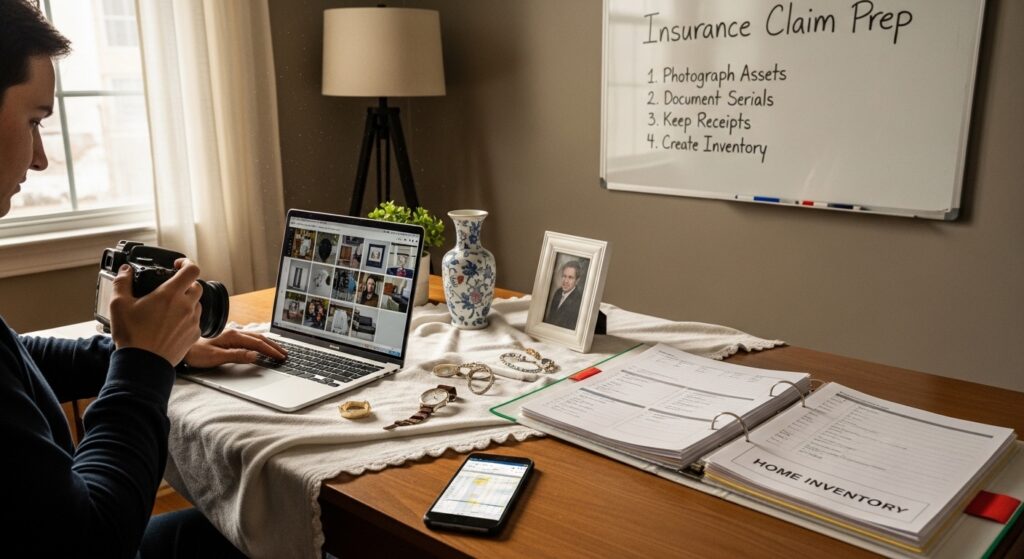
Why Most Homeowners Are Significantly Underprotected Despite Having Insurance
Before we get into the specific documentation process, it is worth understanding precisely why the gap between having a homeowner’s or renter’s insurance policy and being genuinely protected by that policy is so wide for so many people, and why documentation is the bridge that closes it.
The Burden of Proof Falls on the Policyholder
One of the most important and most consistently misunderstood aspects of homeowner’s and renter’s insurance is that the legal and evidentiary burden in a contents claim falls on the policyholder rather than on the insurer. You must prove what you owned, what it was worth, and that it was damaged or destroyed by the covered event. The insurer does not have an independent obligation to assume you owned what you claim to have owned or that the items were worth what you say they were worth.
This means that a policyholder who cannot document their possessions is not simply in a weak negotiating position. They are in a position where the insurer is both legally and practically entitled to pay only what the policyholder can demonstrate they are owed, and demonstration requires documentation that most people have never created.
Replacement Cost Versus Actual Cash Value
Most homeowner’s policies offer a choice between replacement cost coverage and actual cash value coverage, and the documentation requirements differ significantly between them in ways that affect how thoroughly you need to document your assets.
Replacement cost coverage pays what it would cost to replace a damaged item with a new equivalent today, regardless of the age or condition of the original. A five-year-old television covered under a replacement cost policy would be reimbursed at the current retail price of an equivalent model, not the depreciated value of the original purchase.
Actual cash value coverage pays the replacement cost minus depreciation, meaning a five-year-old television would be reimbursed at its current market value as a five-year-old television, which is typically a fraction of its original purchase price and a fraction of its replacement cost.
Understanding which coverage type your policy provides, and documenting your assets accordingly, is one of the most important preparatory steps in the home documentation process. If you have replacement cost coverage, you need to document the model and specifications of items precisely enough that an adjuster can identify an appropriate replacement. If you have actual cash value coverage, you need to document original purchase prices and dates to establish the depreciation calculation baseline.
The Coverage Limits and Scheduled Items Problem
Most homeowner’s policies include sub-limits for specific categories of high-value items, jewelry, fine art, collectibles, musical instruments, fur, silverware, and firearms being the most common categories with specific sub-limits that are typically far below the actual value of the items in those categories that many households own.
A homeowner’s policy with a jewelry sub-limit of 1,500 dollars will only reimburse 1,500 dollars for jewelry losses regardless of how much jewelry the policyholder owned, how well documented that jewelry is, or how clearly the loss is established. Items that exceed their category sub-limit require scheduled personal property endorsements, separate specific coverage additions to the base policy that cover individual high-value items at their appraised value.
Many homeowners discover their policy’s sub-limits only at the moment of a claim, which is the worst possible moment to discover that the jewelry collection accumulated over a lifetime is covered for 1,500 dollars regardless of its actual value. The documentation process described in this guide includes identifying items that may require scheduled coverage and prompting the insurance conversation that addresses sub-limit gaps before a claim makes them financially consequential.
Step 1, Conduct a Room-by-Room Video Walkthrough
The single most impactful and most time-efficient home documentation method available to any homeowner or renter is a systematic, narrated video walkthrough of every room and storage area in the home, conducted with the deliberate purpose of creating a visual record of everything the home contains.
How to Conduct an Effective Documentation Walkthrough
A documentation walkthrough is fundamentally different from the casual video tours that most people occasionally film to share with family or to capture a home for their own memory. Its purpose is evidentiary rather than aesthetic, and its effectiveness depends on the systematic thoroughness and specific narration that evidence-quality documentation requires.
Begin with a fully charged smartphone, a modern camera that records at the highest resolution available to you, or both. Start at the front entrance of your home and work through every room in a consistent, methodical order, ensuring that no room, closet, storage area, garage, basement, attic, or outdoor structure is skipped. The most common and most consequential documentation gap in homeowner inventories is the storage areas, basements, attics, and garages where high-value items are frequently stored but rarely inventoried.
In each room, begin with a wide-angle shot that captures the full space and its general contents. Then systematically capture close-up footage of individual items, groups of related items, and any item that has significant individual value. As you film, narrate specifically and audibly. Do not simply move the camera across the room in silence. Describe what you are filming, including the brand and visible model information of electronics and appliances, the approximate quantity of items in groupings like bookshelves or clothing collections, and any specific information you know about high-value individual items.
Open drawers, closet doors, cabinet fronts, and storage containers as part of the walkthrough. The contents of drawers and cabinets, kitchen equipment, tools, clothing, linens, and personal care items, are among the most frequently underdocumented categories in home inventories precisely because they are out of sight during a casual visual survey and require the deliberate effort of opening storage to be captured.
What to Narrate During the Walkthrough
Your narration during the video walkthrough transforms the footage from a visual record into a comprehensive documented record. For each significant item or category of items you film, state the following information aloud as you film it: the item or category name, the brand and model if visible, an approximate quantity if filming a group of items, your best estimate of the item’s approximate value or original purchase price if known, and any specific relevant information about the item’s condition, provenance, or replacement specification.
“This is the living room television. It is a Samsung 65-inch QLED, model QN65Q80B, purchased approximately two years ago for around 1,100 dollars. The serial number is visible on the back panel.” is the kind of narration that transforms a video frame into a documentable asset record. “And here is the TV” is the kind of narration that creates a visual record with no evidentiary value beyond confirming the item’s existence.
Step 2, Create a Written Home Inventory Spreadsheet
The video walkthrough creates a visual record that is compelling, comprehensive, and immediately producible in the event of a claim. It should be complemented by a written inventory that organizes the same information in a structured, searchable, and easily updated format that an adjuster can work with systematically.
How to Structure Your Home Inventory Spreadsheet
A practical home inventory spreadsheet organizes your assets into rows representing individual items or categories of items and columns representing the key information fields that an insurance claim requires. The most useful column structure for a home inventory includes the item name and description, the category or room location, the brand and model number where applicable, the serial number where applicable and accessible, the approximate purchase date, the original purchase price, the current estimated replacement value, the documentation reference linking to the relevant video footage or photograph, and a notes field for additional relevant information.
Google Sheets provides an ideal platform for this inventory because it is accessible from any device, automatically saved and backed up to the cloud, shareable with your insurance agent and with a trusted person outside your household, and searchable and sortable in ways that a paper record cannot match. A pre-formatted home inventory template is available in the Google Sheets template gallery and provides a ready-to-use structure that requires only populating rather than building from scratch.
Microsoft Excel and Apple Numbers are equally capable alternatives for users who prefer those platforms, with the critical requirement that the completed spreadsheet is saved to cloud storage, either OneDrive for Excel or iCloud for Numbers, rather than stored only on a local hard drive that could be damaged or destroyed in the same event that damages your home contents.
High-Value Item Documentation in the Spreadsheet
For items of significant individual value, the written inventory should include more detailed documentation than the video walkthrough alone can provide. Jewelry, artwork, collectibles, musical instruments, antiques, and other items whose value depends on specific provenance, condition, or authenticity should be documented in the spreadsheet with the additional supporting information that establishes their value more precisely.
For jewelry and watches, this includes the metal type and weight, the gemstone specifications if applicable, and ideally the appraiser’s reference number if a formal appraisal has been conducted. For artwork, it includes the artist, title, medium, dimensions, and provenance information. For collectibles and antiques, it includes any relevant authentication documentation, auction records, or dealer appraisals that establish current market value.
Step 3, Photograph High-Value Items and Their Documentation
While video footage provides a comprehensive visual record of the home’s contents in their context, high-resolution still photographs serve a specific and complementary documentation purpose for individual items of significant value, providing the image quality and detail necessary for precise identification and condition assessment.
How to Photograph Items Effectively for Documentation
Photograph high-value items against a plain, neutral background, ideally a white or light gray surface, using the highest resolution available on your camera or smartphone. Capture multiple angles of each item, a front view, a back view, and any sides that display identifying features, condition details, or manufacturer markings.
For electronics, include a specific photograph of the label showing the serial number and model number, positioned clearly enough in the frame that the text is legible. For jewelry, capture a macro photograph that shows the quality and condition of the piece clearly, and if the piece has hallmarks or maker’s marks, photograph those specifically. For artwork, photograph the front of the work, the back showing any stamps, labels, or identifying marks, and include a scale reference, a ruler or a common object, that establishes the work’s dimensions in the photograph.
For items that have associated physical documentation, purchase receipts, warranty documents, appraisal certificates, authenticity certificates, and manufacturer’s certificates of authenticity, photograph or scan those documents and store the digital copies in the same organized folder system as your item photographs. A photograph of a valuable watch accompanied by a photograph of its original purchase receipt and its service record is a documentation package that an adjuster can work with confidently and completely.
Organizing Your Photo Documentation
Organize your documentation photographs in a folder structure that mirrors your written inventory and your video walkthrough, organized by room or category, with individual item folders for anything of significant individual value. Name your files descriptively rather than accepting the default camera-assigned filenames, which convey no information about the content they contain.
“Living Room, Samsung 65-inch TV, Front.jpg” and “Living Room, Samsung 65-inch TV, Serial Number.jpg” are immediately identifiable and locatable files. “IMG_4857.jpg” and “IMG_4858.jpg” are files that require opening to determine their content and that will require significant organizational effort to use effectively at the time of a claim.
Step 4, Document High-Value Items With Professional Appraisals
For items whose value exceeds the sub-limits in your standard homeowner’s policy or whose value is difficult to establish through purchase records and market comparisons alone, professional appraisals provide the independent, authoritative valuation documentation that both supports a scheduled personal property endorsement and provides the strongest available evidence of value in a claim.
When Professional Appraisal Is Necessary
Professional appraisal is most important for jewelry and watches, fine art, antiques and period furniture, collectibles including coins, stamps, wine, and memorabilia, musical instruments of professional quality, furs, and any item whose value is primarily determined by factors that a layperson cannot reliably assess independently.
A certified appraisal from a qualified professional provides two specific benefits that self-documentation cannot replicate. First, it establishes the item’s value through an independent, credentialed assessment that an insurer cannot reasonably dispute as self-serving. Second, it establishes the value at a specific point in time with specific reference to the current market, which is relevant both for setting the insured value accurately and for establishing the replacement cost basis in the event of a claim.
The American Society of Appraisers, the Appraisers Association of America, and the International Society of Appraisers all maintain directories of credentialed appraisers by specialty and location, allowing you to identify a qualified professional for the specific category of items you need appraised.
Scheduling Appraised Items on Your Policy
Once you have professional appraisals for high-value items, contact your insurance agent to discuss adding scheduled personal property endorsements for those items to your policy. A scheduled endorsement covers the specific appraised item at its specific appraised value, replacing the standard sub-limit that would otherwise cap your reimbursement regardless of the item’s actual worth.
The cost of scheduled endorsements is typically modest relative to the coverage they provide, often a few dollars per hundred dollars of covered value annually, and the protection they offer against the sub-limit gap is significant for households that own jewelry, art, instruments, or collectibles of meaningful value.
Appraisals for scheduled items should be updated every three to five years for most categories, more frequently for items in rapidly appreciating categories like fine art and rare collectibles, to ensure the scheduled coverage accurately reflects current market values rather than potentially outdated valuations.
Step 5, Store Your Documentation Safely Outside Your Home
A home documentation system that is stored only within the home it documents provides no protection against the scenario where the home documentation is damaged or destroyed in the same event that triggers the insurance claim. Fire, flood, storm damage, and theft can all destroy physical records and local digital storage simultaneously with the assets those records document.
The Essential Principle of Off-Site Storage
Every component of your home documentation system, the video walkthrough footage, the written inventory spreadsheet, the item photographs, the scanned receipts and appraisal documents, and any physical records, must be stored in at least one location that is geographically separate from your home and that would survive any event that damages your home.
This principle is simple and its necessity is obvious once stated, yet a significant proportion of homeowners who create documentation store it exclusively on a computer that lives in the home, a portable hard drive kept in a home office drawer, or a physical binder in a closet, all of which are equally vulnerable to the events most likely to trigger a homeowner’s claim.
Cloud Storage as Your Primary Off-Site Solution
Cloud storage platforms are the most practical, most accessible, and most reliably off-site storage solution for digital home documentation. Storing your complete documentation package in a dedicated folder on Google Drive, Microsoft OneDrive, or Apple iCloud ensures that it is accessible from any device with your account credentials, geographically distributed across multiple data centers that are effectively immune to the localized events that damage individual homes, and automatically synchronized whenever you update the documentation.
Create a dedicated folder within your chosen cloud storage platform titled “Home Insurance Documentation” or equivalent, organized with clearly named subfolders for the video walkthrough, the written inventory, the item photographs, and the scanned documents. Ensure that the folder is accessible to at least one trusted person outside your household, a spouse or partner’s separate account, a trusted family member, or your insurance agent, so that it remains accessible even if your personal access credentials are somehow compromised in the same event.
Physical Off-Site Storage for Original Documents
Original physical documents, purchase receipts, appraisal certificates, authentication documents, and warranty cards, are best stored in a fireproof and waterproof home safe for the copies you keep at home, and in a safe deposit box at your bank for originals of the most critical high-value item documentation.
A bank safe deposit box is accessible only to its authorized signatories, protected by the bank’s physical security infrastructure, and located off-site from your home by definition. For original professional appraisals, original certificates of authenticity for valuable collectibles, and original purchase documentation for the highest-value individual items in your household, this level of physical protection provides a backup to digital cloud storage that addresses the edge cases where digital access alone might be insufficient.
Step 6, Maintain and Update Your Documentation Regularly
A home inventory created once and never updated is a documentation system that becomes progressively less accurate as your household assets change through purchases, sales, gifts, and natural lifecycle transitions. A documentation system that is genuinely useful at claim time is one that reflects your actual assets at the time of the claim, not your assets at some point in the past when you initially created the inventory.
Building Documentation Into Your Purchase Habits
The most sustainable approach to keeping your home inventory current is building brief documentation into your habits around significant purchases rather than relying on periodic wholesale inventory reviews to catch everything that has changed.
When you bring a significant new item into your home, make a habit of photographing it immediately, recording its details in your inventory spreadsheet while the purchase information is immediately available to you, and storing any associated receipt or documentation in your cloud storage folder. A habit that takes five minutes per significant purchase requires no dedicated review sessions to maintain and produces a continuously current inventory as a byproduct of normal purchasing behavior.
The definition of “significant” for documentation purposes depends on your policy’s coverage structure and your own judgment about what would be meaningful in a claim. A reasonable general threshold is any item purchased for 100 dollars or more, any item with meaningful sentimental value beyond its monetary worth, and any item in a category with specific policy sub-limits regardless of individual value.
Annual Documentation Review
In addition to the purchase-triggered documentation habits described above, an annual home inventory review conducted at a consistent time each year, perhaps when you review your insurance policy at renewal time, ensures that categories of gradual accumulation are captured that purchase-by-purchase documentation might miss.
Clothing collections, book libraries, hobby-related equipment, tools and garden equipment, and kitchen goods accumulated through small purchases over time are all categories where annual review tends to surface meaningful underdocumentation that purchase-triggered habits do not fully address. Walking through your home once a year with the specific purpose of comparing what you see against your existing inventory, and updating the record for anything that has changed, keeps the inventory genuine and comprehensive rather than a snapshot of a past moment.
After Life Changes That Affect Your Assets
Several life events reliably produce significant changes to household assets that warrant a specific, targeted documentation update beyond the regular annual review. These include marriage, which combines two households’ worth of assets, inheritance, which adds potentially high-value items whose provenance and value may require specific documentation, major renovation or home improvement projects, which add significant value to the structure itself and often introduce new fixtures and equipment, significant gift-giving occasions like milestone birthdays and significant wedding anniversaries, and the acquisition of hobby-related collections that can accumulate substantial value over time without triggering the purchase-by-purchase documentation habit for individual items of modest individual value.
After each of these life events, take the additional time needed to bring your documentation current for the specific categories affected by the change, and review your insurance coverage with your agent to ensure that your policy limits and scheduled items reflect your current asset picture accurately.
Common Home Documentation Mistakes to Avoid
Even motivated and organized homeowners consistently make these errors that undermine the effectiveness of their documentation in a claim:
Documenting the obvious and forgetting the less visible. Most homeowners who create a home inventory document the major furniture, electronics, and appliances that are immediately visible in a room’s general survey and forget the contents of drawers, closets, cabinets, and storage areas that contain items whose cumulative value is often equal to or greater than the visible room contents. Kitchen equipment, clothing and shoes, linens, tools, hobby supplies, children’s toys and equipment, and personal care items collectively represent thousands of dollars in most households and are routinely omitted from informal inventories.
Storing documentation exclusively within the home. A home inventory stored on a laptop in the home office, on a flash drive in a desk drawer, or in a physical binder in a closet provides no protection when the event that triggers the claim is also the event that destroys the documentation. Off-site cloud storage is not optional for a home documentation system to be reliably available when needed.
Never updating the inventory after the initial creation. A three-year-old inventory that pre-dates a kitchen renovation, the acquisition of a valuable hobby collection, and several years of gift-receiving is not a useful claim document. It is a historical record of a household that no longer exists in the form it describes. Regular maintenance is the difference between a documentation system and a documentation artifact.
Failing to review coverage limits alongside documentation. Creating a thorough inventory and then discovering at claim time that your policy sub-limits cap reimbursement for your jewelry collection at 1,500 dollars when the collection is worth 12,000 dollars is a documentation success and an insurance planning failure. The documentation process should prompt a coverage conversation with your insurance agent that ensures your policy actually covers what your documentation reveals you own.
Not sharing the documentation with anyone outside the household. A home inventory that only you know how to access and that is stored only in accounts that only you can sign into provides limited protection in scenarios where you are incapacitated, displaced, or otherwise unable to access your own accounts immediately following a significant loss event. Sharing your documentation with a trusted person outside the household, your insurance agent, or a family member with a standing instruction to access it in an emergency, ensures availability at the moments when it is most urgently needed.
Conclusion and Final Thoughts
My neighbor’s experience following her kitchen fire was not unusual. It was, in fact, the experience of the majority of homeowners who file significant contents claims without prior documentation, the experience of discovering that insurance is a financial tool whose effectiveness depends entirely on the preparation of the person using it.
The gap between having insurance and being genuinely protected by insurance is closed by documentation, and documentation is among the most accessible, most affordable, and most consistently postponed protective actions available to any homeowner or renter. It requires no specialized knowledge, no expensive professional assistance for most of its components, and no more than a single afternoon of focused effort to create an initial comprehensive record.
The six steps covered in this guide, conducting a room-by-room video walkthrough, creating a written inventory spreadsheet, photographing high-value items and their documentation, securing professional appraisals for items exceeding sub-limits, storing all documentation safely off-site, and maintaining the inventory with regular updates, form a complete and immediately applicable framework for transforming your insurance coverage from a theoretical financial protection into a practically effective one.
My neighbor rebuilt her home, replaced most of what she lost, and rebuilt her financial stability. It took longer, cost more, and required more sustained effort than it would have with proper documentation. She now has the most comprehensive home inventory I have ever seen, created in the weeks immediately after her claim was settled, when the motivation to document was at its peak.
The best time to create yours is before you need it.
Have you ever filed an insurance claim and discovered the hard way that your documentation was insufficient, or have you already created a home inventory that you are confident would support a fast and complete claim? Share your experience in the comments below. Whether you are starting your documentation from scratch today or looking to strengthen a system you already have, your perspective could be exactly the motivation another homeowner needs to finally take this important protective step.