About eighteen months ago, a conversation I had with a hiring manager at a mid-sized technology company stopped me in a way that professional conversations rarely do. She had been describing the difficulty her organization was having filling a specific category of open roles, and I had assumed, given that she worked in technology, that she was about to describe a shortage of software engineers or data scientists.
She was not. She was describing a shortage of people who could think clearly about what artificial intelligence tools should be asked to do, evaluate whether they had done it well, communicate the results to non-technical stakeholders, and make sound strategic decisions about where AI capability should and should not be applied in a business context. She had plenty of applicants who could write code. She had almost no applicants who could do those other things with the combination of technical literacy, strategic clarity, and human communication capability that the roles required.
“The coding part,” she told me, “we can train in six weeks. The thinking part takes years, and right now almost nobody has done that thinking with AI specifically.”
That conversation reflected something I had been observing from multiple directions over the preceding year, a genuine and accelerating shift in which digital skills create professional value, driven by the increasing capability of AI tools to perform tasks that previously required specialized human technical training. Basic coding, meaning the ability to write functional scripts and simple programs in common languages, has moved from a differentiating professional skill toward a commodity capability that AI coding assistants can largely replicate, augment, or in many cases replace entirely.
This shift is not a reason for alarm for people who have invested in technical skills. It is, however, a significant and important signal about where professional development energy and investment should be directed in 2026, and about which capabilities are becoming more valuable precisely because AI is making others more abundant.
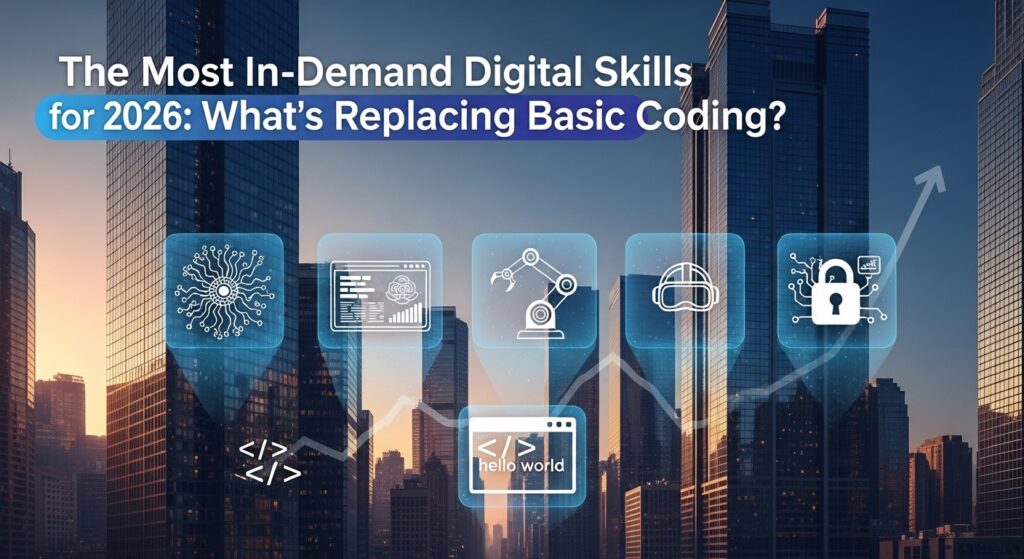
In this guide, you will learn the specific digital skills that the 2026 job market is rewarding most significantly, the capabilities that are genuinely replacing basic coding as differentiating professional assets, the specific platforms and learning paths through which each skill can be developed, and the strategic framework for thinking about your own digital skill development in a rapidly evolving landscape where the skills that create value are changing faster than at any previous point in professional history.
Why Basic Coding Is No Longer the Differentiating Skill It Once Was
Understanding why basic coding has been displaced as a differentiating professional asset requires understanding what happened to the task of writing code when AI coding assistants became genuinely capable.
What AI Has Done to the Economics of Basic Code Writing
For most of the past three decades, the ability to write functional code in languages like Python, JavaScript, HTML, or SQL represented a meaningful professional barrier. Learning to code took time, required cognitive effort, and produced a capability that most people did not have. That relative scarcity created professional value for those who possessed it.
AI coding assistants like GitHub Copilot, Cursor, and Claude have fundamentally changed this equation by making functional code generation accessible to anyone who can describe what they want a program to do in natural language. A marketing analyst who could not previously write a line of Python can now generate functional data analysis scripts by describing the analysis in plain English and iterating on the AI’s output. A small business owner who could not build a web form can now produce functional HTML and JavaScript by describing the form’s requirements to an AI tool and reviewing the result.
This does not mean that skilled software engineers have become less valuable. Senior engineers with deep systems understanding, architectural judgment, and the ability to build complex, scalable software are more valuable than ever, because their ability to direct, evaluate, and build upon AI-generated code amplifies their output dramatically. What it does mean is that the entry-level capability of writing basic functional code has been substantially democratized, reducing the professional premium it commands and shifting the skills gap to higher-order capabilities that AI assistance cannot yet replicate.
The New Skills Gap
The hiring manager’s observation reflects a dynamic that labor market data across the technology, finance, healthcare, marketing, and professional services sectors is increasingly confirming. The skills that are hardest to hire for in 2026 are not basic technical execution skills. They are the judgment-intensive, communication-intensive, and strategy-intensive capabilities that determine what technology should be built, how it should be deployed, whether it is working as intended, and how its outputs should be acted upon.
These are the skills this guide addresses.
Skill 1, AI Literacy and Prompt Engineering
The most universally in-demand digital skill of 2026, cutting across industries, organizational functions, and professional levels, is the ability to use AI tools effectively, which means understanding their capabilities and limitations well enough to direct them productively, evaluate their outputs critically, and integrate them into professional workflows in ways that genuinely improve outcomes rather than simply automating mediocrity.
What AI Literacy Actually Means in Practice
AI literacy is not a single defined skill. It is a cluster of related capabilities that together determine how much professional value a person extracts from the AI tools that are increasingly embedded in every professional context.
The most important component is critical output evaluation, the ability to assess whether an AI-generated response, analysis, piece of content, or code is accurate, appropriate, complete, and fit for the specific purpose it was generated for. AI tools produce outputs that are frequently plausible-sounding but subtly or significantly wrong, and the professional who cannot tell the difference between a correct AI output and a convincing but incorrect one is not using AI as a productivity tool. They are using it as a liability generator.
The second most important component is effective prompt engineering, the skill of formulating requests to AI tools in ways that produce the highest-quality, most useful outputs. This is not a simple or trivial capability. The difference between a prompt that produces a generic, low-value AI response and a prompt that produces a specific, nuanced, immediately applicable one is typically a function of how precisely the requester has defined the task, the context, the constraints, the format, and the success criteria for the output.
Workflow integration judgment, the ability to identify which tasks in a professional workflow benefit from AI augmentation and which require unassisted human judgment, is the third critical component. Every professional workflow contains tasks that AI accelerates dramatically and tasks where AI involvement reduces quality, introduces risk, or eliminates the specifically human value that the work is supposed to deliver. The professional who can identify the appropriate boundary between these categories creates significantly more value from the same AI tools than one who applies them indiscriminately.
How to Develop AI Literacy
Anthropic’s Claude, OpenAI’s ChatGPT, Google’s Gemini, and Microsoft Copilot are the primary general-purpose AI platforms through which AI literacy is most directly developed, and the most effective development path is sustained, intentional, critical daily use rather than occasional exploratory interaction.
Use AI tools for your actual professional tasks, not for fabricated exercises. Develop the habit of evaluating every AI output critically before using it, asking specifically whether it is accurate, whether it is complete, whether it reflects the specific context and constraints of your situation, and whether it would actually serve the purpose for which you generated it. Document the prompt approaches that produce the most useful results for your specific use cases and build a personal library of effective prompt structures for the professional contexts most relevant to your work.
DeepLearning.AI offers a widely respected prompt engineering course that provides a structured framework for understanding how to formulate effective prompts across different AI platforms and use cases. Coursera’s AI literacy specializations and LinkedIn Learning’s AI productivity courses provide structured introductions to AI tool integration for professionals approaching the topic from a business and productivity rather than a technical development perspective.
Skill 2, Data Literacy and Analytics Interpretation
The second most universally in-demand digital skill of 2026 is data literacy, the ability to read, interpret, and draw sound, actionable conclusions from data and data visualizations, without necessarily being a data scientist or statistical analyst.
The Difference Between Data Science and Data Literacy
Data science is a specialized technical field involving statistical modeling, machine learning, and the development of the analytical systems that produce data insights. It is a valuable and well-compensated specialization.
Data literacy is a much more broadly applicable professional capability, the ability to understand what data is showing you, to recognize when data is being used to support misleading conclusions, to ask the right questions of data to surface the information most relevant to a specific decision, and to communicate data-based insights to stakeholders who may have even less data familiarity.
In 2026, virtually every professional role that involves any form of organizational decision-making, from marketing management to product development to operations to finance, requires data literacy as a baseline competency. The professional who cannot read a performance dashboard, cannot recognize when a metric is being cherry-picked to support a predetermined conclusion, and cannot translate data patterns into strategic recommendations is operating at a significant disadvantage relative to peers who can do all three.
The Tools That Define Professional Data Literacy in 2026
Microsoft Power BI and Google Looker Studio, both offering free tiers with professional-grade analytical capability, are the most widely used business analytics and data visualization platforms in organizational settings, and familiarity with one or both is increasingly a stated requirement in job descriptions across industries well beyond the technology sector.
Google Analytics 4 is specifically essential for any professional with marketing, e-commerce, or digital content responsibilities, providing the web analytics capability that is foundational to data-informed digital marketing practice.
Excel and Google Sheets with their increasingly sophisticated data analysis features, including Power Query in Excel and the growing suite of AI-assisted analysis tools in Google Sheets, remain the most universally used data analysis tools in professional settings and the foundation of practical data literacy for the majority of non-specialist knowledge workers.
Tableau Public, the free version of the industry-leading data visualization platform, provides both a learning environment for developing visualization skills and a portfolio-building platform for demonstrating those skills to potential employers.
Developing Data Literacy
Google’s Data Analytics Professional Certificate on Coursera is one of the most widely recognized and most accessible structured paths to foundational data literacy development, covering data analysis, visualization, and the use of key tools including Sheets, SQL, and Tableau across a program completable in approximately six months of part-time study.
Khan Academy’s statistics courses provide the conceptual foundation in statistical thinking that makes data interpretation genuinely rigorous rather than superficially numerical. Understanding the difference between correlation and causation, recognizing selection bias, and interpreting confidence intervals are the kind of statistical literacy fundamentals that separate professionals who truly understand what data is telling them from those who can read charts but cannot assess their validity.
Skill 3, AI Augmented Content Creation and Strategy
Content creation has been one of the most visibly transformed professional domains by AI capability, and the transformation has produced a counterintuitive skills shift. Basic content production, the ability to produce adequate written content, social media posts, email drafts, and similar outputs at adequate quality, has been substantially democratized by AI writing tools. At the same time, the ability to develop genuine content strategy, to direct AI tools toward producing content of genuinely distinctive quality, and to apply the human editorial judgment that separates compelling content from competent content, has become significantly more valuable.
What the Market Is Actually Paying For
The content professionals commanding the highest compensation and the most interesting opportunities in 2026 are not those who can write fastest or produce the highest volume of adequate content. They are those who can develop a coherent content strategy aligned with specific business objectives, who can direct AI tools to produce drafts that serve that strategy, and who can apply the editorial judgment, authentic voice, and genuine subject matter expertise that elevates AI-assisted content from generically acceptable to specifically compelling.
This combination of strategic thinking, AI tool proficiency, editorial judgment, and subject matter depth is genuinely rare and genuinely valuable, precisely because most content professionals have developed either the human craft elements or the AI tool proficiency but not the integrated capability to use AI as a genuine force multiplier for high-quality strategic content rather than as a replacement for thinking about content at all.
SEO and content strategy capabilities are specifically in high demand, because the proliferation of AI-generated content has made the algorithmic and human differentiation of genuinely valuable content from competent but generic content more important than at any previous point in the history of digital marketing.
Tools and Learning Paths for AI-Augmented Content
HubSpot Academy offers free certifications in content marketing strategy and SEO that are widely recognized and that provide a structured foundation in the strategic dimensions of content that technical AI tools cannot replace.
Semrush Academy provides accessible, free training in SEO and content strategy tools that are among the most widely used in professional digital marketing practice.
Coursera’s Digital Marketing Specialization from the University of Illinois covers the strategic, analytical, and content dimensions of digital marketing in an integrated framework that reflects the actual professional competency required in senior digital marketing roles.
Skill 4, Cybersecurity Awareness and Digital Risk Management
As the professional and organizational dependence on digital systems has grown, and as the sophistication and frequency of cybersecurity threats has accelerated in parallel, cybersecurity literacy has moved from a specialist domain into a broadly expected professional competency across organizational roles that have no cybersecurity function in their job description.
Why Cybersecurity Awareness Is a Universal Professional Skill in 2026
The majority of significant organizational cybersecurity failures are not the result of technical system vulnerabilities that a security engineer failed to patch. They are the result of human behavior, employees clicking phishing links, using weak passwords, inadvertently sharing sensitive data in insecure channels, or falling victim to social engineering attacks that exploit trust rather than technical vulnerabilities.
This means that cybersecurity literacy, understanding the specific behaviors that create organizational risk and the specific practices that reduce it, is a professional responsibility that extends to every person in every organization who uses digital systems, which in 2026 means virtually every professional in every industry.
Beyond the defensive awareness dimension, organizations are increasingly seeking professionals who can evaluate the digital risk implications of business decisions, vendor relationships, and technology adoptions, a capability that sits at the intersection of cybersecurity understanding and business judgment and that is genuinely scarce among professionals without a dedicated security background.
Developing Cybersecurity Literacy
Google’s Cybersecurity Professional Certificate on Coursera provides a structured, accessible path to foundational cybersecurity knowledge that is specifically designed for professionals approaching the topic from a general rather than technical background.
CompTIA Security+ is the most widely recognized entry-level cybersecurity certification for professionals who want to demonstrate a meaningful level of cybersecurity competency to employers, and its preparation pathway is well-served by numerous accessible online courses through platforms including Udemy and LinkedIn Learning.
SANS Institute and ISC2 offer more advanced cybersecurity education and certification pathways for professionals who want to develop deeper cybersecurity capability for specialized roles.
Skill 5, UX Thinking and Human Centered Design
The fifth most in-demand digital skill of 2026 is the ability to think about technology products and digital experiences from the perspective of the human being using them, to identify the friction, confusion, and unmet needs that technical teams focused on functionality and feasibility routinely overlook, and to translate user research and empathetic observation into design decisions that make digital products genuinely usable rather than merely technically functional.
Why UX Thinking Has Become a Cross-Functional Professional Asset
User experience design was, for most of the history of digital product development, a specialized discipline practiced by dedicated designers who occupied a specific role in a product team. In 2026, the principles and practices of UX thinking are increasingly expected across a much wider range of professional roles, because the proliferation of AI-powered product features and the increasing sophistication of user expectations have made the ability to think empathetically about product experience a broadly valuable judgment capability rather than a narrowly specialized technical discipline.
Product managers, marketing professionals, business analysts, operations managers designing internal digital workflows, and professionals in any role that involves decisions about how people interact with digital systems benefit significantly from UX thinking capability, even without the specific craft skills of visual design or interaction design.
The most valuable component of UX thinking for non-specialist professionals is user research methodology, the ability to design and conduct the interviews, usability tests, and observational research that reveal how real users actually experience a product or process rather than how its designers imagine they experience it. This capability directly addresses one of the most consistent and most expensive failure modes in technology development, building products based on what engineers and executives believe users want rather than what careful observation of actual user behavior reveals.
Tools and Learning Paths for UX Development
Google’s UX Design Professional Certificate on Coursera is the most widely recognized accessible entry point to UX design capability, covering the core research, prototyping, and design principles through a portfolio-building curriculum that produces demonstrable skills alongside conceptual knowledge.
Figma has become the dominant professional tool for digital product design and prototyping, and Figma’s own free educational resources, alongside the extensive community tutorials available on YouTube and the Figma community platform, provide a practical skills development pathway for professionals who want to develop hands-on design and prototyping capability alongside the conceptual UX framework.
Nielsen Norman Group provides the most widely respected UX research and practice resources available, including free articles and reports on UX research methodology, design patterns, and user psychology that represent professional-grade reference material for practitioners at all levels.
Skill 6, Digital Project Management and Agile Methodology
The sixth in-demand digital skill category of 2026 is the ability to manage digital projects and cross-functional technology initiatives, combining the process discipline of structured project management with the adaptive, iterative practices of agile methodology that modern technology development requires.
Why Digital Project Management Is a Differentiating Skill
The specific challenge of managing digital projects, whether software development, data initiatives, digital marketing campaigns, or technology implementations, is that they involve the coordination of technical and non-technical contributors, the management of uncertainty and requirement change that is inherent to digital work, and the translation between technical realities and organizational priorities that pure project administration skills do not address.
Professionals who can manage digital projects effectively, maintaining momentum through technical uncertainty, communicating progress and risk accurately to non-technical stakeholders, and applying agile principles to adapt plans in response to new information without losing organizational alignment, are in consistent demand across every organizational context that involves digital initiatives.
Scrum and Kanban, the two most widely applied agile frameworks in professional settings, have become nearly universal in technology-adjacent work management, and familiarity with these frameworks is increasingly expected in project management, product management, and team leadership roles across industries.
Certifications and Learning Paths
PMI’s Project Management Professional (PMP) certification remains the most widely recognized credential in project management broadly, and its value in digital project contexts has grown as the certification has incorporated more explicit coverage of agile methodologies in recent versions.
Scrum Alliance’s Certified Scrum Master (CSM) and Scrum.org’s Professional Scrum Master (PSM) certifications are specifically valued in technology and digital product development contexts, providing recognized validation of agile methodology competency for professionals seeking to demonstrate their capability to potential employers.
Asana Academy, Monday.com University, and Atlassian’s Jira and Confluence training resources provide practical, tool-specific project management learning that is directly applicable in organizational settings where these platforms are standard practice.
Skill 7, No-Code and Low-Code Development
The seventh in-demand digital skill of 2026 is the ability to build functional digital tools, automated workflows, and simple applications using no-code and low-code platforms that do not require traditional programming knowledge but do require the kind of systematic, structured thinking about processes and data that makes the difference between a tool that works reliably and one that breaks in unpredictable ways.
The No-Code and Low-Code Revolution
No-code and low-code platforms have matured dramatically in recent years, providing the ability to build genuinely functional and genuinely useful digital tools through visual, drag-and-drop interfaces that translate business process logic into working software without the intermediation of a professional developer for the majority of common use cases.
Zapier and Make (formerly Integromat) allow the automation of complex multi-step workflows connecting dozens of business software applications through visual flow builders that require no coding. A marketing operations professional who can build a Zapier automation that routes leads from a website form through a qualification logic, adds qualified leads to a CRM, triggers a personalized email sequence, and notifies the relevant sales representative, is performing work that would previously have required developer time and now requires only no-code workflow building capability.
Webflow provides the ability to build professional-quality websites and web applications through a visual development environment that gives design-capable professionals the ability to build production-quality digital products without HTML and CSS coding knowledge.
Airtable and Notion provide the ability to build functional relational databases and operational management systems through visual interface builders that serve the majority of small and medium organizational data management needs without requiring SQL database expertise.
Power Platform from Microsoft, including Power Automate for workflow automation, Power Apps for simple application building, and Power BI for analytics dashboards, is deeply embedded in enterprise organizational contexts and represents a no-code and low-code ecosystem with enormous professional reach across the organizational landscape.
Building No-Code Skills
The most effective approach to developing no-code and low-code capability is project-based learning, identifying a specific workflow automation, tool-building, or application need in your professional context and building the solution using the appropriate no-code platform, guided by the platform’s own documentation, YouTube tutorials, and community resources.
Zapier University and Make Academy provide free structured learning paths specific to their respective platforms. Webflow University is widely regarded as one of the best learning resources for any no-code platform, providing a comprehensive free curriculum that takes learners from complete beginner to professional-level Webflow capability through structured video courses and hands-on projects.
Building Your 2026 Digital Skills Strategy
Understanding which skills are in demand is useful. Having a personal strategy for developing them in a sequence and at a pace that produces genuine professional value without creating an overwhelming development burden is more useful.
The Priority Framework for Digital Skills Investment
Not all seven skill categories deserve equal investment from every professional, and attempting to develop meaningful capability in all of them simultaneously is a strategy more likely to produce shallow familiarity with all of them than genuine competency in any of them.
The most effective personal digital skills strategy for 2026 begins with an honest assessment of your current professional context, the specific skills that are most directly relevant to the work you do and the opportunities you want to pursue, and the skill gaps that are most directly limiting your current professional contribution or career advancement.
For most professionals, the highest-priority starting point is AI literacy, because it is the most universally applicable of the seven skills and because developing it through your actual professional work rather than through structured courses means it costs primarily attention and deliberate practice rather than significant time or financial investment.
The second-priority skill development should be the category most directly adjacent to your existing professional expertise, the skill that builds on and amplifies what you already do well rather than requiring you to develop capability in a domain entirely unfamiliar to you. A marketing professional adding data literacy to existing content strategy capability creates a combined professional asset that is more valuable than either alone. An operations professional adding no-code automation capability to existing process management expertise becomes capable of implementing efficiency improvements that previously required developer resources.
Learning Platforms That Make Development Accessible
Coursera and edX offer university-affiliated structured courses and specializations across all seven skill categories, with the ability to audit courses for free and earn recognized certificates through paid enrollment.
LinkedIn Learning provides shorter, more modular skill development content that is particularly well-suited to professionals with limited time for extended course commitment and that integrates directly with LinkedIn profile skills endorsement for demonstrating newly developed capabilities.
YouTube remains one of the most valuable and most underappreciated professional development resources available, with high-quality tutorial content for virtually every tool and skill area covered in this guide available at no cost from practitioner creators who are often more current and more practically oriented than formal course content.
Udemy offers affordable, tool-specific courses with strong practical orientation and lifetime access that makes them useful as reference resources beyond the initial learning period.
Common Digital Skills Development Mistakes to Avoid
Even motivated and ambitious professionals consistently make these errors in their digital skills development efforts:
Developing familiarity instead of proficiency. Completing a course, receiving a certificate, and adding a skill to a LinkedIn profile represents familiarity with a skill domain. Employers and clients value proficiency, the demonstrated ability to apply a skill to real problems and produce genuine results. The gap between familiarity and proficiency is closed only by project-based application, and every digital skills development effort should include a concrete project that demonstrates the skill in practice, not just in assessment.
Chasing trending skills without strategic coherence. The digital skills landscape produces a continuous stream of newly trending capabilities that generate enthusiasm and then stabilize into either lasting professional value or transient hype. Developing digital skills in response to trend cycles rather than in response to a coherent personal strategy produces a fragmented skill portfolio that creates no specific professional identity and commands no specific market premium.
Neglecting the human skills that amplify digital capability. The hiring manager whose observation opened this guide was not describing a shortage of people with technical digital skills. She was describing a shortage of people who could apply technical digital skills with strategic judgment, effective communication, and genuine empathy for the human contexts in which technology operates. Digital skills developed in isolation from these human capabilities create narrow technical specialists. Digital skills developed alongside communication, strategic thinking, and collaborative capabilities create the professionals who lead the organizations and initiatives that those specialists work within.
Waiting until skills are perfect before applying them professionally. Digital skill proficiency develops fastest through professional application, through real projects with real stakes and real feedback. Waiting until you are fully confident in a skill before attempting to apply it professionally is a strategy that maximizes time in preparation and minimizes time in the practice-based learning that produces genuine proficiency.
Conclusion and Final Thoughts
The hiring manager who told me that the coding part takes six weeks and the thinking part takes years was describing, more precisely than she perhaps intended, the fundamental dynamic that is reshaping the professional value of digital skills in 2026.
The capabilities that AI is making abundant, basic code generation, template content production, routine data formatting, and mechanical workflow execution, are precisely the capabilities that were once scarce enough to command professional premiums based on their relative inaccessibility. As those capabilities become abundant, the premium migrates to the capabilities that remain genuinely scarce, the judgment to direct AI tools effectively, the literacy to interpret what data actually means, the strategic thinking to determine what content should accomplish, the empathy to design technology experiences that serve real human needs, and the communication capability to translate technical possibility into organizational action.
The seven skills covered in this guide, AI literacy and prompt engineering, data literacy and analytics interpretation, AI augmented content creation and strategy, cybersecurity awareness and digital risk management, UX thinking and human centered design, digital project management and agile methodology, and no-code and low-code development, represent the specific digital capability portfolio that the 2026 professional landscape is rewarding most significantly.
None of them requires years of specialized education to begin developing. All of them reward the sustained, practice-based, project-oriented development approach that produces genuine proficiency rather than surface familiarity.
The thinking part does take years. But it starts today, with the next project you choose to approach as a deliberate learning opportunity rather than simply a task to complete.
Which of these seven digital skills do you consider the most important for your specific professional context in 2026, and which are you planning to develop first? Share your perspective in the comments below. Whether you are early in your career and building your digital capability foundation or an experienced professional reassessing your skills portfolio in light of the AI revolution, your perspective could be exactly the strategic framing another reader needs to make their own confident development choices.