Seven years ago, I was asked to present the results of a six-month research project to a room of forty people, including three senior executives whose opinions of my work would directly influence my next performance review. I had done the research thoroughly. I understood the material completely. I had prepared a slide deck that I was genuinely proud of. By every measure that mattered intellectually, I was ready.
I was also, standing at the front of that room waiting for the projector to connect, experiencing something that I can only describe as a full-scale physiological revolt. My hands were trembling slightly but visibly. My mouth had gone dry in a way that made every word feel like an effort to produce. My heart was beating with the urgency of someone being chased rather than someone about to share research findings with colleagues. And when I finally began speaking, the voice that came out of my mouth was approximately one octave higher than my normal speaking voice, faster than I had rehearsed, and noticeably less confident than the content I was delivering deserved.
The presentation was not a disaster. The research was solid, and solid research is difficult to obscure entirely even through anxious delivery. But it was not the presentation I was capable of giving, and I knew it. The executives in the room received the content. What they did not receive was the confident, authoritative impression of a professional who owned their work and could advocate for it compellingly, the impression that would have served my career significantly better than the accurate but anxious delivery they actually witnessed.
In the years since that presentation, public speaking has become one of my most practiced and most intentional professional development areas. Not because I am naturally gifted at it, I am not, but because I recognized that the gap between the quality of my thinking and the quality of my communication of that thinking was costing me professionally in ways I could measure and address. I sought out opportunities to speak, sought coaching when I could access it, studied the people whose presentations moved and convinced and inspired, and applied what I learned to every subsequent opportunity to stand in front of a room.
The transformation was not instantaneous and it was not complete. I still feel the physiological symptoms of presentation anxiety before significant speaking engagements. What changed was my relationship with those symptoms, my ability to prepare in ways that build genuine confidence rather than the illusion of it, my understanding of the specific techniques that make a presentation compelling rather than merely accurate, and my recognition that public speaking is a learnable skill that responds to deliberate practice in exactly the same way as every other professional capability.
In this guide, you will learn the specific, practical, immediately applicable tips that have made the most significant difference in my own public speaking development and in the development of the many colleagues and professionals I have observed, worked alongside, and in some cases directly coached through their own speaking challenges. Whether you are preparing for your first significant workplace presentation or refining a speaking practice you have been developing for years, these tips will give you a concrete framework for delivering presentations that do justice to the quality of your thinking and the importance of your ideas.
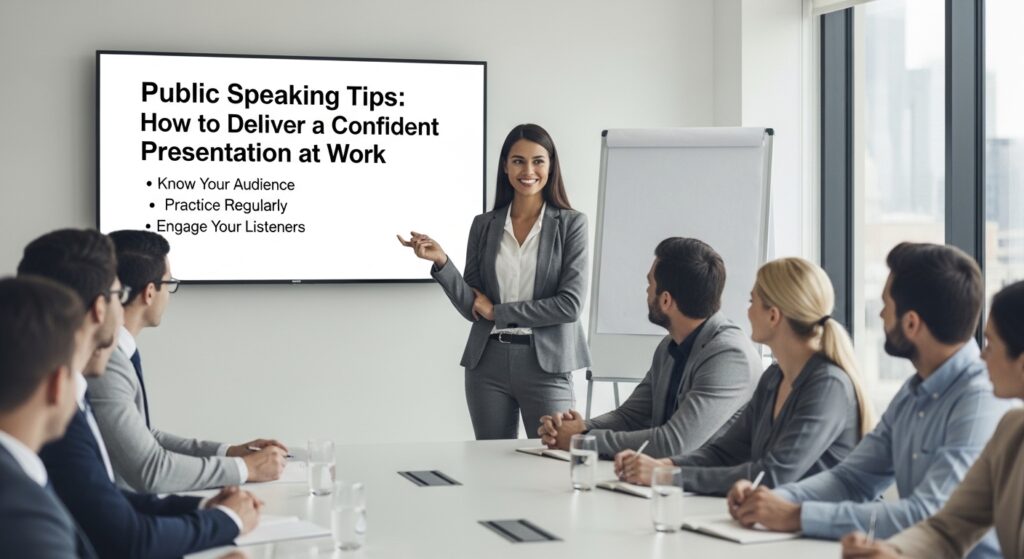
Why Public Speaking Confidence Is a Career Defining Professional Skill
Before we get into the specific tips, it is worth establishing clearly why public speaking deserves the investment of deliberate development time and energy that most other professional skills receive as a matter of course.
The Career Consequences of Communication Quality
Research from multiple professional development organizations consistently identifies public speaking and presentation skills as among the most significant differentiators between professionals who advance to leadership roles and those who do not, regardless of the technical domain they work in. The ability to communicate ideas clearly and compellingly, to hold a room’s attention, to advocate persuasively for a position, and to project the confidence and authority that makes people trust your judgment, these capabilities influence promotion decisions, client relationships, stakeholder management outcomes, and organizational influence in ways that technical expertise alone cannot.
Warren Buffett, whose judgment on what creates professional value is worth taking seriously, has said that communication skills, specifically public speaking, can increase a professional’s value by 50 percent. Whether or not that specific figure is precisely accurate, the directional principle it reflects is widely supported by the experience of virtually every professional who has developed their speaking capability deliberately and observed the career consequences.
The Anxiety Problem Is More Solvable Than Most People Believe
The single most common barrier to public speaking development is the belief, held with surprising firmness by many otherwise confident professionals, that presentation anxiety is a fixed personality characteristic rather than a learnable, manageable response to a specific type of challenge.
This belief is false and importantly so, because it causes people to avoid speaking opportunities that would develop their capability, to attribute their anxiety to something permanent and unchangeable about themselves rather than something situational and addressable, and to stop seeking the deliberate practice that is the primary mechanism through which public speaking confidence is built.
Presentation anxiety is a physiological stress response, a real and involuntary activation of the nervous system’s threat response in a social evaluation context. It is not evidence of weakness, inadequacy, or unsuitability for leadership. It is a completely normal human response that the majority of experienced professional speakers continue to experience in some form before significant speaking engagements, and that virtually all of them have learned to manage, channel, and in some cases use productively rather than allowing it to undermine their performance.
Tip 1, Prepare With Structure and Purpose, Not Just Content
The most common and most limiting preparation mistake that professionals make before a workplace presentation is spending the majority of their preparation time ensuring they know their content thoroughly while spending little or no time on the structural and narrative architecture that determines whether that content lands effectively with the specific audience receiving it.
Knowing your material is necessary but far from sufficient. A presentation is not a data transfer. It is a persuasion and communication experience, and its effectiveness depends on how well its structure, narrative arc, and specific framing serve the specific purpose you need it to achieve with the specific people in the room.
Define Your Single Most Important Objective Before Anything Else
Before creating a single slide, before drafting a single talking point, define with absolute clarity the single most important thing you need your audience to think, feel, or do differently as a result of your presentation. Not the three most important things. Not a general direction. The single most important objective, stated specifically enough that you could objectively assess whether you had achieved it.
“I need the executive team to approve a budget increase of 40,000 dollars for the customer experience initiative” is a specific objective. “I want to share our research findings” is not an objective at all, it is a description of an activity. The specificity of your objective determines the specificity with which you can design every element of your presentation to serve it.
Every subsequent preparation decision, which information to include, how to structure the narrative, which data to emphasize, how to handle anticipated objections, should be evaluated against this single objective. Information that serves the objective belongs in the presentation. Information that does not, however interesting, accurate, or hard-won, should be set aside or moved to an appendix.
Structure Your Presentation Around Your Audience, Not Your Research Process
One of the most common structural mistakes in workplace presentations is organizing the content in the order it was researched or discovered rather than in the order most effective for the audience receiving it. A presentation that walks the audience through your research methodology, your data collection process, your analysis steps, and finally your conclusions at the end is organized around your experience of producing the work rather than your audience’s need to understand and act on it.
The most effective structure for the majority of workplace presentations inverts this order entirely, leading with the conclusion and the recommendation rather than building to them. This approach, often called the Pyramid Principle and popularized by former McKinsey consultant Barbara Minto, recognizes that most professional audiences, particularly busy senior leaders, want to know the answer first and then understand the supporting evidence, rather than sitting through the evidence before finally hearing the conclusion.
Lead your presentation with your recommendation or key finding stated clearly and specifically. Follow with the two or three strongest pieces of supporting evidence. Then provide the deeper background, methodology, and detail for audience members who need it and for the question-and-answer discussion that follows. This structure respects your audience’s time, keeps your most important message from being lost in the middle of a long evidence build-up, and demonstrates the clear, structured thinking that confident professional communication requires.
Prepare for Questions as Thoroughly as You Prepare Your Presentation
The questions following a workplace presentation are often where the professional impression you create is most directly formed, because they require real-time, unscripted responses that cannot be rehearsed in the same way as your prepared remarks. An articulate, well-structured presentation followed by fumbling, uncertain answers to predictable questions leaves the room with a very different impression than the presentation itself suggested.
Spend meaningful preparation time anticipating the specific questions your specific audience is most likely to ask, including the challenging ones, the skeptical ones, and the ones that probe the weaknesses in your argument or the gaps in your data. For each anticipated question, prepare a clear, confident, specific answer. Know where your data has limitations and prepare honest, constructive acknowledgments of those limitations rather than hoping the questions that would expose them will not be asked.
Tip 2, Manage Presentation Anxiety Through Preparation and Reframing
Presentation anxiety is not something to be eliminated before you become a confident public speaker. It is something to be understood, managed, and ultimately integrated into a speaking approach that acknowledges the reality of the physiological response while refusing to allow it to control your performance.
The Physiological Reality of Presentation Anxiety
When you stand in front of an audience and prepare to speak, your nervous system interprets the social evaluation context as a mild threat and activates the same stress response that evolved to help humans deal with physical danger. Adrenaline is released. Heart rate increases. Breathing becomes shallower. Fine motor control is slightly reduced. The mouth dries. The voice may tremble or rise in pitch.
These symptoms are not signs of weakness and they are not signs that something is going wrong. They are the predictable physiological consequences of a stress hormone response that is, in a controlled professional context, producing most of its energy as wasted arousal rather than as genuinely useful performance enhancement. Understanding this, knowing that the trembling hands and the racing heart are a normal, predictable, physiologically explained response rather than evidence of inadequacy, reduces their psychological impact significantly.
Reframe Anxiety as Activation
One of the most practically effective anxiety management techniques in public speaking development is the cognitive reframing of anxiety symptoms from negative signals to neutral or positive ones. Research by Alison Wood Brooks at Harvard Business School demonstrated that individuals who told themselves “I am excited” before a public speaking task performed significantly better than those who told themselves “I am calm,” because excitement and anxiety share the same physiological profile and reframing from anxiety to excitement is more cognitively achievable than reframing from anxiety to calm.
Before your next presentation, try substituting the internal narrative “I am nervous” with “I am activated” or “I am energized.” The physiological experience is identical. The psychological relationship with that experience, and the behavioral consequences of that relationship, can be meaningfully different based on how you narrate it to yourself.
Use Preparation as Your Primary Anxiety Management Tool
The most reliable anxiety reduction mechanism available to any presenter is thorough, systematic preparation. Anxiety in public speaking is driven predominantly by uncertainty, uncertainty about whether you know your material well enough, uncertainty about what questions might be asked, uncertainty about whether your structure will hold under pressure, uncertainty about the room and its dynamics.
Systematic preparation directly addresses each of these uncertainties. Knowing your material thoroughly reduces the fear of being exposed as underprepared. Anticipating questions reduces the fear of being ambushed by something you have not considered. Rehearsing your structure until it is genuinely internalized reduces the fear of losing your place or your thread. Visiting the room in advance, checking the technology, understanding the physical space, reduces the environmental uncertainty that adds to the cognitive load of the presentation itself.
Anxiety that persists despite thorough preparation is manageable through the reframing techniques described above and through the physical techniques described next. Anxiety that is primarily driven by inadequate preparation is best addressed by doing more preparation.
Use Physical Techniques to Reduce Pre-Presentation Arousal
Several physical techniques have meaningful evidence supporting their ability to reduce the physiological symptoms of anxiety before a speaking engagement. Deep, slow diaphragmatic breathing, inhaling slowly through the nose for four counts, holding briefly, and exhaling slowly through the mouth for six counts, activates the parasympathetic nervous system and produces measurable reductions in heart rate and anxiety symptoms within two to three minutes of consistent practice.
The power posture technique, standing in an expansive, upright posture for two minutes before entering the room, has been associated with reductions in cortisol and increases in testosterone in some research, though the evidence base for this specific mechanism is more contested than its popularization suggests. What is more consistently supported is that upright, expansive physical posture produces psychological state changes that most people find genuinely helpful before a speaking engagement, regardless of the precise hormonal mechanism.
Tip 3, Master the Delivery Techniques That Command Attention
A presentation with excellent content and structure can still fail to achieve its objective if the delivery does not create the impression of confidence, authority, and engagement that causes an audience to trust both the message and the messenger. Delivery is not superficial performance on top of substance. It is the mechanism through which substance reaches and influences an audience.
The Power of the Strategic Pause
Nothing communicates confidence in a presentation context more immediately and more convincingly than the strategic pause, a deliberate, comfortable moment of silence at key transition points in your presentation. And nothing betrays presentation anxiety more reliably than the nervous filler sounds, “um,” “uh,” “so,” “you know,” that most people use to fill the silence they are afraid to allow.
The strategic pause serves multiple simultaneous functions. It gives the audience time to process a key point before you move to the next one. It signals that you are completely in control of the pacing rather than rushing to stay ahead of your own anxiety. It creates natural emphasis for the information that precedes and follows it. And it eliminates the filler sounds that undermine the impression of confidence and preparation.
Developing comfort with silence in front of an audience is one of the most counterintuitive and most valuable public speaking skills available, because silence feels much longer to the speaker than it appears to the audience. A pause that feels like three uncomfortable seconds to you registers as a confident, purposeful beat to the people watching. Practicing deliberate pauses in low-stakes contexts, in meetings, in one-on-one conversations, in informal presentations, gradually builds the comfort with silence that transforms your delivery in high-stakes contexts.
Eye Contact as a Relationship and Authority Tool
Sustained, confident eye contact with individual audience members is one of the most powerful tools available for creating the sense of personal connection, authority, and genuine engagement that distinguishes compelling presenters from merely competent ones.
The most effective eye contact technique for workplace presentations involves making genuine, complete eye contact with individual audience members, one person at a time, for a full thought or sentence before moving to the next person. This approach, sometimes called the one thought, one person technique, creates a presentation experience that feels like a series of one-on-one conversations rather than a broadcast to a room, which is dramatically more engaging and more persuasive for the individuals receiving it.
The instinctive alternatives, looking at the screen behind you, looking at your notes, looking over the audience’s heads, scanning rapidly across the room without landing on any individual, all communicate the same thing to the audience, that you are not fully present with them and not fully confident in what you are saying. Genuine, specific individual eye contact communicates presence, confidence, and respect.
Vocal Variety as an Engagement Mechanism
The human voice, used with intentional variety in pace, pitch, volume, and emphasis, is one of the most powerful engagement tools available to a presenter. A voice delivered at constant pace, constant pitch, and constant volume produces what is almost universally described by audiences as a monotone experience, regardless of how interesting the content it is delivering actually is.
Deliberate variation in speaking pace, slowing down for important or complex points and speeding up slightly for background information and transitions, signals to the audience which information deserves their concentrated attention and which can be processed more lightly. Variation in volume, dropping the voice slightly for an important intimate point and raising it for a key conclusion, creates emphasis and holds attention more effectively than consistent moderate volume throughout. Variation in pitch prevents the vocal flatness that registers as lack of engagement or enthusiasm regardless of the speaker’s actual feelings about their material.
Recording yourself presenting, even a brief two to three minute segment of a rehearsal, and listening back specifically to assess your vocal variety, is one of the fastest available routes to identifying and addressing the specific vocal patterns that may be undermining your delivery without your awareness.
Tip 4, Use Visual Aids That Support Your Message Rather Than Replace It
Workplace presentations almost universally involve slide decks, and slide decks almost universally contain more text, more data, and more visual complexity than they should. Understanding the specific role visual aids should play in a presentation, and the specific ways most slide decks undermine rather than support that role, immediately improves both the quality of your visual materials and the effectiveness of your delivery.
The Fundamental Problem With Most Workplace Slide Decks
The most common and most damaging mistake in workplace presentation slide design is treating slides as a document rather than as a visual aid. Slides that contain the full text of what the presenter intends to say, organized in dense bullet points that the audience reads while the presenter reads them aloud, create a presentation experience that is both cognitively redundant and fundamentally disrespectful of the audience’s ability to process information.
When an audience is reading slide text, they are not listening to the presenter. When they are listening to the presenter, they are not reading the slide text. Because most people cannot do both simultaneously with full effectiveness, a slide deck full of text forces the audience into a divided attention mode that reduces their retention of both the visual and the spoken content below what either channel would produce if used independently and appropriately.
The fundamental principle of effective presentation slide design is that slides should communicate visually what words cannot communicate as effectively, and leave to the presenter’s spoken words everything that words communicate better than visuals. Data visualization, process diagrams, comparison frameworks, photographs, and single key words or phrases that anchor spoken content are the appropriate province of slides. Paragraphs of text, complete sentences summarizing the presenter’s points, and bullet point lists that replicate the structure of the spoken presentation are not.
The One Idea Per Slide Principle
The most reliably effective constraint for workplace presentation slide design is the one idea per slide principle, designing each slide to communicate a single, specific idea clearly and visually, and moving to a new slide when a new idea is introduced.
This approach feels initially like it will produce a presentation that is too long or too simple. In practice it produces presentations that are cleaner, clearer, more visually engaging, and more memorable than the dense, multi-point slide decks that most professionals default to. A presentation of twenty single-idea slides is typically more impactful and easier to follow than a presentation of eight dense multi-point slides covering the same content, because each idea gets its own visual space and its own moment of audience attention rather than competing visually with everything else on the same crowded slide.
Design for Visibility, Not for the Slide Document
A common slide design mistake is designing slides that look complete and professional when viewed as a document on a computer screen but become difficult to read when projected in a real room with varying lighting conditions and viewing distances.
Use a minimum font size of 24 points for body text and 36 points or larger for headlines when designing slides intended for projection. Ensure that color contrast between text and background is high enough that text remains legible under the projector-washed lighting conditions of most conference rooms. Limit the amount of information on each slide to what an audience member sitting in the back row of the room can read comfortably at a glance.
Test your slides by viewing them from across the room before your presentation, not just on your laptop screen at arm’s length. What looks perfectly legible at design distance frequently becomes difficult to read at viewing distance in a real presentation environment.
Tip 5, Rehearse in Ways That Build Real Confidence
Rehearsal is the bridge between preparation and performance, and the quality and nature of your rehearsal practice determines how much of your preparation actually translates into confident, effective delivery in the real presentation. Most professionals under-rehearse significantly, and many of those who do rehearse do so in ways that build familiarity with their content without building the delivery confidence that comes from rehearsing in conditions that genuinely simulate the real presentation environment.
The Difference Between Reading and Rehearsing
Reading through your slides or your notes silently at your desk is not rehearsal. It is review. Genuine rehearsal requires speaking your presentation aloud, at full volume, in a manner that simulates the actual delivery conditions of the real presentation as closely as possible.
Speaking your presentation aloud produces insights and reveals challenges that silent review never surfaces. The sentence that reads smoothly on a slide frequently sounds stilted or confusing when spoken. The transition between two sections that feels logical on paper often requires an explicit spoken bridge that is not obvious until you attempt it verbally. The timing of your presentation, including the pauses, the slide transitions, and the overall flow, cannot be assessed through silent review and frequently surprises presenters who have not rehearsed aloud.
Rehearse your complete presentation aloud at least two or three times before any significant speaking engagement, more for presentations with very high stakes or significant unfamiliarity. Each aloud rehearsal will surface specific moments that need refinement, and refinement based on actual rehearsal experience produces meaningfully better final presentations than refinement based on theoretical review.
Rehearse With Simulated Audience Conditions
The most valuable rehearsal experiences simulate the actual conditions of the real presentation as closely as possible. Stand up rather than sitting. Use your actual slides projected on a real screen rather than viewing them on a laptop. Speak at your full presenting volume rather than muttering softly to yourself.
If possible, rehearse in front of at least one other person who can provide honest, specific feedback on your delivery, your pacing, your clarity, and the moments where your explanation is not as clear as you believe it to be. A trusted colleague, a mentor, or even a willing friend provides the social evaluation element that is absent from solo rehearsal and that makes the rehearsal experience more closely simulate the psychological conditions of the real presentation.
Video recording your rehearsal and watching it back with specific attention to eye contact patterns, filler words, pace, posture, and vocal variety provides a level of self-assessment precision that observer feedback alone cannot match. The discomfort of watching yourself on video is real but temporary. The insights it produces are specific, actionable, and often genuinely surprising.
Internalize the Structure, Not the Script
One of the most common and most limiting rehearsal approaches is attempting to memorize a word-for-word script and deliver it from memory. This approach produces presentations that feel mechanical and rehearsed rather than natural and present, because the cognitive effort of word-perfect recall competes with the attention and responsiveness needed for genuine audience engagement. It also creates a fragile delivery that can collapse dramatically when an interruption, a question, or a moment of distraction breaks the memorized sequence.
The more effective approach is internalizing the structure of your presentation thoroughly, knowing your key points, your transitions, and your supporting evidence so completely that you can deliver them naturally in your own words in any order they are needed, rather than following a specific scripted sequence. This approach produces delivery that feels natural, present, and genuinely engaged with the audience rather than performed for them.
Tip 6, Handle Questions and Difficult Moments With Grace
The ability to handle questions, interruptions, and unexpected challenges gracefully and confidently is as important a component of a successful workplace presentation as the prepared delivery itself. In many organizational contexts, the question-and-answer discussion following a presentation is where the most important professional impression is formed.
The PREP Framework for Answering Questions Clearly
The PREP framework, standing for Point, Reason, Example, Point, is a simple and highly effective structure for answering questions in a presentation context. Begin with a clear, direct statement of your main answer to the question. Follow with the primary reason or reasoning that supports that answer. Provide a specific, concrete example that illustrates the reasoning. Conclude by restating the main point clearly.
This structure produces answers that are clear, organized, and complete, that demonstrate the same structured thinking as your prepared presentation rather than the scattered or defensive quality that unprepared question responses often have. It also gives you a reliable structure to fall back on in the moment of answering, reducing the cognitive load of formulating a response under pressure.
How to Handle Questions You Cannot Answer
Every presenter who presents often enough will eventually be asked a question they cannot answer, either because the information required is genuinely not available to them or because the question addresses a dimension of the topic they have not prepared for. How a presenter handles these moments is often more revealing of their professional character and confidence than how they handle the questions they can answer easily.
The most confident and most professionally impressive response to a question you cannot answer is a simple, direct acknowledgment: “That is a genuinely important question and I want to give you an accurate answer rather than speculate. Let me check the specific data and come back to you by end of day.” This response demonstrates intellectual honesty, respect for the questioner, and the professional confidence to acknowledge a limitation without defensiveness or elaborate justification.
What it does not demonstrate, and what should always be avoided, is the temptation to answer confidently despite not actually knowing the answer, hoping the confidence will compensate for the inaccuracy. In professional contexts, where the people asking questions often know the answers and are assessing your honesty and judgment as much as your knowledge, this approach is among the most damaging possible responses to a question you cannot answer.
Handling Hostile or Challenging Questions
Hostile or aggressively skeptical questions are a feature of many high-stakes workplace presentations, particularly those involving budget requests, organizational change recommendations, or positions that challenge existing priorities or assumptions. Handling them well requires a combination of emotional regulation, genuine intellectual engagement, and structural composure.
The most effective first response to a hostile question is a genuine, non-defensive acknowledgment of the concern it reflects. “That is a legitimate concern and I want to address it directly” is a more powerful opening than defensiveness, justification, or dismissal, because it signals confidence rather than threat response and immediately reduces the adversarial dynamic that hostile questions can create.
Address the substance of the challenge specifically and honestly, including acknowledging limitations or uncertainties in your position where they genuinely exist. A presenter who handles a difficult challenge with honest, structured, confident engagement consistently makes a stronger professional impression than one who deflects, dismisses, or becomes defensive, regardless of whether their underlying position is stronger or weaker than the challenger’s.
Tip 7, Build Your Speaking Confidence Through Deliberate Practice
Confidence in public speaking is not a personality trait that some people are born with and others are not. It is a skill that is built through deliberate, cumulative practice, and it develops in direct proportion to the frequency and quality of your speaking experiences.
Seek Out Speaking Opportunities Proactively
The most direct path to public speaking confidence is deliberately seeking out speaking opportunities in lower-stakes contexts that build the repetition and feedback accumulation that high-stakes speaking requires. Volunteer to present updates in team meetings rather than simply attending them. Offer to represent your team in cross-functional briefings. Propose presentations to internal stakeholders on projects you are leading. Ask to introduce speakers or facilitate discussions at company events.
Each of these opportunities is a low-stakes speaking experience that builds the familiarity, the physical habituation to the stress response, and the accumulated feedback that gradually shift your relationship with public speaking from anxious avoidance to confident engagement. The professionals who develop the strongest public speaking capabilities are almost always those who pursued the most speaking experiences, not those who waited until they felt ready before saying yes.
Join a Speaking Practice Community
Toastmasters International is the most widely available structured environment for deliberate public speaking practice, with more than 16,000 clubs in 145 countries offering regular, supportive, feedback-rich speaking practice sessions accessible to professionals at every level of speaking experience.
The specific value Toastmasters provides that most professionals cannot easily replicate on their own is the combination of frequent, low-stakes speaking repetition, immediate structured feedback from experienced peers, and a progressive development curriculum that builds specific speaking skills systematically rather than leaving development to the somewhat random lessons of unstructured experience.
For professionals who are serious about developing their public speaking capability deliberately and efficiently, joining a Toastmasters club or an equivalent professional speaking community is among the highest-return professional development investments available.
Record, Review, and Refine Continuously
The single most accelerating practice for public speaking development that most professionals either do not use or use inconsistently is systematic video self-review. Recording your presentations, whether formal workplace presentations or informal meeting contributions, and reviewing those recordings with specific attention to the delivery dimensions you are working to improve, produces a feedback loop that accelerates skill development significantly beyond what experience alone provides.
The discomfort of watching yourself on video is real and nearly universal. It also diminishes quickly with repetition, and the insights it produces remain consistently valuable at every level of speaking development. Every significant public speaker, coach, and speaking trainer I have encountered or read about identifies video self-review as among the most important practices in their own development and in the development they facilitate for others.
Common Public Speaking Mistakes to Avoid
Even experienced and capable presenters consistently make these errors that undermine the effectiveness of their workplace presentations:
Beginning with an apology or a disclaimer. Opening a presentation with “I am sorry, I know you are all very busy” or “This is a bit rough, I did not have as much time to prepare as I would have liked” immediately undermines your credibility and the audience’s confidence in what follows. Your audience does not know what a more prepared version would have looked like. Begin with confidence in what you have prepared, not with apologies for what you did not.
Reading from slides or notes rather than speaking from internalized knowledge. Reading directly from the text on your slides or from printed notes communicates to the audience that you do not know your material well enough to speak about it naturally, which reduces both their engagement and their confidence in your expertise. Internalize your content thoroughly enough to speak about it in your own words, using slides as visual anchors rather than scripts.
Ignoring the room during your presentation. Fixating on your laptop screen, your notes, or the screen behind you rather than on the actual human beings in the room in front of you creates a presentation experience that feels detached and impersonal regardless of the quality of the content. The audience is in the room with you. Keep your attention there.
Failing to close with a clear, specific call to action. Many workplace presentations end with a vague invitation for questions or a trailing “so, yes, that is basically it” that leaves the audience uncertain about what they are supposed to do or decide as a result of what they have just heard. Every workplace presentation should close with a clear, specific statement of what you need from the audience, what decision you need them to make, what action you need them to take, or what position you need them to support.
Rushing through the presentation out of anxiety. Pace anxiety, the instinct to speak faster than the content warrants because slowing down feels more exposed and more vulnerable, is one of the most common and most immediately audience-visible manifestations of presentation anxiety. Consciously slow your pace to approximately 70 percent of what feels natural to you, and you will typically arrive at approximately the pace that actually sounds natural and confident to your audience.
Conclusion and Final Thoughts
The presentation I gave seven years ago to those forty people, including three executives whose opinions mattered directly to my career, was not the presentation I was capable of giving. The research was good. The delivery did not do it justice. That gap, between the quality of the thinking and the effectiveness of the communication of that thinking, is the gap that public speaking development closes, and it is a gap that has genuine, measurable, career-defining consequences for the professionals who address it and for those who do not.
The seven tips covered in this guide, preparing with structure and purpose, managing anxiety through preparation and reframing, mastering the delivery techniques that command attention, using visual aids that support rather than replace your message, rehearsing in ways that build real confidence, handling questions and difficult moments with grace, and building speaking confidence through deliberate practice, form a complete and immediately applicable framework for developing the public speaking capability that your professional ideas and your professional ambitions deserve.
Public speaking is not a talent. It is a skill. Skills are built through knowledge, deliberate practice, honest feedback, and the sustained commitment to keep showing up for the speaking opportunities that build capability through accumulation.
The room is waiting. Your ideas deserve to be heard. And the version of you that delivers them with the confidence and clarity they deserve is not some distant, aspirational future self. It is you, with the right preparation, the right techniques, and the right amount of deliberate practice behind your next performance.
What is the single most challenging aspect of workplace presentations for you personally, and which of these seven tips are you planning to apply to your next speaking opportunity? Share your experience in the comments below. Whether you are conquering your first major presentation or refining a speaking practice you have been developing for years, your perspective could be exactly the encouragement another professional needs to step up and say yes to the next opportunity that asks them to stand at the front of the room.