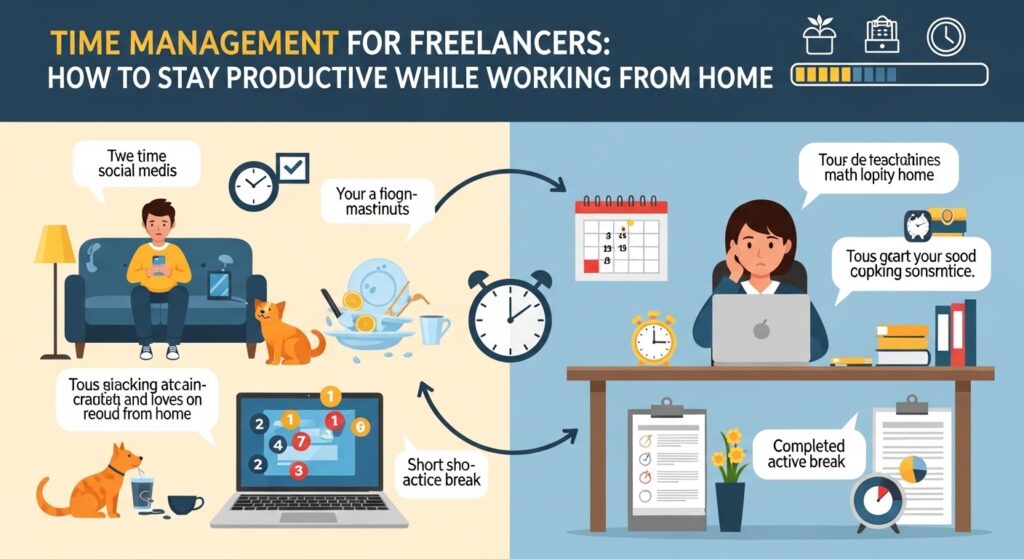
During my first six months of freelancing, I was technically working from home every single day, but I was barely working at all. I would wake up without an alarm, spend forty-five minutes scrolling through my phone before getting out of bed, eat breakfast in front of the television, finally open my laptop sometime around midday, get distracted by household chores, answer a few emails, watch the afternoon disappear, and then spend the evening in a low-grade panic trying to make up for the lost hours before collapsing exhausted into bed, only to repeat the entire cycle the next morning.
On paper, I was a freelancer living the dream. In reality, I was completely adrift without the external structure that an office environment had always provided without me ever having to think about it.
The turning point came when a more experienced freelancer I admired shared something with me that reframed everything. She said: “Freedom without structure is not liberation. It is just chaos with better lighting.” She was right. The moment I stopped treating my home as a place where work happened occasionally and started treating it as a place where a professional showed up every day with intention and a system, my productivity, income, and work satisfaction transformed almost overnight.
Freelancing is one of the most rewarding professional paths available in 2026 — but it comes with a set of time management challenges that are genuinely unique and that no amount of motivation or good intentions alone can solve. Without the natural structure of an office, a fixed schedule, a manager checking on your progress, and the social accountability of visible colleagues, time has a way of slipping through your fingers in ways that feel inexplicable until you understand exactly why they happen.
In this guide, you will learn the most effective time management strategies specifically designed for freelancers working from home, practical, proven approaches that will help you protect your productive hours, meet your deadlines consistently, avoid burnout, and build a freelance career that is sustainable and genuinely fulfilling for the long term.
Why Time Management Is the Freelancer’s Most Critical Skill
Before we get into the specific strategies, it is worth understanding why time management is so uniquely challenging in a freelance, work-from-home context, and why the solutions that work in a traditional office setting often fail completely when applied to freelance life.
When you work in an office, time management is largely handled for you by external forces. Your commute creates a clear psychological transition between home life and work life. Fixed office hours define when your workday begins and ends. The visible presence of colleagues creates social accountability that makes it difficult to procrastinate openly. Scheduled meetings structure your day whether you planned them or not. And a manager’s oversight provides a layer of external accountability that most people underestimate until it disappears.
Freelancing removes every single one of these external structures simultaneously and replaces them with complete autonomy, which sounds wonderful until you discover that complete autonomy without self-imposed structure is one of the most psychologically disorienting professional experiences a person can have.
The three core time management challenges that freelancers consistently report are unpredictable income flow — which makes it difficult to know how hard to push versus when to rest, the blurring of boundaries between work time and personal time when both happen in the same physical space, and the feast-or-famine cycle — the tendency to overwork frantically when client work is abundant and underwork unproductively when it is slow, rather than maintaining a consistent, sustainable daily rhythm.
Each of the strategies in this guide directly addresses one or more of these core challenges. Let us work through them step by step.
Step 1 — Design Your Ideal Workday Before It Designs Itself
The single most impactful time management decision a freelancer can make is to design their workday deliberately rather than allowing it to take whatever shape the morning’s distractions, mood, and incoming messages happen to give it.
Identify Your Peak Productivity Hours
Not all hours in your workday are created equal. Every person has a biological rhythm, sometimes called their chronotype — that determines when their cognitive performance is at its highest and when it naturally dips. Some people do their best creative and analytical thinking in the early morning. Others hit their peak in the late morning or early afternoon. A significant number of people are most productive in the evening hours.
As a freelancer with control over your schedule, you have the rare and valuable opportunity to align your most demanding work with your peak performance hours, something most office workers can never do because their schedule is determined for them regardless of their natural rhythm.
Spend one week paying close attention to when you feel most mentally sharp, most creative, and most naturally focused. Once you have identified your peak hours, protect them fiercely. Schedule your most cognitively demanding client work, writing, design, coding, analysis, strategy, during those hours, and reserve your lower-cognitive tasks like email, admin work, invoicing, and scheduling for your natural energy valleys.
Build a Consistent Daily Routine
Routine is the freelancer’s most underrated productivity tool. When your brain knows what to expect at each point in the day, it stops wasting cognitive energy on deciding what to do next and channels that energy into actually doing the work.
Your ideal freelance daily routine does not need to be rigid or military in its precision. But it should include consistent anchor points, a regular start time, a defined morning ritual that signals to your brain that the workday has begun, a midday break that genuinely disconnects you from work, and a clear end-of-day ritual that marks the transition back to personal time.
The morning ritual is particularly important. Rather than opening your laptop the moment you wake up and immediately diving into emails and messages, a habit that puts you in reactive mode from the very first minutes of your day, design a morning ritual that prepares you mentally and physically for focused, intentional work. This might include exercise, a proper breakfast eaten away from screens, a brief review of your priorities for the day, and a specific physical action, making a cup of coffee, sitting in your designated work chair, putting on headphones, that your brain learns to associate with the beginning of focused work time.
Step 2 — Master the Art of Time Blocking for Freelance Work
Time blocking is the practice of dividing your workday into specific, dedicated blocks of time assigned to specific tasks or categories of work, and it is one of the most consistently effective productivity techniques available to freelancers managing multiple clients and projects simultaneously.
How Time Blocking Works for Freelancers
Instead of starting each day with a vague to-do list and working through it reactively as time allows, time blocking requires you to assign every working hour to a specific purpose before the day begins. A typical time-blocked freelance day might look something like this:
Your first two hours are dedicated exclusively to your most demanding client project, the one requiring the deepest concentration and the highest quality of output. No email, no social media, no phone. Just focused, uninterrupted creative or analytical work during your peak hours.
Your next hour is assigned to responding to client emails, reviewing project feedback, and handling any administrative communication that has accumulated. By batching all your communication into one designated window rather than responding to every message the moment it arrives, you protect your focus blocks from the constant interruption that kills deep work productivity.
After a genuine lunch break, eaten away from your desk, ideally outside or at least away from your screen — a second focused work block is dedicated to a secondary client project or task. A late-afternoon block handles business development activities like prospecting, proposal writing, or marketing. The final thirty minutes of your workday are reserved for reviewing what you accomplished, updating your task list, and planning tomorrow’s time blocks before you close your laptop.
Tools for Effective Time Blocking
Google Calendar is the simplest and most widely used tool for time blocking, and for most freelancers it is all that is needed. Create color-coded calendar events for each type of work — one color for client work, another for business development, another for admin, another for personal development, and schedule them as recurring blocks that form the skeleton of your ideal week.
For freelancers who want more sophisticated time management capabilities, tools like Notion and Todoist integrate seamlessly with Google Calendar to connect your time blocks to specific tasks within projects, creating a complete view of both your schedule and your task list in one place. (For a full breakdown of the best productivity tools for remote workers and freelancers, check out our guide on [Top 5 Productivity Apps to Organize Your Remote Work Life].)
Step 3 — Set Boundaries That Protect Your Time and Energy
One of the most persistent and damaging misconceptions about freelancing is that working from home means being available to everyone — clients, family members, friends, neighbors, and household responsibilities — at all hours of the day. This misconception, if left unchallenged, will destroy your productivity and your wellbeing simultaneously.
Setting Boundaries With Clients
Client boundary setting is one of the most important and most difficult skills a freelancer must develop, particularly in the early stages of a freelance career when the fear of losing clients can make any boundary feel like an unaffordable luxury.
The reality is the opposite. Clients who respect your boundaries are the ones worth keeping. And the way you set and maintain boundaries with clients from the beginning of a working relationship directly shapes the expectations and dynamics of that relationship for its entire duration.
Establish your working hours clearly and communicate them explicitly to every client at the start of each engagement. Something as simple as stating in your initial onboarding communication that your working hours are Monday through Friday, 9am to 6pm, and that messages received outside those hours will be responded to on the next business day, sets a professional expectation that most clients will respect without question.
Resist the pressure — internal or external — to respond to client messages in the evenings, on weekends, or during your designated offline hours except in genuine emergencies. Every time you respond to an after-hours message, you train your client to expect after-hours availability. Maintaining your stated boundaries consistently is both a professional standard and a self-preservation strategy.
Setting Boundaries With Your Household
If you share your home with family members, a partner, roommates, or anyone else whose daily life overlaps with your work-from-home schedule, establishing clear household boundaries around your working hours is equally important.
Communicate your working hours and the importance of uninterrupted focus time clearly and kindly. If possible, designate a specific room or area of your home as your dedicated workspace and establish a shared understanding that when you are in that space during your working hours, you are at work in the same meaningful sense as if you were in an office. Visible signals, a closed door, headphones on, a do-not-disturb sign, can help communicate your focus status without requiring verbal interruption.
Step 4 — Track Your Time to Understand Where It Actually Goes
Here is a question that most freelancers find genuinely uncomfortable to answer honestly: if you were asked right now to account for every hour of your last five working days, could you do it accurately?
For most freelancers, the answer is no, and that inability to account for their time is itself one of the most significant contributors to the feeling of being constantly busy without making meaningful progress.
Time tracking — the practice of recording exactly how long you spend on every task and activity throughout your workday, is the most powerful diagnostic tool available to a freelancer who wants to understand and improve their productivity.
Why Time Tracking Transforms Freelance Productivity
When you first start tracking your time in detail, the results are almost always surprising and frequently humbling. Most freelancers discover that they spend significantly more time on low-value administrative tasks, unfocused browsing, unnecessary communication, and transition time between tasks than they ever realized, and significantly less time on the high-value, billable, income-generating work that their business depends on.
That data is not comfortable to look at. But it is extraordinarily valuable, because you cannot improve what you cannot accurately measure. Once you can see clearly where your time is actually going, you can begin making deliberate, evidence-based decisions about how to restructure your day to protect more time for the work that truly matters.
The Best Time Tracking Tool for Freelancers
Toggl Track is the most widely used and most highly regarded time tracking tool among freelancers, and its free plan is more than sufficient for most individual freelancers’ needs. It allows you to track time by client and by project, generates detailed weekly and monthly reports showing exactly where your time went, and can calculate your effective hourly rate, the actual amount you are earning per hour of total time invested in your business, including unbillable admin hours, which is often a revealing and motivating figure for freelancers trying to optimize their income.
Spend at least two full weeks tracking every hour of your workday in detail before drawing any conclusions or making changes. Give yourself enough data to identify genuine patterns rather than reacting to the anomalies of a single unusual day.
Step 5 — Manage Distractions Before They Manage You
Distraction is the natural predator of freelance productivity. And in a work-from-home environment in 2026 — where your phone, your social media accounts, your streaming services, your household chores, and every other competing interest in your life are all within arm’s reach throughout the workday, the ability to manage distraction is not a minor convenience. It is a fundamental professional survival skill.
The Two Categories of Distraction
Understanding distraction management begins with recognizing that not all distractions are the same. External distractions are the interruptions that come from your environment — notifications on your phone, messages from family members, background noise, household tasks that catch your eye. Internal distractions are the ones that originate in your own mind, the sudden urge to check your email for the fifteenth time, the anxiety about an unfinished task pulling your attention away from a current one, the restless mental wandering that strikes in the middle of a difficult task.
Both categories require different management strategies, and effective distraction management addresses both simultaneously.
Managing External Distractions
The most effective approach to external digital distraction is radical simplicity: remove the temptation rather than relying on willpower to resist it. Put your phone in another room during focus blocks rather than leaving it face-up on your desk. Use browser extensions like Freedom or Cold Turkey to block distracting websites during designated work periods. Turn off all non-essential notifications, not just silence them, but disable them entirely during working hours.
For noise and household distractions, a pair of noise-canceling headphones is one of the most valuable investments a work-from-home freelancer can make. Beyond blocking environmental noise, headphones also serve as a powerful social signal to anyone sharing your space that you are in focus mode and not available for casual interaction.
Managing Internal Distractions
Internal distractions are trickier to address because they cannot be blocked by an app or silenced by a notification setting. They require the development of genuine mental discipline through consistent practice.
The most effective technique for managing internal distraction during focused work is a method called the capture-and-continue approach. Keep a small notepad or a dedicated note in your phone beside you while you work. Whenever an unrelated thought, task, or worry intrudes on your focus, a bill you need to pay, an email you suddenly remember you forgot to send, an idea for a different project — write it down immediately on your capture list and return your attention to your current task. The simple act of writing it down satisfies the brain’s fear of forgetting it and removes the mental pressure to think about it further right now.
Review your capture list at the end of each work session and process the items at an appropriate time. Over time, this practice trains your brain to trust the capture system, reducing the frequency and urgency of intrusive thoughts during focused work.
Step 6 — Protect Your Energy, Not Just Your Time
Here is a truth that most time management advice for freelancers overlooks entirely: time management without energy management is incomplete. You can have a perfectly structured schedule, a flawless time-blocking system, and an impeccable task list, and still produce mediocre work and feel constantly depleted if you are not actively managing your physical and mental energy alongside your time.
The Four Dimensions of Energy Management
Performance researchers identify four dimensions of human energy that directly affect professional performance: physical energy — the foundation, fueled by sleep, nutrition, movement, and recovery; emotional energy — the capacity to remain calm, positive, and resilient under pressure; mental energy — the ability to concentrate, think clearly, and process complex information; and purposeful energy — the sense of meaning and motivation that makes sustained effort feel worthwhile.
Neglect any one of these dimensions consistently and the others begin to suffer. A freelancer who sleeps poorly, skips meals, never exercises, and never takes genuine time off will find that their productivity and quality of work deteriorates steadily over time,regardless of how disciplined their time management system might be on paper.
Recovery Is Not Laziness
One of the most damaging cultural myths that freelancers internalize — particularly in their early years when the pressure to prove themselves and build their income is highest, is that rest and recovery are luxuries that productive professionals do not need.
The opposite is true. Strategic recovery — taking genuine breaks during the workday, protecting your evenings and weekends from work encroachment, taking regular vacations even as a freelancer, and engaging in activities that genuinely restore your mental and physical energy, is a professional performance strategy, not an indulgence.
Research on cognitive performance consistently shows that the brain requires genuine rest periods to consolidate learning, restore attention, and maintain the quality of creative and analytical output. The freelancer who works twelve-hour days seven days a week will consistently produce lower-quality work than the freelancer who works six focused, well-structured hours five days a week with genuine recovery built into the rhythm.
Build non-negotiable recovery practices into your weekly schedule with the same seriousness you give to client deadlines. Exercise, adequate sleep, genuine social connection, time in nature, creative activities unrelated to work, these are not distractions from your freelance productivity. They are the fuel that makes it sustainable.
Step 7 — Build Systems That Work Even When Your Motivation Does Not
The final and perhaps most important time management principle for freelancers is this: never rely on motivation as your primary driver of productive behavior.
Motivation is real, but it is also inconsistent, unpredictable, and heavily influenced by factors outside your control, your mood, your health, the weather, a difficult client interaction, a slow month of income. Building your entire productivity system around the assumption that you will feel motivated every morning is building on sand.
Systems and habits, by contrast, are reliable precisely because they do not require motivation to activate. A habit is a behavior that has been repeated consistently enough to become semi-automatic — something your brain initiates with minimal conscious effort or decision-making energy.
Building Productive Habits That Stick
The most effective framework for building lasting productive habits is the one popularized by habit researcher James Clear, making the desired behavior obvious, attractive, easy, and satisfying.
Make your productive behaviors obvious by designing your environment to prompt them. Keep your laptop open on your desk in the morning rather than in your bag. Have your task list visible before you sit down. Put your workout clothes beside your bed the night before if morning exercise is part of your routine.
Make them attractive by pairing necessary but uninspiring tasks with something genuinely enjoyable. Reserve a favorite podcast or playlist exclusively for administrative work sessions. Allow yourself a particularly good cup of coffee only after completing your morning planning ritual.
Make them easy by reducing the friction involved in starting. Commit to working for just ten minutes on a difficult task before deciding whether to continue. Open the document before deciding whether you feel ready to write. Starting is almost always the hardest part, once momentum begins, continuation becomes significantly easier.
Make them satisfying by building in small, genuine acknowledgments of completed work. Cross items off your task list deliberately. Use a habit tracking app to maintain a visual streak of consecutive productive days. Share a weekly accomplishment with a fellow freelancer or accountability partner.
The Power of Freelance Accountability Partners
Speaking of accountability, one of the most effective and most underutilized tools for freelance productivity is a genuine accountability partnership with another freelancer whose work ethic and goals you respect.
An accountability partner is someone with whom you share your weekly goals and commitments at the beginning of each week and report your actual progress at the end. The knowledge that someone you respect will be hearing an honest account of how you spent your week creates a powerful form of social accountability that significantly increases follow-through — providing something of the external accountability structure that an office environment gives for free.
Common Time Management Mistakes Freelancers Must Avoid
Even experienced freelancers fall into these patterns regularly:
- Underestimating how long tasks actually take: Almost every freelancer chronically underestimates task duration, leading to overpromising on deadlines and the constant stress of running behind. After tracking your time for two weeks, add a 25 to 30 percent buffer to your time estimates for any task you have not done before — you will almost always need it.
- Saying yes to every client request: Overcommitment is one of the most common and most damaging time management errors freelancers make. Every project you accept that exceeds your available capacity takes time away from existing commitments, reduces the quality of your work across the board, and accelerates burnout. Learn to say no, or at minimum, not yet — with confidence and without guilt.
- Checking email first thing in the morning: Starting your day by opening your inbox immediately puts you in reactive mode from the very first minutes of your workday. Someone else’s priorities become your first task of the day before you have had any opportunity to work on your own. Protect at least the first hour of your morning for your own highest-priority work before opening any communication channels.
- Working in the same space where you relax: When your sofa or bed becomes your workspace, your brain stops associating those spaces with rest and begins associating them with work — making it genuinely harder to relax when you need to and focus when you need to. Designate a specific, consistent workspace and use it exclusively for work during working hours.
- Skipping the weekly review: Taking thirty minutes at the end of each week to review what you accomplished, what fell short, why it fell short, and what you want to prioritize next week is one of the highest-return time investments a freelancer can make. Without it, the same inefficiencies, distractions, and time leaks repeat week after week without ever being identified or addressed.
- Confusing being busy with being productive: Busyness and productivity are not the same thing, and nowhere is this more dangerous than in freelance life where you are both the worker and the manager. Always ask yourself whether the task you are working on right now is genuinely moving your business forward — or whether it is a comfortable, low-stakes activity that feels productive without actually being so.
Conclusion and Final Thoughts
Time management for freelancers is not simply about squeezing more hours of work into each day. It is about designing a professional life that is genuinely sustainable, one where your best work consistently gets done, your clients are reliably served, your income grows with intention, and you still have the time and energy to enjoy the freedom that drew you to freelancing in the first place.
The seven strategies in this guide — designing your ideal workday, mastering time blocking, setting firm boundaries, tracking your time honestly, managing distraction proactively, protecting your energy alongside your time, and building systems that do not depend on motivation — work together as an integrated framework for freelance productivity that delivers results not just in the short term, but year after year as your career develops and your client base grows.
The chaos of my first six months of freelancing feels like a distant memory now. Not because freelancing became easier, it did not. But because I stopped relying on motivation and willpower alone, and built a system that showed up reliably even on the days when I did not particularly feel like it.
That same shift is available to you. Start with one strategy from this guide. Apply it consistently for two weeks before adding another. Build your system gradually, evaluate it honestly, and refine it continuously.
Freedom with structure is not a contradiction. It is the foundation of a freelance life that is both productive and genuinely fulfilling.
Which of these time management strategies are you going to implement first, and what is the single biggest time challenge you face in your freelance or work-from-home routine right now? Share your answer in the comments below. Your experience might be exactly what another freelancer needs to hear to finally get their days under control.