Two years into my first proper job after university, I was doing what I thought was a reasonably responsible thing with my credit card. I was paying my bill every month. I was not maxing it out. I was using it for everyday purchases and earning the reward points that the card advertised so enthusiastically on its welcome brochure. I genuinely believed I was managing my credit card sensibly.
Then, during a particularly busy month when a work deadline collided with a house move, I missed my payment due date by four days. The late fee that appeared on my next statement was unpleasant but not catastrophic. What genuinely shocked me was what I discovered when I called my card provider to query the charge and, while on the phone, asked the customer service representative to explain exactly how the interest on my balance had been calculated every month.
The number she walked me through bore no resemblance to the simple percentage figure printed prominently on my card agreement. The way interest was being calculated, applied, and compounded on my account meant I had been paying significantly more than I ever realized, and the single missed payment had triggered a penalty interest rate that would cost me substantially more in the months ahead if I did not take immediate action.
That phone call was one of the most financially educational thirty minutes of my life. And it taught me something that I wish someone had explained clearly before I ever opened my first credit card account: the difference between understanding how credit card interest works in theory and understanding how it actually works in practice, in the specific, granular, sometimes deliberately obscure way that card providers apply it to real accounts, is a difference that costs the average cardholder hundreds or even thousands of dollars every single year.
In this guide, you will learn exactly how credit card interest is calculated, how late fees work and compound, the specific strategies that prevent you from ever paying unnecessary interest or fees again, and how to use your credit card in a way that makes it a genuinely powerful financial tool working entirely in your favor rather than an expensive trap slowly draining your financial resources.
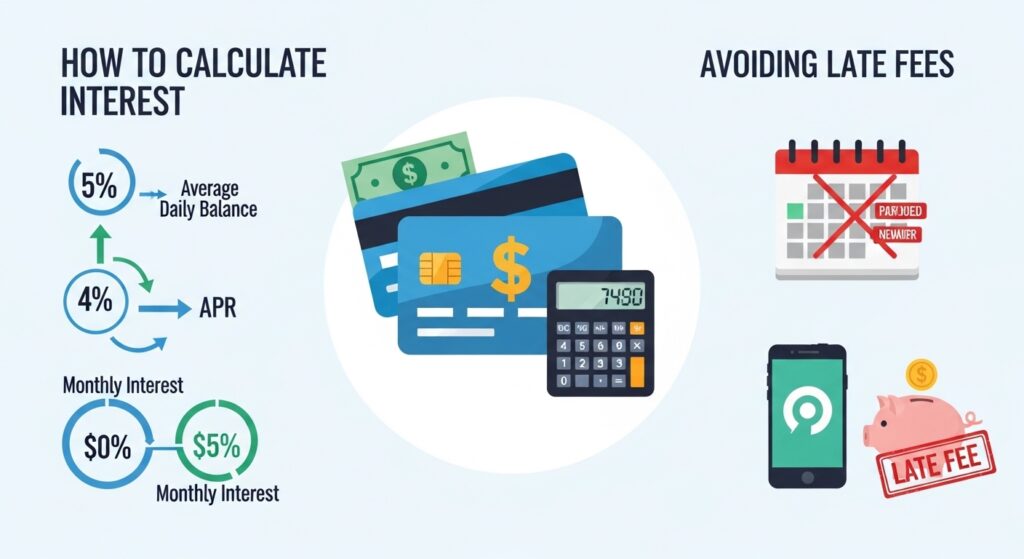
The Fundamentals of Credit Card Interest — What You Are Actually Paying For
Before we get into calculations and strategies, it is essential to understand the basic mechanics of how credit card interest works, because the terminology and structure that card providers use is deliberately complex in ways that obscure the true cost of carrying a balance.
What APR Actually Means and How It Is Applied
Every credit card carries an Annual Percentage Rate (APR) — the annual interest rate charged on balances that are not paid in full each month. If your card has an APR of 20 percent, you might reasonably assume that carrying a balance of one thousand dollars for a year would cost you two hundred dollars in interest. This assumption is incorrect, and the reason why reveals one of the most important mechanics of credit card interest.
Credit card interest is not calculated annually despite being expressed as an annual rate. It is calculated daily. Card providers convert your APR into a Daily Periodic Rate (DPR) by dividing the annual rate by 365. A card with a 20 percent APR has a daily periodic rate of approximately 0.0548 percent per day. This daily rate is then applied to your average daily balance — the average of your outstanding balance across every day in the billing cycle.
The practical implication of daily compounding rather than annual calculation is that interest accumulates faster than the headline APR figure suggests, and even partial payments that reduce your balance mid-cycle affect your interest charges less dramatically than most people expect.
The Grace Period — Your Most Valuable Credit Card Feature
The grace period is the window of time between the end of your billing cycle and your payment due date — typically between 21 and 25 days, during which you can pay your full statement balance without incurring any interest charges whatsoever. During this period, your credit card is essentially a free short-term loan.
The critical mechanics of the grace period that most cardholders do not fully understand is that it only applies when you carry no balance from the previous month. If you have an existing balance that was not paid in full, most card providers begin charging interest on new purchases immediately, from the day of the transaction, rather than waiting until the end of the grace period. This means that carrying a balance from one month to the next eliminates the interest-free grace period on all new purchases, not just on the carried balance.
This single mechanics point explains why financial advisors so consistently and so urgently recommend paying your full statement balance every month rather than just the minimum payment, because paying in full preserves the grace period on future purchases, while paying anything less destroys it and triggers immediate interest accumulation on everything new you charge to the card.
The Minimum Payment Trap
The minimum payment printed on your credit card statement each month is calculated to be just large enough to keep your account in good standing while being small enough to maximize the interest you pay over time. Most minimum payments are set at approximately one to two percent of your outstanding balance or a small fixed dollar amount, whichever is greater.
The insidious effect of making only minimum payments is best illustrated with a concrete example. A balance of five thousand dollars on a card with a 20 percent APR, paid using only the minimum payment each month, would take approximately 35 years to fully repay and would cost more than seven thousand dollars in interest alone, meaning you would pay more than twice the original balance in total. The five thousand dollar purchase would ultimately cost you over twelve thousand dollars.
This is not an extreme scenario. It is the mathematical reality of how minimum payments are designed to work, and it is the reason why carrying a credit card balance is one of the most expensive forms of debt available to ordinary consumers.
Step 1 — How to Calculate Your Credit Card Interest Precisely
Understanding the calculation gives you the power to predict exactly what your interest charges will be before your statement arrives — removing the helplessness and surprise that most cardholders feel when they see their monthly interest charge.
The Daily Periodic Rate Calculation
The first step in calculating your credit card interest is converting your APR into a daily rate.
Daily Periodic Rate = APR ÷ 365
For a card with a 20 percent APR: 20% ÷ 365 = 0.0548% per day (or 0.000548 as a decimal).
The Average Daily Balance Calculation
Credit card interest is applied to your average daily balance rather than your end-of-month balance, which means both your purchases and your payments throughout the month affect your interest charge, not just your balance at month-end.
To calculate your average daily balance, add up your balance for every single day in the billing cycle and divide by the number of days in the cycle. In practice, this calculation tracks your balance day by day, increasing it by the amount of each new purchase on the day it is made and reducing it by the amount of each payment on the day it is received.
A simplified example: if your billing cycle is 30 days, your starting balance is one thousand dollars, you make no new purchases, and you make a five hundred dollar payment on day fifteen, your average daily balance would be calculated as follows. Days one through fourteen have a balance of one thousand dollars. Days fifteen through thirty have a balance of five hundred dollars. The calculation is: (1,000 × 14) + (500 × 16) divided by 30. That equals (14,000 + 8,000) ÷ 30 = 733.33 dollars average daily balance.
The Monthly Interest Charge Calculation
With your daily periodic rate and average daily balance calculated, your monthly interest charge is:
Monthly Interest = Average Daily Balance × Daily Periodic Rate × Number of Days in Billing Cycle
Using our example: 733.33 × 0.000548 × 30 = approximately $12.07 in interest for that month.
This calculation, applied to your own card’s APR and actual spending and payment patterns, gives you precise advance knowledge of what your interest charge will be — transforming a mysterious monthly line item into a predictable, manageable figure.
Step 2 — Understanding Late Fees and Their True Cost
Late fees are the most immediately visible credit card penalty, the charge that appears when a payment is received after the due date, but their true financial cost extends significantly beyond the fee itself in ways that most cardholders never fully account for.
How Late Fees Are Structured
Credit card late fees are typically charged on a tiered structure based on your outstanding balance. For smaller balances, the fee may be a fixed amount of twenty to twenty-nine dollars. For larger balances, the fee can rise to forty dollars or more per occurrence. Some card providers charge a flat late fee regardless of balance size.
The late fee itself is added to your balance immediately, begins accruing interest at your card’s APR from the day it is added, and therefore costs you more than its face value over the months it takes to pay it down if you are carrying a balance.
The Penalty APR — The Hidden Consequence of Late Payments
Far more financially damaging than the late fee itself is a consequence that many cardholders never see coming: the penalty APR. Most credit card agreements include a clause that allows the provider to increase your interest rate to a significantly higher penalty rate, typically between 29 and 31 percent — if you make a payment late, miss a payment entirely, or exceed your credit limit.
This penalty APR can be applied to your existing balance, your new purchases, or both, depending on the terms of your specific card agreement. It can remain in effect for a minimum of six months and sometimes significantly longer, meaning a single late payment can trigger an interest rate increase that costs you many times the value of the original late fee over the months that follow.
Before the Credit CARD Act of 2009 in the United States — legislation that introduced significant consumer protections around penalty rates, fee structures, and billing practices, card providers had even greater latitude to apply penalty rates aggressively and retroactively. Understanding the specific penalty APR terms in your own card agreement is one of the most important pieces of knowledge any cardholder should have.
The Credit Score Impact of Late Payments
Beyond the direct financial cost of late fees and penalty rates, late payments have a significant and lasting impact on your credit score — the three-digit number that determines your access to and cost of credit across every financial product you will ever use.
Payment history is the single largest component of most credit scoring models, typically accounting for approximately 35 percent of your total score. A payment that is 30 or more days late is reported to the credit bureaus and can reduce your credit score by a meaningful number of points, with more severe impacts for payments that are 60 or 90 days late. These negative marks remain on your credit report for up to seven years, affecting your ability to qualify for mortgages, car loans, personal loans, and even some employment and rental applications throughout that period.
The cumulative financial cost of a damaged credit score, through higher interest rates on future loans and credit products, can significantly exceed the direct cost of the late fees and penalty rates that triggered the credit damage in the first place. This compounding of consequences is why avoiding late payments deserves to be treated as a genuine financial priority rather than a minor administrative consideration.
Step 3 — The Strategies That Eliminate Interest and Late Fees Entirely
Armed with a genuine understanding of how credit card interest and late fees work, the strategies for avoiding them are straightforward, and when implemented consistently, they transform your credit card from a potential financial liability into a powerful tool that provides genuine value at zero cost.
Strategy 1: Set Up Automatic Full Balance Payments
The single most reliably effective strategy for eliminating credit card interest and late fees simultaneously is setting up an automatic payment for the full statement balance on or before the due date each month.
Most card providers allow you to configure automatic payments through their online banking portal or mobile app. You can typically choose between paying the minimum amount, a fixed custom amount, or the full statement balance automatically on your due date each month. Selecting the full statement balance option ensures your entire balance is paid every month without requiring any manual action, preserving your grace period on new purchases, eliminating all interest charges, and making a late payment virtually impossible as long as your linked bank account maintains sufficient funds.
Setting up this automation takes approximately five minutes and may be the single highest-return five-minute financial action available to any credit card holder. Once configured, your credit card becomes mathematically interest-free, a tool that provides purchasing convenience, reward points, and consumer protections with literally zero interest cost.
Strategy 2: Set Multiple Payment Reminders as a Backup System
Even with automatic payments configured, maintaining a manual reminder system as a backup provides an additional layer of protection against the unlikely but consequential scenario where an automatic payment fails, due to an expired linked bank account, an insufficient funds situation, or a technical error.
Set calendar reminders or phone alerts five days before your payment due date and again one day before. These reminders give you enough advance notice to manually initiate a payment if the automatic payment has not processed correctly, while still falling within the window that allows the payment to clear before the due date.
Strategy 3: Pay More Than the Minimum — Always
If you carry a balance and full payment is not currently possible, paying more than the minimum amount due every single month is one of the most important and most financially impactful habits you can build.
Every dollar above the minimum payment reduces your principal balance directly, which reduces the average daily balance on which interest is calculated, which reduces next month’s interest charge, which frees additional funds for the month after. This virtuous cycle — sometimes called the debt avalanche effect — means that consistently paying even modestly above the minimum payment produces a compounding improvement in your financial position that accelerates significantly over time.
If you have multiple credit card balances, prioritize paying down the card with the highest APR first while making minimum payments on all others. Once the highest-rate card is paid in full, redirect its payment amount to the next highest-rate card. This approach, known as the debt avalanche method — minimizes the total interest you pay across all cards and produces the fastest possible path to being entirely debt-free.
Step 4 — Understanding Your Credit Card Statement in Detail
Your monthly credit card statement contains all the information needed to fully understand your account’s financial performance, but it is structured in a way that requires deliberate interpretation rather than casual reading.
The Key Line Items Every Cardholder Should Review Monthly
Your previous balance shows what you owed at the start of the billing cycle. Your purchases and credits show the new transactions added and any refunds received during the cycle. Your payments show the payments received during the cycle. Your fees charged shows any late fees, annual fees, or other charges applied. Your interest charged shows the exact amount of interest calculated for the cycle. Your new balance is the total amount owed at the end of the cycle.
Reviewing each of these line items individually every month, rather than simply checking the minimum payment and due date, gives you complete visibility into how your account is performing and immediately surfaces any errors, unexpected charges, or unusual activity that should be investigated.
Understanding Transaction Dates Versus Posting Dates
Every transaction on your credit card statement has two dates: the transaction date — when the purchase actually occurred, and the posting date — when the merchant submitted the transaction to the card network for processing. For the purposes of interest calculation, most card providers use the posting date rather than the transaction date.
Understanding this distinction helps explain why transactions made near the end of a billing cycle sometimes appear on the following month’s statement, the purchase was made before the cycle closed but the transaction posted after. It also means that payments you make close to your due date may not post in time to avoid a late fee if there is a processing delay, which is why financial advisors recommend initiating payments at least three to five business days before your due date rather than on the due date itself.
Identifying Billing Errors and Unauthorized Charges
Your monthly statement review is also your primary opportunity to identify billing errors, incorrect amounts, duplicate charges, subscriptions you cancelled that continue to appear, and unauthorized charges that may indicate your card details have been compromised.
Under the Fair Credit Billing Act in the United States, cardholders have the right to dispute billing errors by notifying their card provider in writing within 60 days of the statement date on which the error appeared. During the dispute process, you are not required to pay the disputed amount, and the card provider must investigate and respond within a defined timeframe.
Reviewing your statement line by line every month, a process that takes less than five minutes for most accounts, is the only reliable way to catch these issues promptly enough to dispute them within the required window.
Step 5 — Use Credit Cards as a Tool, Not a Lifestyle Supplement
The most important philosophical distinction in responsible credit card management is the difference between using your card as a payment method — a convenient, rewarding way to pay for purchases you have already decided you can afford, and using it as a borrowing mechanism — a way to purchase things you cannot currently afford and pay for over time.
The Rewards Arbitrage Opportunity
When used as a pure payment method with the full balance paid every month, a rewards credit card provides genuine, measurable financial value at zero cost. The cashback, travel points, purchase protections, extended warranties, and other benefits offered by premium rewards cards are funded by the interest payments of cardholders who carry balances, which means responsible cardholders who pay in full each month effectively receive these benefits subsidized by the card provider and by less financially disciplined cardholders.
Maximizing this rewards arbitrage opportunity requires choosing a rewards card aligned with your actual spending patterns, using the card consistently for purchases you would make anyway, and paying the full balance each month without exception. Used this way, a well-chosen rewards card can generate hundreds of dollars in annual value from spending you were going to do regardless.
The Utilization Rate and Its Impact on Your Credit Score
Beyond interest management, maintaining a low credit utilization rate — the percentage of your total available credit that you are currently using, is one of the most powerful strategies for building and maintaining a strong credit score. Credit utilization is typically the second largest factor in most credit scoring models, accounting for approximately 30 percent of your score.
Keeping your utilization below 30 percent of your total credit limit is the standard recommendation — with below 10 percent producing the most favorable scoring impact. If you carry a balance of three thousand dollars on a card with a ten thousand dollar limit, your utilization on that card is 30 percent. Paying that balance down to one thousand dollars reduces your utilization to 10 percent, a change that can produce a meaningful improvement in your credit score within one to two billing cycles.
Step 6 — What to Do If You Are Already in Credit Card Debt
If you are currently carrying significant credit card debt and the interest charges are consuming a meaningful portion of your monthly budget, the strategies above describe where you want to get to — but getting there requires a specific, practical action plan designed for your current starting point.
The Balance Transfer Option
A balance transfer involves moving your existing credit card debt from a high-interest card to a card offering a promotional 0 percent APR period on transferred balances, typically between 12 and 21 months. During the promotional period, every dollar of your payment reduces your principal directly rather than being partially consumed by interest, dramatically accelerating your debt elimination timeline.
Balance transfer cards typically charge a transfer fee of 3 to 5 percent of the transferred amount, a one-time cost that is almost always significantly less than the interest you would pay on the original card over the same period. The critical discipline required to make a balance transfer successful is paying down as much of the transferred balance as possible before the promotional period ends, because the interest rate that applies after the promotional period typically reverts to a standard or even elevated APR.
The Debt Consolidation Loan Option
For larger credit card balances, a personal loan at a lower interest rate than your credit cards used to consolidate multiple card balances into a single, lower-rate, fixed-term loan can be a powerful debt reduction strategy. Converting revolving credit card debt, which can linger indefinitely at high interest rates, into a fixed-term installment loan with a defined payoff date creates both immediate interest savings and a clear, predictable timeline for becoming debt-free.
The psychological benefit of consolidation, replacing the complexity and stress of multiple card balances and due dates with a single monthly payment — should not be underestimated as a factor in sustained debt repayment motivation.
Contacting Your Card Provider Directly
Many people in credit card debt do not realize that their card provider may be willing to work with them directly, temporarily reducing their interest rate, waiving late fees, or establishing a hardship payment plan — if they contact the provider proactively and explain their situation honestly.
Card providers have significant financial incentive to help customers avoid default — the alternative of a customer who stops paying entirely is far more costly than a temporary reduction in interest income. Calling your card provider, asking to speak with the hardship or customer retention department, and having an honest conversation about your situation can produce genuinely helpful accommodations that a customer who simply stops paying would never receive.
Common Credit Card Mistakes to Avoid
Even financially aware people consistently make these costly credit card errors:
- Only reading the promotional APR: Many credit cards advertise a low or zero percent promotional APR that applies only for an introductory period. The standard APR that applies after that period, often substantially higher, is what you need to understand and compare when evaluating card options.
- Ignoring the cash advance APR: Cash advances on credit cards, withdrawing cash using your card at an ATM — typically carry a significantly higher APR than purchase transactions, begin accruing interest immediately with no grace period, and incur an additional cash advance fee on top of the interest. Using a credit card for cash advances is almost always one of the most expensive ways to access money available to a consumer.
- Closing old credit card accounts unnecessarily: Closing an old credit card account reduces your total available credit and therefore increases your credit utilization rate, potentially damaging your credit score. Unless a card carries an annual fee that is not justified by its benefits, keeping old accounts open and occasionally using them for small purchases maintains their positive impact on your credit history length and available credit.
- Applying for multiple new cards simultaneously: Each new credit card application triggers a hard inquiry on your credit report, which temporarily reduces your credit score by a small amount. Multiple applications in a short period can produce a more significant cumulative impact and signal financial distress to potential lenders.
- Ignoring your card’s benefits and protections: Most credit cards — particularly premium travel and rewards cards, include valuable benefits that the majority of cardholders never use, including purchase protection, extended warranty coverage, travel insurance, rental car insurance, and price protection. Taking thirty minutes to read your card’s benefits guide can reveal hundreds of dollars in annual value you are already paying for and simply not claiming.
Conclusion and Final Thoughts
Credit card interest and late fees are not inevitable costs of using a credit card, they are entirely avoidable costs that result from specific, changeable behaviors and a lack of precise understanding about how the underlying mechanics work. The cardholder who pays their full balance every month, maintains automatic payment reminders as a backup, reviews their statement carefully each billing cycle, and keeps their utilization low pays nothing in interest or late fees while receiving all the convenience, rewards, and consumer protections that a well-chosen credit card provides.
The cardholder who carries a balance, makes only minimum payments, occasionally misses due dates, and does not understand how their interest is calculated may pay two, three, or even four times the value of their actual purchases in cumulative interest and fees over the life of their account, a silent, ongoing financial drain that compounds month after month without ever announcing itself dramatically enough to provoke action.
The difference between these two outcomes is not income, not intelligence, and not financial sophistication. It is simply knowledge and the habits that knowledge makes possible. The knowledge is now yours. The habits are yours to build.
That thirty minute phone call with my card provider years ago changed the way I use credit cards permanently. I have not paid a dollar in credit card interest or a single late fee since. Not because I earn more money than I did then, but because I finally understood exactly how the system worked, and used that understanding to make it work entirely in my favor.
That same outcome is available to every cardholder who chooses to pursue it. And it starts with the next billing cycle.
Do you currently pay your credit card balance in full each month, or is carrying a balance something you are working to address? Share your experience and any strategies that have helped you in the comments below. Whether you have completely mastered your credit cards or are just starting to understand how they really work, your perspective could be exactly what another reader needs to take control of this important part of their financial life.