About two years ago, I opened my electricity bill and genuinely thought there had been a mistake. The amount was nearly double what I had been paying the previous year, and as far as I could tell, nothing in my daily routine had changed significantly enough to explain the difference. I called my utility provider, sat on hold for forty minutes, and was told politely but firmly that the bill was correct and that rising energy costs were affecting customers across the board.
That conversation was frustrating enough to push me into doing something I had never seriously done before, sitting down and genuinely examining every way energy and water were being consumed in my home, and identifying every realistic opportunity to reduce that consumption without making my daily life uncomfortable or inconvenient.
What I discovered over the following three months genuinely surprised me. The majority of the changes that made the biggest difference required no significant financial investment, no dramatic lifestyle sacrifice, and in most cases no more than fifteen minutes of my time to implement. By the end of that first quarter of deliberate attention, my combined monthly utility bills had dropped by just over 30 percent, a saving that has compounded month after month ever since.
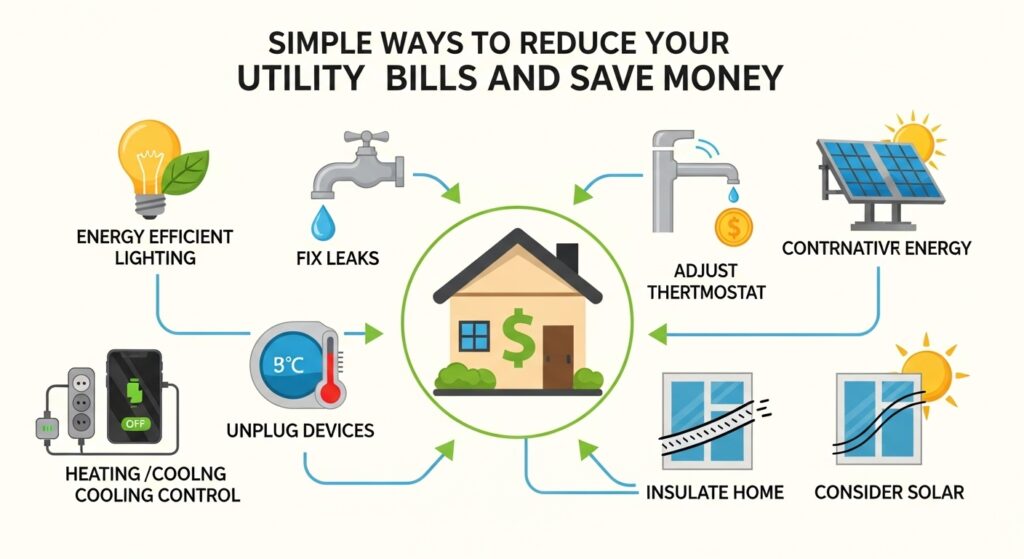
Rising utility costs are one of the most universal financial pressures facing households around the world in 2026. Electricity prices, water rates, gas costs, and internet and phone bills have all increased significantly over recent years, and for many families these combined expenses represent one of the largest and most stressful items in their monthly budget.
The encouraging reality is that a substantial portion of what most households pay in utility costs every month is entirely avoidable, the result of inefficient appliances, unconscious habits, outdated equipment, and simple lack of awareness about where consumption is actually happening. In this guide, you will learn 10 simple, practical, and immediately applicable ways to reduce your monthly utility bills and keep more of your hard-earned money where it belongs, in your pocket.
Why Most Households Overpay on Utility Bills Without Realizing It
Before we get into the ten strategies, it is worth understanding the fundamental reason why utility bill reduction is such a fertile opportunity for most households.
The core issue is unconscious consumption, the energy and water that is used not through deliberate choice but through habit, inattention, outdated equipment, and simple lack of awareness. Most people have a reasonable idea of their major energy consumers, the air conditioner, the washing machine, the electric oven. What they dramatically underestimate is the cumulative cost of dozens of smaller, less visible consumption patterns that add up to a surprisingly significant portion of the monthly bill.
Standby power consumption, the electricity drawn by devices that are plugged in and switched on at the wall but not actively being used, is a perfect example. Individual devices in standby mode draw relatively small amounts of power. But in a modern household with televisions, gaming consoles, desktop computers, phone chargers, microwaves, printers, and a dozen other plugged-in devices, the combined standby consumption can account for between 5 and 10 percent of the total electricity bill every month, a cost that provides zero value whatsoever.
Understanding that your utility bills are not fixed, inevitable costs but rather the financial reflection of specific, changeable behaviors and equipment choices is the mindset shift that makes everything else in this guide possible. Let us get into the ten strategies.
Tip 1 — Conduct a Home Energy Audit to Find Where Money Is Escaping
The single most valuable first step in reducing your utility bills is understanding exactly where your energy is being consumed — and where it is being wasted. A home energy audit is the process of systematically examining your home’s energy consumption patterns to identify the specific areas of highest waste and greatest savings potential.
The DIY Energy Audit
You do not need to hire a professional to conduct a useful energy audit. A thorough self-assessment can identify the majority of significant energy waste opportunities in your home.
Walk through every room of your home with fresh eyes, specifically looking for sources of energy waste. Check every window and exterior door for drafts, old a lit candle or a thin piece of paper near the edges and watch for movement that indicates air leakage. Look for gaps around electrical outlets on exterior walls, spaces under doors, and any visible cracks in window frames or door surrounds.
Check your attic or ceiling insulation if accessible. Inadequate insulation is one of the most significant and most overlooked causes of high heating and cooling costs, because it allows conditioned air to escape and outside temperature to penetrate your living spaces continuously.
Take note of every appliance and device that is plugged in throughout your home. Consider purchasing a simple plug-in energy monitor — an inexpensive device available from most hardware stores — that measures the actual electricity consumption of individual appliances. Plugging this monitor into different devices around your home for a day or two each will reveal exactly which appliances are your highest energy consumers and which are drawing unexpected amounts of standby power.
Professional Energy Audits
If you own your home and are serious about maximizing energy savings, a professional energy audit conducted by a qualified energy assessor provides a significantly more detailed and comprehensive picture of your home’s energy performance. Many utility companies offer subsidized or even free professional energy audits to customers — contact your provider to ask whether this service is available in your area before paying for one independently.
Tip 2 — Switch to LED Lighting Throughout Your Entire Home
If there is a single utility bill reduction strategy that delivers the best combination of simplicity, cost-effectiveness, and immediate impact, it is replacing every remaining incandescent or halogen light bulb in your home with LED (Light Emitting Diode) alternatives.
The Numbers That Make LED Switching a No-Brainer
The energy efficiency advantage of LED bulbs over traditional incandescent bulbs is not marginal — it is transformative. A standard LED bulb uses approximately 75 to 80 percent less electricity than an equivalent incandescent bulb to produce the same amount of light. It also lasts between 15,000 and 25,000 hours compared to the 1,000-hour lifespan of a typical incandescent bulb — meaning you replace it far less often, reducing both cost and inconvenience.
For a household with twenty light fixtures that are used an average of five hours per day, switching from incandescent to LED bulbs can reduce lighting-related electricity costs by a significant amount monthly — a saving that begins from the very first day the new bulbs are installed and continues every day thereafter.
LED bulbs are available in a wide range of color temperatures — from warm, amber-toned light that replicates the familiar glow of traditional incandescent bulbs, to cool, bright white light better suited to task-oriented spaces like kitchens and home offices. The quality and variety of LED lighting available in 2026 is exceptional, and the price of LED bulbs has fallen to the point where the upfront cost difference compared to incandescent bulbs is negligible.
Replace your highest-use bulbs first — the ones in rooms where lights are on for the longest periods each day — and work through the rest of your home over the following weeks. Within a single month, the electricity savings will be visible in your bill.
Tip 3 — Tame Your Heating and Cooling Costs With a Smart Thermostat
Heating and cooling typically represent the single largest component of a household’s monthly electricity or gas bill — often accounting for 40 to 50 percent of total energy consumption. This makes it the area with the greatest potential for meaningful savings, and the place where a relatively modest investment can produce significant and sustained returns.
The Smart Thermostat Advantage
A programmable or smart thermostat allows you to set your heating and cooling system to operate only when and at the temperatures that are actually needed — rather than running continuously at a fixed temperature regardless of whether anyone is home, what time of day it is, or what the weather outside is doing.
The logic is straightforward but powerful. There is no rational reason to heat or cool your home to a comfortable living temperature while you are at work, asleep, or away for the weekend. A programmable thermostat allows you to set your heating or cooling to reduce to an energy-saving temperature during those periods automatically, and restore it to your comfortable setting before you return home or wake up — without any sacrifice in daily comfort.
Smart thermostats like the Google Nest or Ecobee take this concept significantly further. They learn your schedule and temperature preferences over time, adjust automatically based on whether anyone is detected at home, integrate with weather forecast data to optimize heating and cooling decisions, and can be controlled remotely from your smartphone. Most smart thermostat manufacturers report that their devices pay for themselves in energy savings within the first twelve to eighteen months of use.
For every degree you reduce your thermostat setting during heating season — or raise it during cooling season — you can expect to save approximately 1 to 3 percent on your heating or cooling costs for that period. Over the course of a full year, these adjustments add up to a genuinely meaningful reduction in your utility bills.
Tip 4 — Fix Air Leaks and Improve Your Home’s Insulation
This is the tip that most people skip because it feels like a project rather than a quick fix — and it is the tip that consistently delivers some of the largest and most sustained energy savings of any intervention on this list.
Sealing Air Leaks: The Cheapest High-Impact Fix
Air leaks around windows, doors, electrical outlets, and other penetrations in your home’s exterior envelope allow heated or cooled air to escape and outside air to infiltrate — forcing your heating and cooling system to work continuously harder to maintain your desired indoor temperature. This continuous extra effort translates directly into higher energy consumption and higher bills.
Weatherstripping around doors and caulking around window frames are the two primary tools for sealing air leaks, and both are inexpensive, widely available at any hardware store, and require no specialist skills to apply. A thorough weatherstripping and caulking session around your home’s exterior doors and windows can be completed in a single weekend afternoon and can reduce your heating and cooling costs by a meaningful percentage immediately.
Draft excluders placed along the bottom of exterior doors provide an additional simple and inexpensive barrier against air infiltration. Insulating covers for electrical outlets on exterior walls — available for just a few dollars each — address a surprisingly common but rarely considered source of air leakage.
Improving Insulation for Long-Term Savings
If your home has inadequate attic or wall insulation — which is common in older properties — improving it represents one of the highest-return home improvement investments you can make. Heat rises, and a poorly insulated attic allows a significant proportion of your winter heating investment to escape directly through the ceiling. Proper attic insulation keeps that heat inside your living space where it belongs, reducing heating demand and the associated costs substantially.
Many governments and utility companies offer insulation rebates and incentive programs that significantly offset the cost of insulation upgrades. Research what programs are available in your area before undertaking any insulation work — you may find that a substantial portion of the cost is covered.
Tip 5 — Optimize Your Water Heating Costs
Water heating is typically the second largest energy expense in most households after space heating and cooling, accounting for around 15 to 20 percent of the average home’s total energy consumption. It is also an area where several simple and inexpensive interventions can produce immediate and sustained savings.
Lower Your Water Heater Temperature
Many water heaters are set at the factory to 60 degrees Celsius or higher, a temperature significantly hotter than most households actually need for comfortable daily use. Lowering your water heater thermostat to 49 degrees Celsius reduces the energy required to maintain the water at temperature continuously, while still providing perfectly comfortable hot water for showers, dishwashing, and laundry.
This single adjustment takes approximately five minutes to make and costs nothing. The energy savings it generates are ongoing and permanent.
Install Low-Flow Showerheads and Tap Aerators
Low-flow showerheads reduce the volume of hot water consumed during each shower by restricting the flow rate without significantly reducing the perceived shower pressure. Modern low-flow showerheads are dramatically better than earlier generations of the technology — they use clever aeration techniques that make a lower-volume water flow feel almost indistinguishable from a full-pressure shower.
Similarly, tap aerators — small, inexpensive attachments that screw onto your existing bathroom and kitchen taps — mix air into the water flow to maintain perceived pressure while reducing actual water consumption by up to 50 percent. Both low-flow showerheads and tap aerators are inexpensive to purchase, simple to install with no plumbing expertise required, and reduce both your water bill and your water heating costs simultaneously.
Insulate Your Hot Water Pipes
Uninsulated hot water pipes lose heat to the surrounding air as water travels from your water heater to your taps, meaning you run the tap longer waiting for hot water to arrive, wasting both water and the energy used to heat it. Foam pipe insulation is inexpensive, available at any hardware store, and can be cut to length and fitted around accessible hot water pipes in minutes.
Tip 6 — Eliminate Phantom Power and Standby Consumption
As discussed in the introduction, phantom power, the electricity consumed by devices that are plugged in but not actively in use, is one of the most pervasive and most invisible sources of wasted household energy expenditure.
The solution is beautifully simple: power strips with individual switches or smart power strips that can be controlled remotely or set on a timer. Plugging your television, gaming console, sound system, and other entertainment devices into a single switched power strip and turning it off at the strip when those devices are not in use eliminates their standby consumption entirely.
The same principle applies to home office equipment, desktop computers, monitors, printers, and speakers all draw standby power when plugged in. A single switched power strip for your entire desk setup allows you to cut all standby power with one switch at the end of each working day.
Smart plugs — Wi-Fi enabled devices that allow you to control individual power outlets remotely through a smartphone app or voice assistant, offer an even more convenient solution, allowing you to schedule automatic power-off times for specific devices or turn them off remotely if you leave home and realize you forgot.
Make it a household habit to unplug chargers when they are not actively charging a device. Phone chargers, laptop chargers, and tablet chargers all continue drawing small amounts of power when plugged into the wall even with no device connected, a small individual waste that adds up meaningfully when multiplied across every charger in a modern household over a full year.
Tip 7 — Use Major Appliances More Efficiently
Your washing machine, dishwasher, tumble dryer, and refrigerator are among the highest energy-consuming appliances in your home. Small changes in how you use them can produce surprisingly significant reductions in energy consumption without requiring any change in your cleaning standards or food storage habits.
Washing Machine and Tumble Dryer
Washing clothes in cold water rather than warm or hot water is one of the simplest and most impactful laundry changes you can make. The vast majority of the energy a washing machine consumes goes not toward agitating the clothes but toward heating the water, switching to cold water cycles eliminates that energy cost almost entirely. Modern cold-water detergents clean just as effectively as hot-water alternatives for the majority of everyday laundry loads.
Always run your washing machine with a full load rather than multiple partial loads. A washing machine uses approximately the same amount of water and energy for a half-full load as it does for a completely full one — so combining smaller loads into full ones immediately halves the number of cycles required and the associated energy cost.
If you use a tumble dryer, clean the lint filter before every single cycle. A clogged lint filter forces the dryer to work significantly harder and longer to dry the same load of clothes, wasting energy and increasing wear on the appliance. Better yet, whenever weather and space permit, line dry your clothes outdoors instead of using the tumble dryer. Line drying costs nothing, is gentler on fabrics, and eliminates the tumble dryer’s energy consumption entirely for those loads.
Dishwasher
Run your dishwasher only when it is completely full, and select the eco cycle or energy-saving mode if your dishwasher offers one — these cycles use less water and lower water temperatures while achieving excellent cleaning results for everyday dishes. Avoid using the heated drying cycle and instead open the dishwasher door at the end of the wash cycle to allow dishes to air dry, a zero-energy alternative that works perfectly well in most households.
Refrigerator
Your refrigerator runs continuously, twenty-four hours a day, seven days a week — making its efficiency a permanent factor in your monthly energy bill. Keep the refrigerator coils at the back or underneath clean and dust-free, as dusty coils force the compressor to work harder. Ensure the door seals are intact and creating a proper airtight closure, a simple test is to close the door on a piece of paper and see whether it slides out easily, which would indicate a compromised seal requiring replacement.
Set your refrigerator temperature to between 3 and 5 degrees Celsius and your freezer to minus 18 degrees Celsius, the optimal temperatures for food safety and energy efficiency. Temperatures colder than these use more energy than necessary without providing any additional food safety benefit.
Tip 8 — Reduce Water Consumption Across Your Household
Your water bill and your water heating costs are directly linked — reducing water consumption reduces both simultaneously. Beyond the low-flow fixtures discussed in Tip 5, several additional habits and practices can meaningfully reduce your household’s monthly water consumption.
Fix Leaks Immediately
A dripping tap that releases just one drop of water per second wastes more than 10,000 liters of water per year, a significant volume that appears directly on your water bill month after month. A leaking toilet can waste even more, often without any audible or visible indication that there is a problem. Adding a few drops of food coloring to your toilet cistern and checking after fifteen minutes whether color appears in the bowl without flushing is a simple test that can reveal a silent toilet leak immediately.
Fixing a dripping tap or a running toilet is almost always a simple and inexpensive repair, in many cases a DIY job requiring only a replacement washer and fifteen minutes. The water savings from fixing even a single dripping tap or running toilet typically pay for the repair cost many times over within the first few months alone.
Adopt Water-Saving Shower Habits
Reducing your average shower time by just two minutes per shower, using a simple timer if needed to stay aware of elapsed time, can save thousands of liters of water per person per year. Turning off the shower while applying shampoo or body wash, and turning it back on to rinse, reduces water consumption further without extending the time spent in the bathroom.
Collecting the cold water that runs from your shower while waiting for the hot water to arrive, in a bucket placed in the shower before you step in, provides free water for garden irrigation, toilet flushing, or mopping floors, eliminating that wasted volume from your water bill entirely.
Tip 9 — Review and Negotiate Your Utility Tariffs and Providers
This is the tip that requires the least physical effort of any on this list and can produce some of the most immediately impactful financial results, yet it is the one that most people never think to try.
Check Whether You Are on the Best Available Tariff
Many utility customers remain on standard variable tariffs, often the most expensive option available from their provider — simply through inertia. Utility companies frequently offer significantly cheaper fixed-rate tariffs, time-of-use tariffs, or promotional rates for existing customers that are never proactively offered unless the customer specifically requests a tariff review.
Contact your electricity, gas, internet, and phone providers and ask explicitly: “Am I currently on your best available tariff, and is there a cheaper option I could switch to without penalty?” This question, asked once a year, costs nothing and can produce meaningful savings with a single phone call.
Compare Alternative Providers
Utility markets in many countries are competitive, with multiple providers offering meaningfully different prices for the same essential services. Comparison websites that aggregate utility pricing from multiple providers allow you to see instantly whether you could be paying less for electricity, gas, internet, or phone services by switching to a different provider.
Switching providers for a better rate on broadband or mobile phone service is particularly straightforward in 2026, and the potential savings, particularly if you have not reviewed your contracts in more than twelve months, can be substantial. Loyalty to a utility provider is rarely financially rewarded. Regular comparison and switching is the financially rational behavior.
Bundle Services Where Genuine Savings Exist
Some providers offer meaningful discounts when multiple services, internet, television, and phone, for example, are bundled into a single package. If you currently purchase these services separately from different providers, it is worth obtaining a bundle quote from your primary provider and comparing it against your current combined spend to determine whether consolidation would produce genuine savings rather than simply the appearance of them.
Tip 10 — Develop Energy-Saving Habits That Become Second Nature
The final and perhaps most sustainable approach to reducing your monthly utility bills is the simplest: developing a set of consistent energy-saving habits that gradually become as automatic and unconscious as the wasteful habits they replace.
The Daily Habits That Add Up Fastest
Turn lights off every time you leave a room, without exception. This habit alone, practiced consistently across an entire household, produces a meaningful reduction in lighting costs over the course of a month. Make it easier to maintain by placing light switches in obvious positions and considering motion-activated lighting for rooms like bathrooms, hallways, and storage spaces where lights are often left on unnecessarily.
Take shorter showers as a default rather than an occasional discipline. Set a water-resistant timer in your bathroom if needed, or use a favorite song as a shower timer, most four-minute pop songs make an excellent benchmark for a water-efficient shower duration.
Only boil as much water as you actually need when using an electric kettle. Boiling a full kettle to make a single cup of tea or coffee wastes the energy required to heat the excess water that immediately begins cooling unused. Filling the kettle to just above the minimum water level for your intended use saves a small but consistent amount of energy with every use — multiplied across multiple kettles boiled daily throughout a year, the saving is more meaningful than it might initially appear.
Switch off computers, monitors, and televisions completely rather than leaving them in standby mode when they will not be used for an extended period. Dim your screen brightness on laptops, tablets, and smartphones, display screens are among the highest energy consumers on these devices, and reducing brightness even modestly can meaningfully extend battery life and reduce charging frequency.
Creating Household Accountability
Energy-saving habits are significantly easier to maintain when everyone in a household is aligned around the same goals and practices. Share your utility bill reduction goals with every member of your household, explain the specific habits you are trying to establish and why, and create a shared sense of purpose around the collective financial benefit that results from everyone participating.
Consider creating a simple household energy-saving challenge, tracking your monthly bill total against the previous month and celebrating when the number goes down. The combination of shared goals, visible progress, and collective celebration creates a positive behavioral momentum that makes energy-saving habits genuinely enjoyable to maintain rather than feeling like a constant series of petty restrictions.
Common Utility Bill Mistakes Households Make Every Month
Even well-intentioned households consistently fall into these energy-wasting patterns:
- Leaving devices charging overnight unnecessarily: Most modern smartphones and laptops reach full charge within one to two hours. Leaving them plugged in and charging throughout an eight-hour night provides no additional benefit and consumes electricity unnecessarily. Charge during the day when you can monitor progress and unplug when complete.
- Ignoring the energy efficiency ratings of new appliances: When replacing any major household appliance, refrigerator, washing machine, dishwasher, air conditioner, the purchase price is only part of the real cost. An appliance with a higher energy efficiency rating may cost slightly more upfront but will cost significantly less to run every month for the ten to fifteen years of its operational lifespan. Always factor running costs into any appliance purchasing decision.
- Using the tumble dryer for every load regardless of weather: On dry, breezy days, line drying is free and equally effective. Defaulting to the tumble dryer out of habit on days when outdoor drying is perfectly viable wastes energy unnecessarily.
- Never checking for available rebates and incentives: Many governments, utility companies, and local councils offer rebates, grants, and incentive programs for energy-efficient upgrades including LED lighting, smart thermostats, insulation improvements, solar panel installation, and efficient appliance purchases. A brief online search for energy efficiency incentives in your area before making any relevant purchase can result in meaningful cost reductions that most people never access simply because they did not know to look.
- Heating or cooling unused rooms: If you have rooms in your home that are rarely occupied, spare bedrooms, storage rooms, formal dining rooms, there is no rational reason to heat or cool them to the same temperature as your living spaces. Close the vents or radiator valves in these rooms and redirect that heating or cooling energy to the spaces where you actually spend your time.
Conclusion and Final Thoughts
Reducing your monthly utility bills is not about making your home uncomfortable, abandoning modern conveniences, or submitting to a life of constant energy-conscious restriction. It is about eliminating the significant proportion of your current utility spend that provides you absolutely no value — the phantom power drain of standby devices, the heat escaping through draft-ridden windows, the energy wasted heating water to temperatures higher than you ever actually use, the electricity consumed by incandescent bulbs that could be replaced with LEDs producing the same light for a fifth of the cost.
The 10 strategies covered in this guide, conducting a home energy audit, switching to LED lighting, optimizing your thermostat, sealing air leaks, improving water heating efficiency, eliminating phantom power, using appliances more efficiently, reducing water consumption, reviewing your tariffs and providers, and building consistent energy-saving habits, work together as a comprehensive approach to household energy management that can realistically reduce your combined monthly utility bills by 20 to 40 percent when applied consistently.
My own experience of cutting bills by over 30 percent through these exact strategies was not the result of a single dramatic intervention. It was the compounded result of a dozen smaller changes made consistently over three months, each individually modest, but collectively transformative.
Start with the two or three strategies that feel most immediately applicable to your specific situation. Build from there. Review your bills monthly to track your progress and celebrate the savings as they accumulate. And remember that every dollar you reclaim from an unnecessarily high utility bill is a dollar that can go toward something in your life that actually brings you genuine value and enjoyment.
Which of these 10 tips are you going to try first, and have you already implemented any strategies that have made a noticeable difference to your monthly bills? Share your experience and results in the comments below. Your practical tip could save another reader hundreds of dollars every single year.